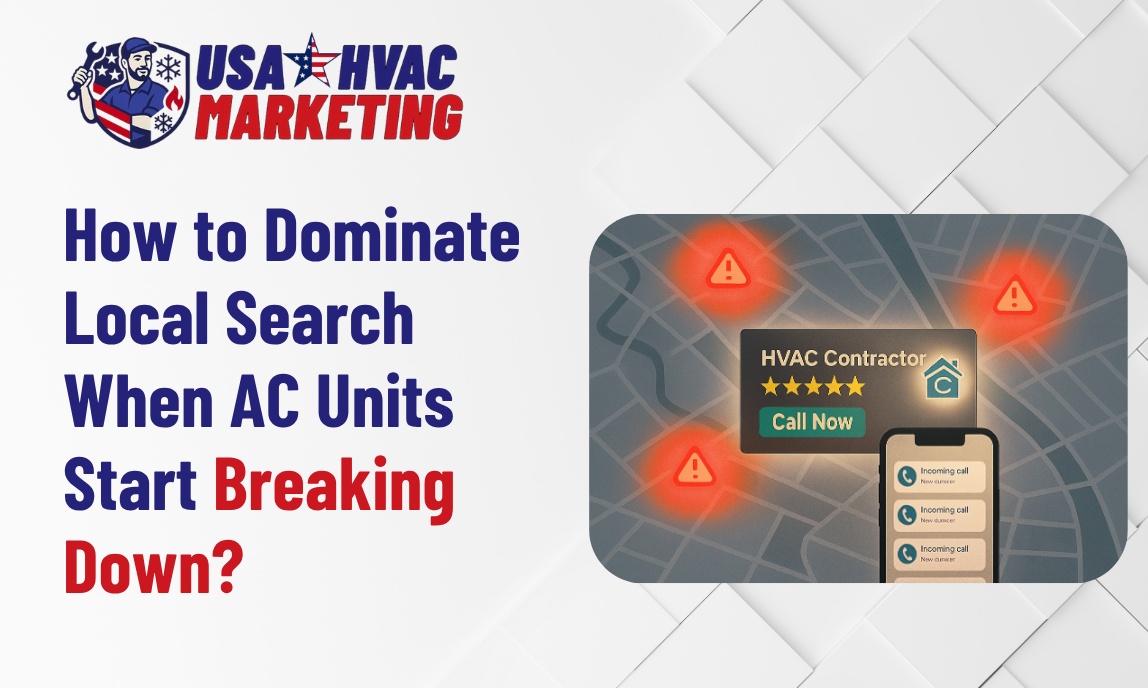
To dominate local search when the first heatwave hits, an HVAC company must build a strong digital foundation before the season starts. The core strategy rests on three pillars: a fully optimized Google Business Profile, a continuous stream of recent, positive customer reviews, and locally-focused website pages targeting emergency service keywords. When a homeowner’s air conditioner fails, their search for a solution is urgent and immediate. Being the most visible and trusted option at that exact moment is what separates a busy summer from a record-breaking one.
This guide provides a clear, actionable plan to capture that seasonal surge in demand. Drawing from extensive experience in the HVAC industry, USA HVAC Marketing has identified the precise steps that turn a company’s online presence into a powerful customer acquisition engine. The work done in the spring directly determines the calls received in the summer.
Build Your Foundation with Google Business Profile
Your Google Business Profile (GBP) is often the first, and sometimes only, impression a potential customer will have of your business. It is the single most important tool for local search visibility.
Fully Complete Every Section
An incomplete profile signals to Google that you might be less legitimate or active than a competitor. Go through every tab and fill it out completely.
- Services: List every single service you offer, from “central AC repair” to “ductless mini-split installation” and “refrigerant leak detection.”
- Business Description: Write a clear description of your company, mentioning your key services and the main cities you serve.
- Q&A: Proactively add your own questions and answers. Think like a customer: “Do you offer 24-hour service?” or “What brands do you service?” Answering these ahead of time saves customers a step and shows you understand their needs.
Define Your Service Area Precisely
In your GBP settings, list every city, town, and zip code you service. This information helps Google show your business to users searching for HVAC help within those specific locations. This is especially important for “near me” searches, which have become a default for mobile users.
Use Google Posts for Timely Updates
Google Posts are short updates that appear on your GBP listing. They are perfect for seasonal messaging. As the weather warms up, start publishing posts about:
- Emergency AC service availability
- Pre-season tune-up reminders
- Tips for identifying common AC problems
Bonus Tip: Schedule a series of Google Posts to publish automatically in late spring. One post could highlight the importance of cleaning coils, another could talk about checking refrigerant levels. This activity warms up your profile and builds topical relevance before the emergency calls begin.
Establish Unshakeable Trust with Reviews
When a customer’s AC is out, they need a reliable contractor, fast. Reviews are the most powerful form of social proof available.
Focus on Recent, High-Quality Reviews
It’s not just about having a high star rating; it’s also about having recent reviews. A steady flow of new reviews signals to Google that your business is active and consistently providing good service. According to BrightLocal’s consumer survey, 87% of consumers used Google to evaluate local businesses last year source, making reviews a critical decision-making factor.
Systematize Your Review Generation Process
Don’t leave reviews to chance. Implement a simple process:
- Train Technicians: Coach your techs to mention to happy customers that they will receive a text or email with a review link.
- Automate the Ask: Use your dispatching or CRM software to automatically send a follow-up message with a direct link to leave a Google review after a job is completed.
- Respond to Every Review: Thank customers for positive reviews and address negative feedback professionally. This engagement is a positive signal to both customers and Google.
Optimize Your Website for Local Emergencies
Your website needs to confirm what your GBP promises: that you are the best local choice for an urgent AC repair.
Create Hyper-Local Service Pages
Don’t just have one “AC Repair” page. If you serve a metropolitan area, create dedicated pages for the main suburbs. For example:
- AC Repair in Plano, TX
- Emergency AC Service in Frisco, TX
- Air Conditioner Installation in McKinney, TX
This strategy targets customers who search by location instead of relying on “near me.” The table below shows the difference.
| Generic Service Page | Hyper-Local Service Page |
|---|---|
| Title: AC Repair Services | Title: 24/7 Emergency AC Repair in Mesa, AZ |
| Headline: We Fix Air Conditioners | Headline: Fast & Reliable AC Repair for Mesa Homeowners |
| Content: General info about AC problems | Content: Mentions common AC issues in Mesa’s dry heat, name-drops local landmarks or neighborhoods, includes Mesa-specific testimonials. |
| Result: Competes with every company in the region | Result: Ranks highly for specific, high-intent searches from customers in Mesa. |
Target “Panic” Keywords
When it’s 95 degrees inside, customers don’t search for “air conditioner maintenance.” They search with urgency. Make sure your website content includes phrases like:
- “Emergency AC repair”
- “24/7 HVAC service”
- “AC unit not blowing cold air”
- “Why is my AC running but not cooling?”
Make Your Contact Info Impossible to Miss
Nearly one-third of all mobile searches are related to location, and many of those are for emergency services. Your phone number must be a clickable button at the very top of your website on mobile devices. Don’t make a desperate customer hunt for it.
Bonus Tip: Create content that addresses specific regional climate challenges. An HVAC contractor in a humid area like Houston should have a blog post titled “Why Is My AC Not Removing Humidity?” For a company in a dry climate like Phoenix, a better topic is “Preventing AC Breakdowns During Arizona’s Monsoon Season.” This shows true local expertise.
Ensuring Your Business is Ready for Peak Season
Once your digital strategy is in place to increase calls, you must ensure you can handle them. First, evaluate your team’s capacity. If your SEO efforts are successful, your call volume could increase significantly. Is your dispatch system ready? Do you have enough technicians on call? Second, consider review management software. Manually sending review requests can be time-consuming; investing in a tool can automate the process and improve your results. Finally, plan your budget. It can be wise to allocate more marketing funds to SEO during the slower spring months to ensure you’re in a strong position when summer demand peaks.
Preparing for the Inevitable Rush
Dominating local search when AC units fail is not about luck; it’s about preparation. By treating your Google Business Profile as a dynamic tool, systematically generating social proof through reviews, and tailoring your website to local, urgent needs, you can position your company as the obvious choice for homeowners in distress. The key is to take these steps before the summer heat arrives. A strategy implemented in May will not be mature enough to capture the peak demand in July.
Get a Clear Strategy
Building a dominant local presence requires a focused and consistent effort. If you need expert guidance on how to apply these principles to your specific market, the team at USA HVAC Marketing is available to help.
To discuss a strategy that fits your business goals, email us at [email protected] for a straightforward consultation.
Frequently Asked Questions
When is the best time to start preparing for the summer rush?
The ideal time to start is late winter or early spring (February-April). This gives Google’s algorithm enough time to recognize and reward your optimization efforts before search volume skyrockets in June and July.
Do Google Ads help my local SEO rankings?
Not directly. Paying for ads does not influence your organic ranking. However, a well-run ad campaign can increase brand awareness. A user who sees your ad might later search for your company by name, which is a positive signal for SEO. The two systems are separate but can support each other.
How much does my business address affect local rankings?
Your physical address is a strong proximity signal, especially for searches done very close to your location. However, a strong profile with many excellent reviews, high relevance, and lots of engagement can help you rank well throughout your entire defined service area, even for customers who aren’t right next door.
What is the biggest mistake HVAC companies make in local SEO?
The most common mistake is the “set it and forget it” approach to Google Business Profile. Companies that don’t actively update their profile with new photos, posts, and Q&As, and who fail to consistently generate new reviews, will slowly lose visibility to more active competitors.
Should I list my home address if I run my business from home?
No. According to Google’s guidelines, service-area businesses that do not serve customers at their physical address should hide their address in their profile. You will still define your service area, and hiding your address prevents unwanted customer visits and protects your privacy without hurting your rankings.
How can a smaller company compete with larger competitors?
Compete where you’re strongest. Instead of trying to rank across a huge metropolitan area, dominate a smaller cluster of towns or neighborhoods. You can also focus on a niche, such as becoming the go-to expert for high-efficiency inverter systems or specializing in a specific brand of equipment.
Sources
- BrightLocal – This annual survey provides key statistics on how consumers find and choose local businesses, with a focus on the role of online reviews.