Why HVAC Business Owners Ask This Question
Every HVAC contractor who invests in SEO asks the same thing within the first few weeks: “When am I going to see results?” It is one of the most common and most legitimate questions in digital marketing, and it deserves a straight answer, not vague promises.
The Frustration With Slow Results
You are running a business. You have crews to pay, trucks to maintain, and customers to keep happy. When you invest marketing dollars, you want a return, and you want it fast. SEO does not work that way, and the gap between expectation and reality is where most HVAC companies get burned. They hear “we will rank you on page one” and picture phone calls flooding in by next month. The truth is more nuanced, and understanding it upfront saves you thousands of dollars and months of frustration. According to a study by Search Engine Journal, most SEO experts agree that it takes between four months to a year to see significant results from a well-executed strategy.
SEO vs Paid Ads: Speed Comparison
Google Ads can put your phone number in front of homeowners searching for AC repair today. SEO takes longer to build but creates something paid ads never can: compounding, long-term authority that keeps generating leads even when you stop spending. Both have a role in a smart HVAC marketing strategy, but they serve very different timelines.
The Honest Answer: HVAC SEO Timeline Overview
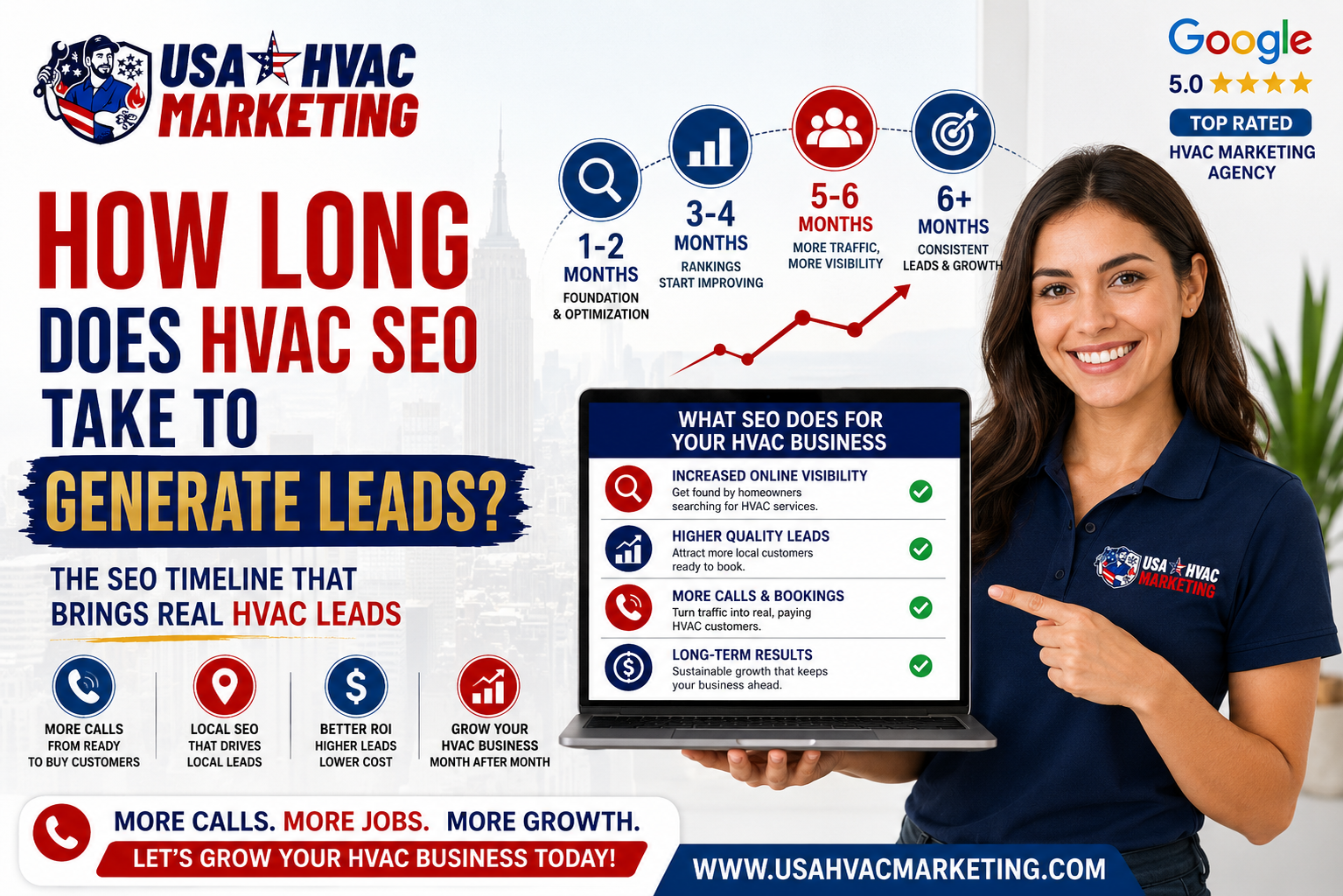
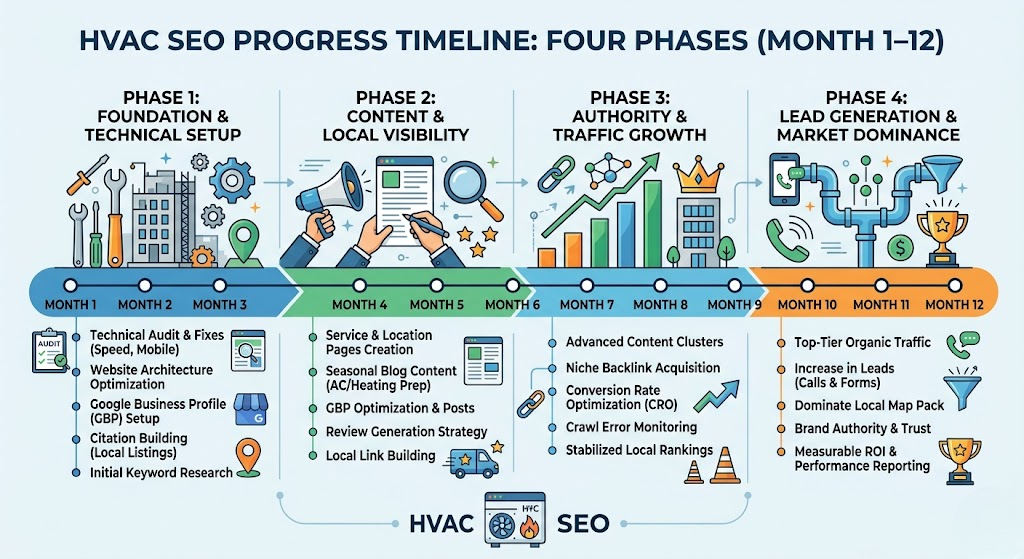
Most HVAC companies start seeing meaningful lead generation between months 6 and 12. Here is what that journey looks like, broken into four phases.
Month 1–3: Foundation Phase
This is the groundwork stage. Technical fixes, site audits, keyword research, Google Business Profile setup, and initial content creation. Nothing visible to the customer yet, but everything happening under the hood that makes future rankings possible.
Month 4–6: Momentum Phase
Content is indexed. Backlinks begin accumulating. Rankings start moving. Traffic ticks upward. Some lower-competition keywords may already hit page one. Early calls may start coming in, but volume is still low.
Month 7–9: Traction Phase
Multiple keywords ranking on page one. Organic traffic grows noticeably. Google Business Profile calls increase week over week. This is the phase where business owners start feeling the shift.
Month 10–12: Lead Generation Phase
Consistent, qualified leads arriving from organic search. Cost per lead drops significantly compared to paid ads. The investment starts delivering measurable ROI, and the compounding effect accelerates.
What Happens in Each Phase?
Technical Fixes and Site Audit (Month 1)
Before any content is written or any keyword is targeted, the website itself needs to be solid. Month one involves a full technical audit: fixing crawl errors, improving page speed, ensuring mobile responsiveness, correcting broken links, and setting up proper schema markup. Google cannot rank what it cannot properly read.
Keyword Targeting and Content Creation (Month 2–3)
This is where your service pages get built or rebuilt around the exact phrases your customers type into Google. “Emergency AC repair in [city].” “Furnace installation cost.” “HVAC maintenance near me.” Every page is written with search intent in mind, targeting real buying signals rather than generic traffic.
Google Business Profile Optimization (Month 1–2)
Your Google Business Profile is often the first thing a local homeowner sees. Optimizing your categories, service areas, business hours, photos, and review response strategy runs parallel to website work and typically produces faster local visibility gains than anything else in the early months. Data from BrightLocal shows that an optimized Google Business Profile remains the single most important factor for ranking in the local map pack.
Link Building and Authority Growth (Month 3–6)
Google treats backlinks as votes of confidence. Earning links from local directories, industry publications, and relevant websites signals that your business is trustworthy and authoritative in your market. This is slow, deliberate work that pays off over months, not weeks.
Rankings Start Moving (Month 4–6)
By month four, Google has crawled and indexed your updated pages, processed early backlinks, and begun reassessing your site’s relevance. You will see keyword positions climbing in rank tracking tools. Traffic starts converting into actual inquiries for some businesses at this stage.
Consistent Leads Coming In (Month 6–12)
This is the phase HVAC contractors stay in business for. Multiple high-intent keywords ranking on page one, map pack appearances for local searches, and a steady stream of inbound calls from people actively looking for the services you offer.
Factors That Speed Up or Slow Down Your HVAC SEO Results
Age and Authority of Your Website
A ten-year-old domain with existing content has a head start over a brand-new site. Google gives weight to domain history and trust signals accumulated over time. If your site is newer, expect the timeline to run slightly longer on the front end. Research from Ahrefs indicates that only 5.7% of all newly published pages will reach the Google Top 10 within a year.
How Competitive Your Local Market Is
Ranking in a small rural town is a different challenge from ranking in a major metro with dozens of established competitors. Market competition is the single biggest timeline variable. Your HVAC SEO agency should give you a competitive landscape analysis before any work begins.
Quality of Your Google Business Profile
A fully optimized GBP with consistent reviews, accurate categories, updated photos, and regular posts significantly accelerates local map pack rankings. Businesses with strong profiles often start seeing GBP traffic within the first 60 days.
How Much Content You Publish
HVAC companies that publish helpful blog content around seasonal topics, maintenance tips, and cost guides build topical authority faster and rank across a broader set of keywords. More relevant content means more entry points from search.
Consistency of Your SEO Investment
SEO is not a one-time project. It is a sustained effort. Companies that pause their campaign midway lose ground to competitors who do not. The algorithm rewards consistency, and stopping is almost always more expensive than continuing.
Realistic Lead Expectations by Month
| Timeframe | What to Expect | Estimated Lead Volume |
|---|---|---|
| Month 3 | Technical foundation complete, early keyword indexing, GBP improved | 0–3 organic leads/month |
| Month 6 | Rankings climbing, map pack appearances, traffic growing | 5–15 organic leads/month |
| Month 12 | Multiple page-one rankings, consistent inbound calls, strong local authority | 20–50+ organic leads/month |
These figures vary by market size and competition level. A company in a mid-size metro with moderate competition and a well-optimized website can reach the higher end of these ranges.
HVAC SEO vs Google Ads: Which Gets Leads Faster?
Short-Term: Google Ads Wins
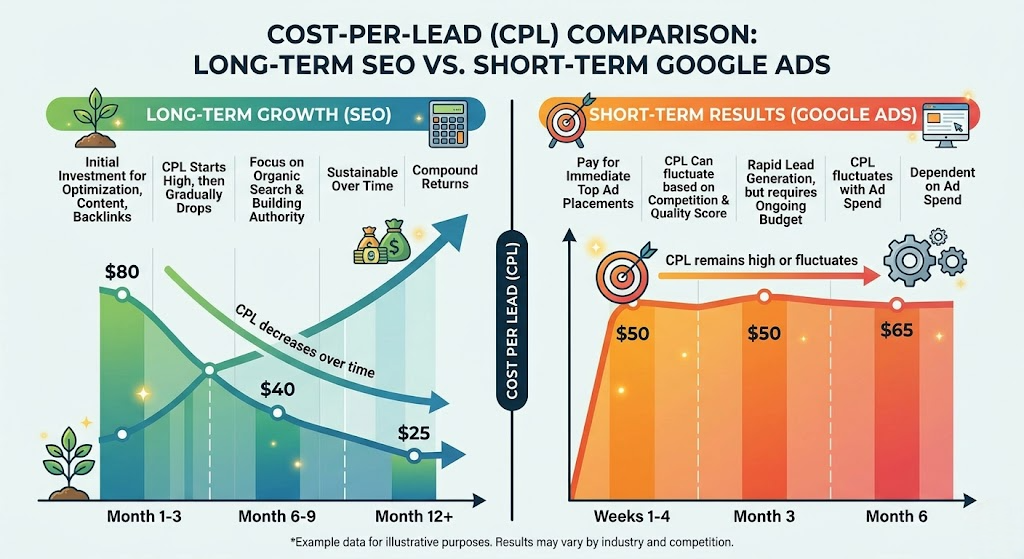
If you need calls this week, Google Ads is the answer. You can be live within 24 to 48 hours, targeting homeowners searching for emergency repairs or seasonal tune-ups right now. The trade-off is cost: HVAC keywords are competitive, and cost-per-click in many markets runs between $15 and $50 per click.
Long-Term: SEO Wins on Cost Per Lead
Once SEO starts delivering, the economics shift dramatically. Organic leads typically cost 60 to 80 percent less than paid leads when measured over a 12-month period. A well-ranking HVAC website continues generating calls even when your ad budget goes to zero. That is an asset Google Ads cannot build for you.
The Smart Strategy: Running Both Together
The companies that grow fastest run Google Ads while SEO is building. Ads cover immediate lead generation while SEO compounds in the background. By month six to nine, organic starts supplementing paid volume. By month twelve, many HVAC businesses reduce ad spend significantly because SEO is carrying more of the load.
Why Most HVAC Companies Quit SEO Too Early
The 6-Month Mistake
The most common error HVAC business owners make is pulling out of SEO at the five or six month mark, right before results start compounding. Month six is typically when rankings begin converting to real leads. Stopping then is like drilling for water and quitting three feet from the source.
What You Lose When You Stop
When you stop SEO, you do not just stop progressing. You begin declining. Competitors who keep publishing content and building links push past your rankings. Google interprets inactivity as a relevance signal. The authority you spent six months building erodes, and restarting always costs more than continuing would have.
How to Track If Your HVAC SEO Is Actually Working
Organic Traffic Growth
Monthly visitors arriving from Google search should trend upward over time. Use Google Analytics to track source-level traffic and separate organic visits from paid, direct, and referral channels.
Google Business Profile Calls and Views
GBP Insights shows how many people called directly from your listing and how many viewed your profile each month. Both numbers should grow consistently as your local SEO takes hold.
Keyword Ranking Progress
Tools like Google Search Console or SEMrush show your average position for target keywords. Watch for movement from page three to page one across your core service terms like “AC repair,” “furnace replacement,” and “HVAC maintenance” plus your city name.
Lead Volume and Cost Per Lead
The bottom-line number. Track how many calls and form fills came from organic search specifically, not just total leads. As SEO matures, your cost per organic lead should drop month over month, making it the most efficient lead source in your marketing mix.
Final Verdict: Is the Wait Worth It for HVAC Companies?
Yes, unequivocally. HVAC companies that invest in SEO and stay the course consistently outperform their competitors in lead volume and cost efficiency over a 12 to 24 month horizon. The key is entering with realistic expectations, tracking the right metrics, and partnering with a team that understands the HVAC industry specifically.
Generic marketing agencies apply the same playbook to every client. USA HVAC Marketing builds strategy around how your customers search, what your local competitors are doing, and what actually drives calls in your service area. That specificity is what separates campaigns that compound from ones that stall.
If you are ready to stop wondering when SEO will work and start building a lead engine that runs 24 hours a day, reach out to the team at USA HVAC Marketing.
Email us today at [email protected] or email [email protected] to get a free SEO audit for your market.
Frequently Asked Questions
How long does it take for HVAC SEO to show results?
Most HVAC companies begin seeing measurable ranking improvements between months three and six. Consistent lead generation typically starts around months six through twelve. The timeline depends on your market’s competition level, your website’s current condition, and how aggressively content and link building are executed from day one.
Is SEO or Google Ads better for HVAC companies?
Google Ads delivers leads faster but costs significantly more per lead over time. SEO takes longer to build but produces a much lower cost-per-lead at maturity and continues working without ongoing ad spend. The strongest HVAC marketing strategies run both simultaneously, using paid ads for immediate coverage while SEO compounds in the background.
How many leads can I expect from HVAC SEO per month?
At the three-month mark, expect zero to three organic leads per month. By month six, that typically grows to five to fifteen depending on your market. At the twelve-month mark, well-optimized HVAC websites in mid-size markets commonly generate twenty to fifty or more qualified organic leads per month.
What factors affect how fast HVAC SEO works?
The five biggest factors are: the age and existing authority of your domain, how competitive your local market is, the quality of your Google Business Profile, how consistently you publish new content, and whether your SEO investment is maintained without pauses or gaps. All five can be managed with the right strategy in place.
Why should I choose a specialized HVAC SEO agency instead of a general marketing agency?
HVAC SEO requires understanding seasonal search patterns, local service area targeting, and the specific keywords that convert homeowners into callers. A general agency applies the same framework to every industry. A specialist understands how heating and cooling customers search, what drives urgency in your market, and how to position your business against local competitors who have been building authority for years.
Sources
- https://www.searchenginejournal.com/how-long-seo-takes/258473/ – A detailed breakdown from Search Engine Journal about the time investment required for SEO and why it typically takes 4-12 months to see a return.
- https://www.brightlocal.com/research/local-search-ranking-factors/ – An authoritative annual report by BrightLocal that identifies the top local SEO factors, specifically focusing on Google Business Profile impact.
- https://ahrefs.com/blog/how-long-does-it-take-to-rank/ – Data-heavy analysis from Ahrefs regarding the age of top-ranking pages and the statistical probability of ranking quickly in Google.