Introduction: Why Some HVAC Companies Get More Leads From the Same Budget
You’re spending money on ads every month. The budget is there. The campaigns are running. But the phone isn’t ringing the way it should, and somehow your competitor down the street seems to be everywhere, Google, social media, yard signs, and still booking solid jobs.
That gap is frustrating, and it’s more common than most HVAC business owners realize. The truth is, two companies can invest the exact same advertising budget and get completely different results. One walks away with a full schedule of booked appointments. The other gets a handful of tire-kickers and a shrinking profit margin. The difference almost never comes down to how much money was spent, it comes down to how strategically it was spent.
HVAC advertising ROI depends on a combination of factors: where your budget goes, how your ads are written, where people land after clicking, and whether your system captures and converts those leads before they move on. Understanding each of these factors is the first step toward closing the gap between you and your highest-performing competitors.
What Is a Good ROI for HVAC Advertising?
Average HVAC Advertising ROI Benchmarks
A realistic ROI benchmark for HVAC advertising sits between 200% and 500%, meaning for every dollar spent, you should expect two to five dollars back in revenue. A marketing guide from ServiceTitan explains that high-performing contractors who have dialed in their targeting, landing pages, and lead follow-up systems can push well beyond that range, especially during peak seasonal demand.
Typical HVAC Cost Per Lead by Channel
| Advertising Channel | Average Cost Per Lead |
|---|---|
| Google Local Services Ads | $25 – $75 |
| Google Search Ads (PPC) | $50 – $150 |
| Facebook / Meta Ads | $40 – $120 |
| SEO (Organic) | $10 – $40 (long-term) |
| Direct Mail | $80 – $200 |
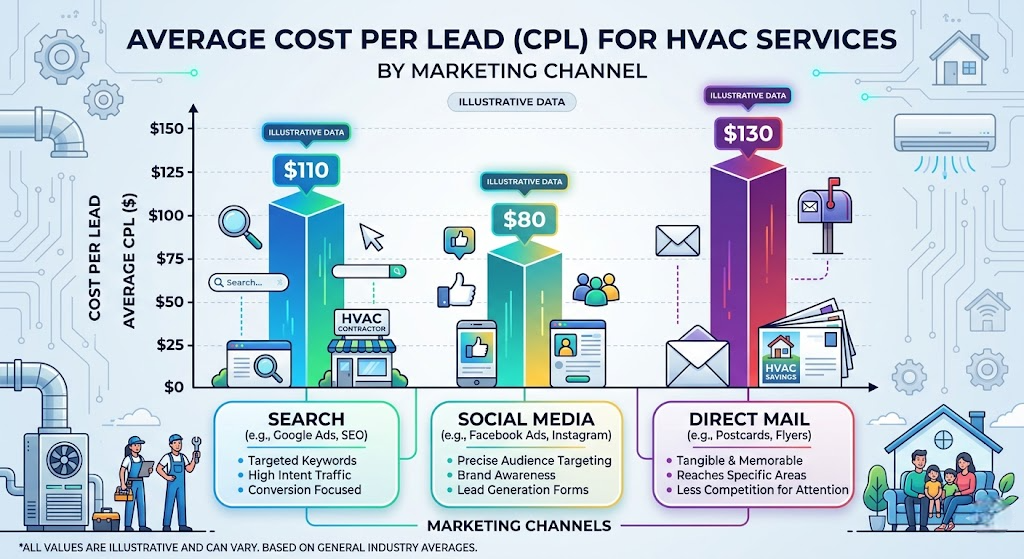
These numbers vary based on your market, competition level, and how well your campaigns are optimized. Data shared by WordStream indicates that the home services industry often faces higher-than-average costs due to the hyper-local nature of the competition.
Signs Your ROI Is Below Industry Standards
Your ROI is likely underperforming if your cost per lead is consistently above $150, if less than 30% of your leads convert to booked jobs, if you cannot identify which ad channel drove each call, or if your schedule has noticeable gaps during seasons that should be peak periods.
Why Your HVAC Advertising ROI Is Lower Than Competitors (Quick Summary)
Before diving deep into each issue, here is a fast overview of the most common reasons HVAC advertising underperforms:
- Wrong audience targeting
- Poor landing pages that fail to convert visitors
- Weak or generic offers that don’t motivate action
- Improper budget allocation across channels
- Missing conversion tracking
- No retargeting strategy in place
- Lack of lead nurturing after the first contact
Each of these issues compounds the others. Fix one and you improve results. Fix all of them and you transform your ROI entirely.
1. You’re Targeting the Wrong Audience
Broad Targeting vs. Hyper-Local Targeting
One of the fastest ways to drain an HVAC advertising budget is targeting too broadly. Running ads to an entire metro area when your crew can only service a 20-mile radius means you’re paying for clicks from people you’ll never convert. Hyper-local targeting — down to specific zip codes, neighborhoods, or even income brackets — tightens your audience and dramatically reduces wasted spend.
Ignoring Customer Intent Signals
Not all search traffic is equal. Someone searching “how does an AC unit work” is curious. Someone searching “AC repair same day near me” is ready to book. Technical documentation from Google Ads Help notes that campaigns that target informational keywords alongside high-intent commercial keywords blend cold traffic with hot leads and inflate your cost per conversion. Prioritize intent-driven keywords for your paid campaigns.
Missing Seasonal Demand Opportunities
HVAC demand is cyclical. The weeks just before summer heat hits and just before the first cold snap of fall are peak conversion windows. Competitors who ramp up spend and adjust messaging during these windows capture disproportionate market share. If your campaigns run on flat budgets year-round, you’re missing the moments when leads are cheapest and easiest to convert.
2. Your Landing Pages Are Losing Potential Customers
Slow Load Times and Poor Mobile Experience
More than 60% of HVAC searches happen on mobile devices. A report from Think with Google shows that if your landing page takes more than three seconds to load, a significant portion of your paid traffic leaves before seeing your offer. Page speed is not optional — it directly affects both your ad quality score and your conversion rate.
Weak or Missing Calls-to-Action
A landing page without a clear, prominent call-to-action leaves visitors uncertain about what to do next. Every HVAC landing page needs one primary action call now, request a quote, or book online, placed above the fold and repeated throughout the page.
Lack of Trust Signals and Social Proof
Homeowners are inviting a technician into their home. They need to trust you before they call. Licensing badges, Google review ratings, years in business, and real customer testimonials are not decorative elements, they are conversion tools. Pages without them consistently underperform against pages that include them.
3. Your Offer Doesn’t Stand Out From Competitors
Generic Messaging vs. Unique Value Propositions
“Quality HVAC service at a fair price” tells a homeowner nothing they couldn’t read on every competitor’s website. A strong unique value proposition answers the question: why should I call you instead of the next result? Same-day service guarantees, specific financing terms, or a satisfaction promise give people a concrete reason to choose you.
Free Estimates and Special Promotions
Promotional offers lower the barrier to entry. A free service call, a seasonal tune-up discount, or a first-time customer deal generates action from people who are still deciding. These offers do not devalue your service — they start a relationship.
Financing Options That Increase Conversions
System replacements can cost $5,000 to $15,000 or more. Many homeowners delay that decision because of upfront cost. Advertising flexible financing options directly in your ads and on your landing pages removes that hesitation and converts high-value leads who would otherwise keep shopping.
4. Your Ad Budget Allocation Is Costing You Leads
Spending Too Much on Low-Converting Channels
Display advertising and broad social campaigns build awareness but rarely drive immediate service calls. Putting the majority of a limited HVAC budget into those channels while underfunding Google Search means you’re paying for impressions when you should be paying for intent.
Underinvesting in Google Local Services Ads
Google Local Services Ads (LSAs) appear above everything else in search results, above regular PPC ads, above map packs, above organic results. An analysis from WordStream clarifies that these ads charge per lead, not per click, and the Google Guarantee badge attached to them builds instant credibility. Many HVAC contractors are still underutilizing this channel entirely.
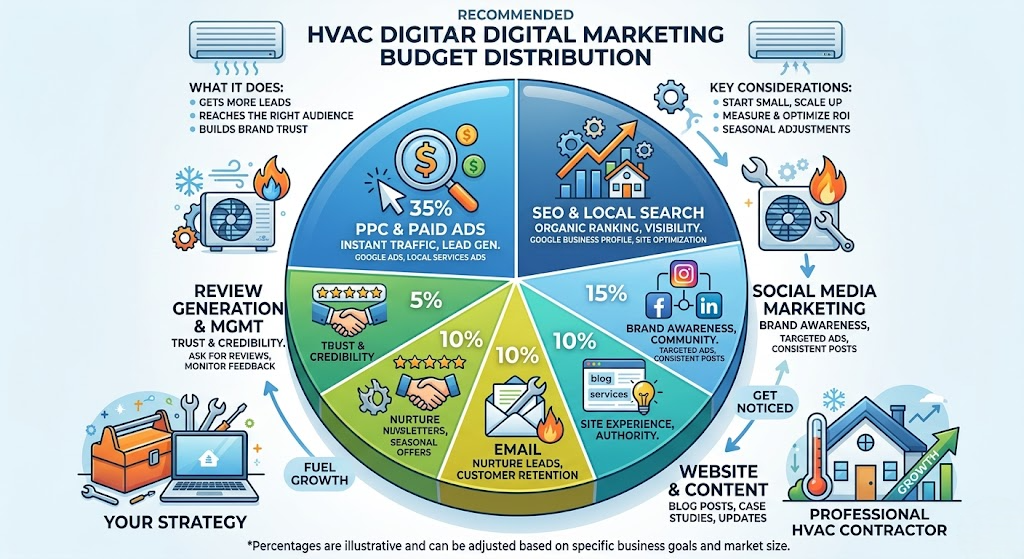
Finding the Right Budget Split Across Channels
A balanced allocation for most HVAC companies looks something like this:
| Marketing Channel | Recommended Budget Share | Primary Goal |
| Google Local Services Ads (LSAs) | 30% – 40% | Generate high-intent leads and phone calls |
| Google Search Ads (PPC) | 30% – 35% | Capture customers actively searching for HVAC services |
| Retargeting Campaigns | 10% – 15% | Re-engage website visitors who didn’t convert initially |
| Local SEO | 15% – 20% | Build long-term organic visibility and reduce cost per lead |
| Social Media & Display Ads | 5% – 10% | Increase brand awareness and support remarketing efforts |
5. You’re Not Tracking the Right Metrics
Vanity Metrics vs. Revenue Metrics
Impressions and clicks feel good on a report but mean nothing if they don’t convert to booked jobs. The only metrics that matter for HVAC advertising ROI are cost per lead, lead-to-appointment rate, cost per booked job, and revenue per customer. If your reporting is built around clicks and impressions, you’re optimizing for the wrong outcomes.
Missing or Inaccurate Call Tracking
Most HVAC leads call directly. Without dynamic call tracking numbers assigned to each ad channel, there is no way to know which campaign generated which call. You end up making budget decisions based on incomplete data, which almost always means overspending on underperforming channels.
Poor Lead Attribution
Multi-touch attribution matters. A homeowner might click a Google ad, leave your site, see a retargeting ad on Facebook three days later, and then call from an organic search result. Without proper attribution tracking, that lead gets credited to the wrong source and you pull budget from the campaign that actually drove the conversion.
6. Your Competitors Are Using Strategies You’re Not
Google Local Services Ads and Review Generation
Top-performing HVAC companies treat LSA rankings as seriously as organic SEO. The more verified reviews you have connected to your Google Business Profile, the higher your LSA placement. Competitors actively requesting reviews after every job are systematically climbing past companies that leave reviews to chance.
Retargeting Previous Website Visitors
The majority of people who click your ad are not ready to book on the first visit. Retargeting campaigns keep your brand visible to those visitors across Google Display and social media for days after their first interaction. This dramatically increases conversion rates from traffic you already paid to acquire.
Emergency Service and Seasonal Campaigns
Separate campaigns built specifically for emergency AC repair, furnace failure calls, and seasonal tune-ups consistently outperform generic “HVAC service” campaigns. Competitors who build dedicated ad sets with matching landing pages for each service type win more of the high-urgency, high-value calls.
Competitor Keyword Targeting
Bidding on competitor brand names is a legitimate and widely used strategy. When someone searches for your competitor by name, your ad appearing alongside theirs gives you a chance to intercept that lead. It is not aggressive, it is standard competitive advertising practice.
HVAC Advertising ROI Comparison: Average Contractor vs. Top Performer
| Average HVAC Advertiser | High-ROI HVAC Advertiser |
|---|---|
| Broad targeting | Hyper-local targeting |
| Generic ads | Seasonal and service-specific offers |
| No retargeting | Active retargeting campaigns |
| Basic landing pages | Conversion-focused dedicated pages |
| Limited or inconsistent reviews | Strong, growing review profile |
| No call tracking | Full multi-touch attribution tracking |
7. You’re Not Nurturing Leads After the First Interaction
No Email Follow-Up System
Most leads do not book on first contact. An automated email sequence that follows up within minutes of a form submission, delivers a service reminder 30 days later, and promotes seasonal offers keeps your company in front of prospects until they are ready to act. Competitors with these systems in place consistently close a higher percentage of the same leads.
Missing SMS Automation
SMS open rates exceed 90%. A study from Gartner shows that automated text messages sent within minutes of a lead submission increase contact rates dramatically compared to email. Few HVAC contractors use this tool, which makes it a competitive advantage for those who do.
Ignoring Referral and Repeat Customers
Existing customers cost a fraction of what a new lead costs to acquire. A structured referral program and a regular maintenance reminder sequence keep your name in front of people who have already proven they trust you. These customers also leave better reviews and refer higher-quality leads.
No Review Request Process
Reviews directly affect both LSA rankings and conversion rates on your Google Business Profile. A systematic process of requesting a review via text immediately after every completed job builds your review count consistently. This is not passive — top performers treat it as a standard part of the job close.
How to Diagnose Your HVAC Advertising ROI Problem
Audit Your Current Advertising Channels
List every channel where you are currently spending money and pull the actual cost, lead volume, and conversion data from each. Most HVAC contractors discover that one or two channels are generating the majority of their booked jobs while others are consuming budget with little return.
Compare Performance Against Industry Benchmarks
Use the cost-per-lead benchmarks in this article to evaluate each channel. If your Google Search campaigns are producing leads above $150 consistently, there is a targeting, bidding, or landing page problem that needs attention.
Review Landing Page Conversion Rates
A well-optimized HVAC landing page should convert between 8% and 15% of paid traffic into leads. If your conversion rate is below 5%, the landing page is likely the primary bottleneck in your funnel, not the ads themselves.
Check Your Tracking and Attribution Setup
Verify that call tracking numbers are active on every channel, that Google Analytics goals are firing correctly, and that your CRM is capturing the lead source for every contact. Without this foundation, optimization is guesswork.
Calculate Your True Cost Per Lead and Cost Per Customerthe
Divide total ad spend by total leads generated to get cost per lead. Then divide total ad spend by total booked jobs to get cost per customer. These two numbers reveal where your funnel is leaking and where you have most opportunity to improve.
How Top HVAC Companies Consistently Achieve Higher Advertising ROI
Combining Google Ads With Local SEO
Paid and organic search work best together. Google Ads delivers immediate visibility while local SEO builds long-term organic rankings that lower your overall cost per lead over time. Companies investing in both channels reduce their dependence on paid spend and dominate more of the search results page.
Using Dedicated Service Landing Pages
A single homepage trying to speak to every service simultaneously converts poorly. Top performers build dedicated landing pages for AC repair, furnace replacement, maintenance plans, and emergency services, each with messaging, offers, and CTAs specific to that service and the customer’s likely intent.
Building a Strong Review Strategy
Review volume and recency directly affect both LSA rankings and consumer trust. A structured post-service review request process, combined with a system for responding to every review, builds a profile that consistently outperforms competitors with sporadic or neglected review management.
Leveraging Retargeting Campaigns
Retargeting is one of the highest-ROI tools available to HVAC advertisers because you are only spending money on people who have already shown interest. A modest retargeting budget applied to Google Display and Facebook can significantly increase the conversion rate of your existing traffic.
Tracking Every Call and Lead Source
Full attribution tracking is what separates companies that grow intentionally from those that grow by accident. When you know exactly which campaign, keyword, and ad drove every booked job, every optimization decision becomes clear and every dollar spent is accountable.
Conclusion: Closing the HVAC ROI Gap Starts With Small Improvements
The gap between your current advertising ROI and your top competitor’s performance is not usually the result of one massive mistake. It is the accumulation of several small, fixable problems: a landing page that loads slowly, a campaign targeting the wrong zip codes, a follow-up system that never gets built, a tracking setup that leaves half the picture dark.
Fix these one at a time and the gap closes. Fix them systematically and you become the competitor that other HVAC companies are trying to figure out.
If you are ready to stop guessing and start making every advertising dollar work harder, USA HVAC Marketing can help. Our team specializes in full-funnel HVAC advertising strategy built specifically for contractors who want measurable, scalable results.
Contact USA HVAC Marketing today at [email protected] or call (315) 907-5444 to schedule a free advertising audit and find out exactly where your ROI is leaking.
FAQs
What is a good ROI for HVAC advertising?
A good ROI for HVAC advertising is typically 200% to 500%, meaning you generate $2 to $5 in revenue for every $1 spent on marketing. Top-performing HVAC companies often exceed this range by combining high-intent advertising, optimized landing pages, strong reviews, and effective lead follow-up systems.
How much should an HVAC company spend on advertising?
Most HVAC companies should invest 5% to 10% of their annual revenue in advertising. For example, a business targeting $1 million in annual revenue may spend $50,000 to $100,000 per year on Google Ads, Local Services Ads, local SEO, and retargeting campaigns.
Which advertising platform works best for HVAC contractors?
Google Local Services Ads (LSAs) and Google Search Ads typically deliver the highest ROI for HVAC contractors. These platforms target homeowners actively searching for HVAC services, making them more effective for generating qualified leads and service calls than most other advertising channels.
How long does it take to see results from HVAC advertising?
Google Ads and Local Services Ads can start generating leads within days of launch. SEO generally takes three to six months to produce significant results. Businesses often improve ROI faster by optimizing targeting, landing pages, and conversion tracking before increasing their advertising budget.
Why do competitors get more leads from the same ad budget?
Competitors often generate more leads from the same budget because they have better targeting, higher-converting landing pages, stronger offers, and more accurate tracking systems. Small improvements in each area can significantly increase lead volume and advertising ROI without increasing ad spend.
Sources
- https://www.servicetitan.com/blog/hvac-marketing – A detailed resource from a leading field service management software regarding marketing ROI benchmarks for HVAC businesses.
- https://www.wordstream.com/blog/ws/2023/05/15/google-ads-benchmarks – A comprehensive industry report providing cost-per-lead and click-through rate benchmarks for various industries, including home services.
- https://support.google.com/google-ads/answer/1704371 – Official Google documentation regarding keyword selection and how to align campaigns with consumer search intent.
- https://www.thinkwithgoogle.com/consumer-insights/consumer-trends/mobile-page-speed-data/ – Research from Google detailing how mobile site speed affects user bounce rates and overall conversion potential.
- https://www.wordstream.com/blog/ws/2017/09/19/google-local-services-ads – An explanatory guide on the structure and benefits of Google Local Services Ads for local contractors.
- https://www.gartner.com/en/digital-markets/insights/the-importance-of-sms-marketing-in-2021 – An analysis of modern marketing trends emphasizing the high engagement and conversion rates associated with SMS automation.