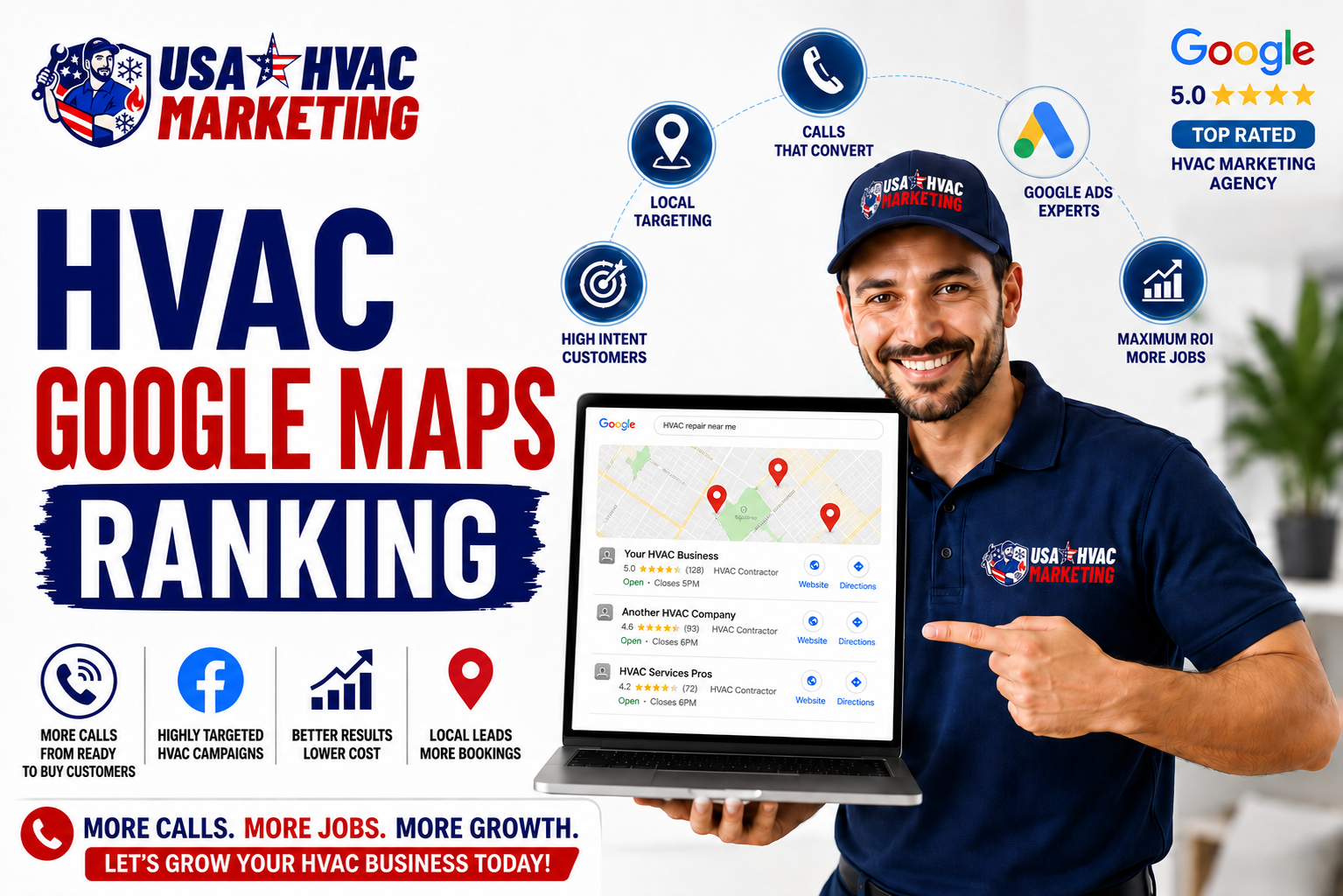
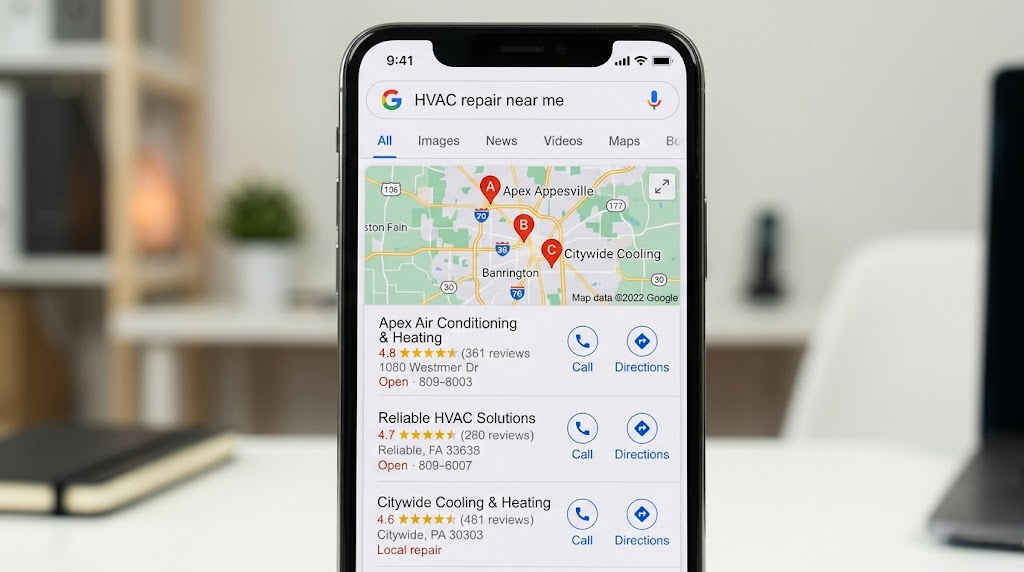
When a homeowner’s AC breaks down in the middle of July, they don’t scroll through pages of Google results. They search “HVAC near me” and call one of the first three businesses they see on the map.
That top section, the Google Map Pack, is where your phone starts ringing.
If your HVAC business isn’t showing up there, you’re invisible to hundreds of potential customers every single month. The good news: ranking on Google Maps is one of the most achievable wins in local SEO if you know exactly what to do.
At USA HVAC Marketing, we’ve helped HVAC contractors across the country move from page three on Google Maps to the top three positions and seen their inbound call volume double within six months. This guide breaks down exactly how we do it.
Why Google Maps Rankings Matter More Than Ever for HVAC
Google Maps results appear above organic website results. That means even if your website ranks on page one, the Map Pack gets clicked first.
The top three Google Maps listings capture the majority of local clicks. Position four and below gets almost nothing. In the HVAC world, second place means your competitor answered the phone instead of you.
For HVAC contractors, this is everything. Your customers are:
- Searching on mobile while their system is broken
- Ready to call immediately, with no research or comparison shopping
- Choosing the first contractor they see with strong reviews and a complete profile
Ranking on Google Maps isn’t just an SEO goal. It’s a direct lead generation strategy.
Step 1: Claim and Fully Optimize Your Google Business Profile
Your Google Business Profile (GBP) is the single most important ranking factor for Google Maps. Recent data from Whitespark confirms that an optimized profile is the primary driver of local pack visibility. Most HVAC contractors have a profile but leave it half-complete. That’s exactly why they’re stuck behind competitors.
Do this today:
- Set your primary category to “HVAC Contractor,” not “Air Conditioning Contractor” or a generic term
- Add every service you offer: AC repair, furnace installation, heat pump service, duct cleaning, maintenance plans
- Write a keyword-rich business description that includes your city name and main services
- Add your full service area, including every city and zip code you cover
- Upload at least 10 high-quality photos of your team, trucks, completed jobs, and office
- Ensure your phone number, address, and hours are 100% accurate and consistent
What most contractors miss: Post to your GBP at least once per week. Google treats active profiles as more relevant. Share seasonal tips, promotions, and completed job photos. Five minutes per week directly impacts your ranking.
Real Example: GBP Optimization in Action
One of our clients, an HVAC contractor in the Dallas-Fort Worth area, came to us ranking in position 9 on Google Maps. Their GBP had no photos, an incomplete service list, and hadn’t been posted to in over eight months.
Within 60 days of a full GBP overhaul, including 22 new photos, weekly posts, a complete service list, and an optimized business description, they moved to position 4. By month four, they were in the top 3 and receiving an average of 34 additional calls per month directly from Google Maps.
Step 2: Build Consistent NAP Citations Across the Web
NAP stands for Name, Address, and Phone number. As explained by Moz, Google cross-references your business information across hundreds of directories to confirm you’re a legitimate, established local business.
If your business name appears differently across listings, or your old phone number is still showing somewhere, Google gets confused and your ranking drops.
Get listed and consistent on:
- Yelp, Angi, HomeAdvisor, and Thumbtack
- BBB (Better Business Bureau)
- Local chamber of commerce websites
- Apple Maps and Bing Places
- Facebook Business Page
Every listing must have the exact same name, address, and phone number. This consistency signals trust to Google and is one of the most overlooked ranking factors in local SEO.
Real Example: Citation Cleanup Results
An HVAC contractor in Phoenix came to us with 14 inconsistent citations, including mismatched phone numbers, two different business names across directories, and an old address still showing on three platforms.
After a full citation audit and cleanup, their Google Maps ranking improved from position 7 to position 3 within 90 days without changing anything else. Calls from Google Maps increased by 41% during that same period.
Step 3: Generate Google Reviews Consistently
Reviews are one of the top local ranking factors. Not just the star rating, but the volume and recency of reviews matter equally. A study from BrightLocal shows that consumers increasingly value the recency of reviews when choosing a local service provider.
An HVAC company with 150 reviews at 4.7 stars will usually outrank a company with 20 reviews at 5.0 stars in a competitive market.
The system that works:
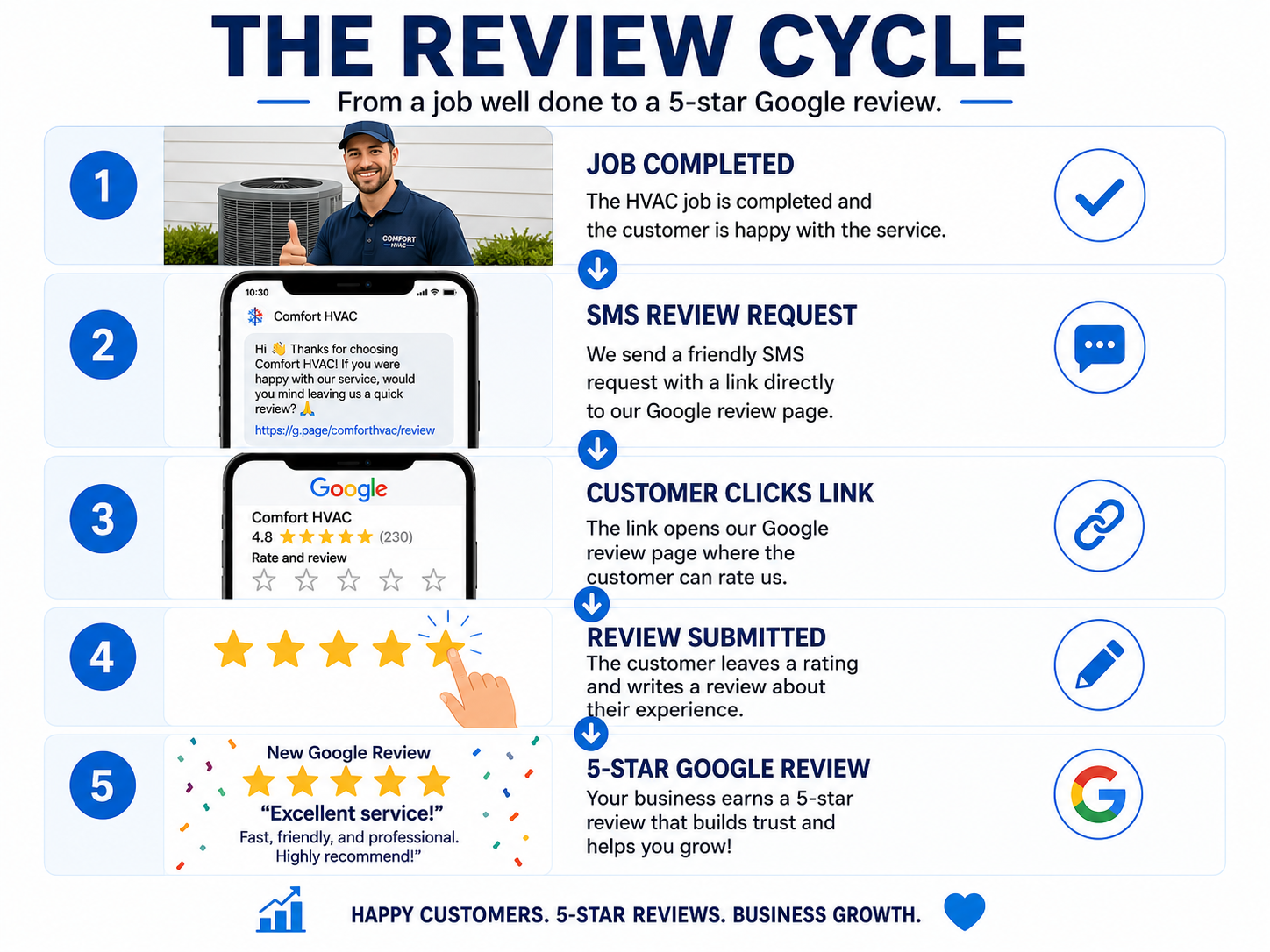
- Train every technician to ask for a review immediately after completing a job, when customer satisfaction is highest
- Send an automated SMS with your direct Google review link within two hours of job completion
- Respond to every review within 24 hours by thanking positive reviewers and professionally addressing concerns
- Never stop asking for reviews because fresh reviews signal to Google that your business is actively serving customers
Real Example: Review Velocity Drives Rankings
A residential HVAC contractor in Nashville had 27 Google reviews after three years in business. Their competitor across town had 190 reviews and consistently ranked above them in the Map Pack.
We implemented a post-job SMS review request system for their team. Within four months, they collected 84 new reviews, bringing their total to 111 with a 4.9-star average. Their Maps position moved from 6 to 2, and inbound calls from Google Maps increased by 63%.
Step 4: Optimize Your Website for Local Keywords
Your Google Business Profile and your website work together. Google looks at your website to confirm that you genuinely serve the areas you claim and that your business is credible.
What to fix on your website:
- Add your city and service to every page title, such as “AC Repair in [City] | USA HVAC Marketing”
- Create a dedicated page for every service you offer instead of one generic services page
- Create a dedicated location page for every city you serve because this is one of the highest-impact changes most HVAC websites can make
- Embed a Google Map on your contact page
- Ensure your NAP information exactly matches your GBP
What a Location Page Should Look Like
A weak location page says: “We serve Phoenix and surrounding areas.”
A strong location page says: “USA HVAC Marketing provides AC repair, furnace installation, and HVAC maintenance to homeowners in Phoenix, AZ. Our licensed technicians serve the 85001 through 85099 zip codes with same-day service available.”
One of our clients added dedicated location pages for 11 cities they served but hadn’t specifically targeted. Within five months, they were ranking in the Map Pack for six of those cities and had added $14,000 in monthly revenue from markets where they previously had no visibility.
Step 5: Earn Local Backlinks
Backlinks from other websites tell Google that your business is trusted and established in the community. For local SEO, local backlinks carry the most weight.
Where to get them:
- Local chamber of commerce memberships
- HVAC equipment suppliers and manufacturer directories
- Local news features or community sponsorships
- Home services directories
- Neighborhood blogs and local resource websites
Most HVAC contractors do nothing here, which means even a handful of strong local backlinks gives you a real competitive edge.
What’s Changed in 2026: AI Search and Google Maps
AI-powered search now pulls local business recommendations directly from Google Maps data. Insights from Search Engine Journal suggest that when homeowners ask AI platforms “Who are the best HVAC contractors near me?”, the businesses recommended are usually the ones with optimized GBPs, strong review profiles, and active local signals.
To rank in AI search results:
- Keep your GBP updated with fresh photos and posts every week
- Encourage reviews that mention specific services and locations, such as “fixed our AC in Scottsdale same day”
- Add a detailed FAQ section to your website because AI search often pulls directly from this content when answering homeowner questions
This is territory most HVAC contractors are still ignoring. The companies that optimize for AI search now will own those recommendations before the competition catches on.
How Long Does It Take to Rank on Google Maps?
Based on the contractors we work with at USA HVAC Marketing:
- Smaller markets (population under 200K): Movement in 45 to 90 days with consistent action
- Mid-size markets: 3 to 4 months to see significant ranking improvement
- Competitive metro areas: 4 to 6 months to reach the top 3
The contractors who get there fastest treat it as a system, not a one-time project. GBP updates, review collection, citation consistency, and website optimization compound over time. The businesses that quit after 60 days never see the results that were three months away.
Conclusion
Ranking on Google Maps in 2026 is not about tricks or shortcuts. It’s about showing Google and your future customers that your HVAC business is active, trusted, and genuinely serving your local community.
Every step in this guide is something we implement for HVAC contractors at USA HVAC Marketing. The results are real: more Map Pack visibility, more inbound calls, and more booked jobs. The process works, but only if you execute it consistently.
Start today. The HVAC contractors who begin building local authority now are the ones that dominate the Map Pack long-term.
Free Local SEO Audit for HVAC Contractors
Not sure why your HVAC business isn’t showing up on Google Maps? We’ll show you exactly what’s holding you back for free.
What you get in your free audit:
- Full Google Business Profile review
- Citation consistency check across top directories
- Review profile analysis versus your top 3 local competitors
- Website local SEO assessment
- A clear, prioritized action plan to start ranking higher
You’ll receive a detailed breakdown of what’s limiting your visibility and the highest-impact actions to improve rankings.
📧 Email us: [email protected]
Frequently Asked Questions (FAQs)
How do HVAC companies rank higher on Google Maps?
HVAC companies rank higher on Google Maps by optimizing their Google Business Profile, generating consistent reviews, building accurate local citations, improving local website SEO, and earning trusted local backlinks. Google mainly evaluates relevance, distance, and prominence when ranking businesses in the Map Pack.
What is the most important Google Maps ranking factor for HVAC contractors?
A fully optimized Google Business Profile is the biggest ranking factor. Businesses with complete profiles, strong reviews, updated photos, correct categories, and regular activity usually outperform inactive competitors on Google Maps.
How many Google reviews does an HVAC company need to rank?
There’s no exact number, but HVAC contractors in competitive markets often need 75 to 150 quality reviews to compete consistently in the Google Map Pack. Review recency, keywords, and response activity matter alongside total review count.
How long does HVAC local SEO take to show results?
Most HVAC companies start seeing noticeable ranking improvements within 60 to 90 days. In highly competitive cities, reaching the top three Google Maps positions may take 4 to 6 months of consistent optimization, review generation, and local SEO work.
Can HVAC companies rank in multiple cities?
Yes. HVAC contractors can rank in multiple cities by creating dedicated location pages with unique local content for each service area. Generic service area pages usually perform poorly compared to optimized city-specific pages.
Sources
- Whitespark: A comprehensive annual study and report detailing the primary ranking factors for Google’s Local Pack and Organic search results.
- Moz: An authoritative SEO educational resource explaining the role of local citations and NAP consistency in business rankings.
- BrightLocal: A specialized local marketing research firm providing data on how consumer behavior and review trends impact local business visibility.
- Search Engine Journal: A leading industry publication offering analysis on how Search Generative Experience (AI) affects local SEO strategies.