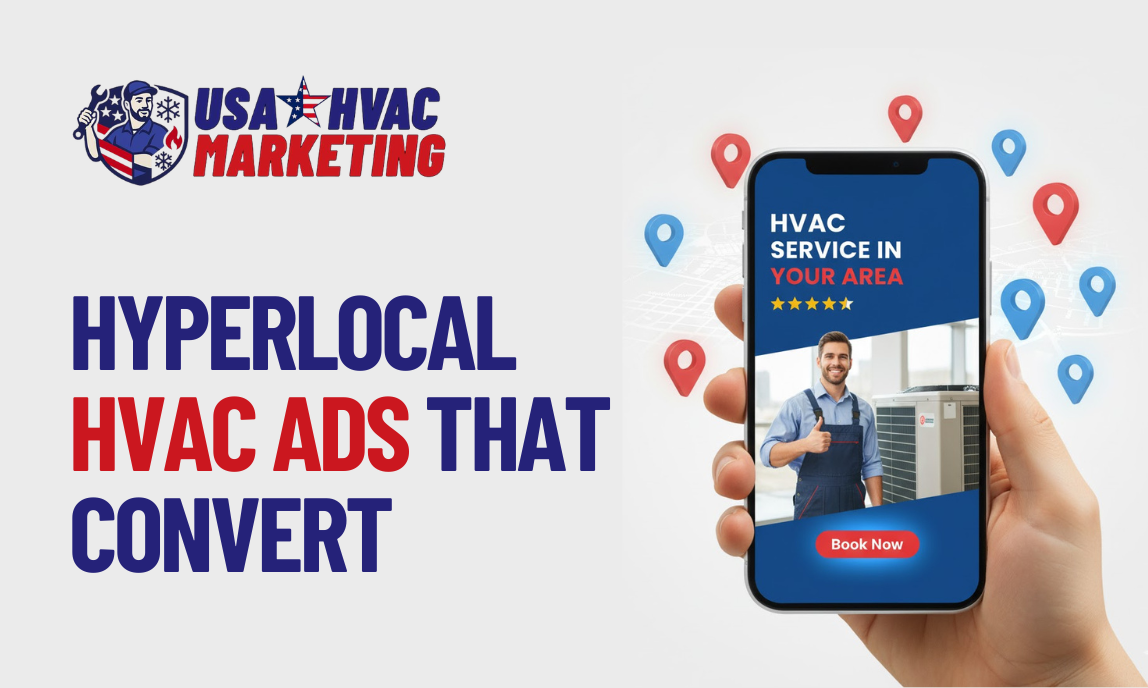
Hyperlocal Facebook targeting is more effective than broad city-wide campaigns for HVAC businesses because it concentrates advertising budgets on the most profitable service areas. This approach targets potential customers in specific zip codes or even within a few miles of a current job site, leading to higher ad relevance, lower customer acquisition costs, and a better return on investment. By focusing on smaller, defined geographic areas, ads reach homeowners who are not only within the service radius but are also more likely to have similar housing types, income levels, and immediate needs.
This strategy moves away from the wasteful spending inherent in city-wide advertising, where a significant portion of the budget is spent on showing ads to people who are too far away or live in apartments and are not decision-makers for HVAC services. This article explains the mechanics behind hyperlocal targeting, its direct financial benefits, and how to apply it effectively to an HVAC marketing plan. The information is based on direct experience running successful digital advertising campaigns for heating and cooling contractors across the country.
Hyperlocal vs. City-Wide: A Head-to-Head Comparison
Understanding the functional differences between hyperlocal and city-wide targeting shows why one is clearly more efficient for service-based businesses. A city-wide campaign might seem like a good way to reach a lot of people, but it lacks the precision needed for an industry built on service calls and local reputation.
The Problem with City-Wide Campaigns
A city-wide campaign targets everyone within the geographical limits of a major metropolitan area. While this generates a high number of impressions, it comes with several disadvantages:
- High Ad Waste: A large percentage of the audience may live outside the company’s profitable service area, leading to clicks and calls from customers that cannot be served.
- Lower Relevance: An ad for a furnace replacement in a northern suburb has little relevance to someone living in a downtown high-rise condo. Facebook’s algorithm penalizes low relevance with higher costs.
- Generic Messaging: It’s difficult to create a message that speaks to the specific needs of diverse communities across a large city.
The Power of Hyperlocal Precision
Hyperlocal targeting drills down to specific neighborhoods, zip codes, or a tight radius (e.g., 1-5 miles) around a point of interest. This precision is where the advantage lies.
- Bonus Tip: A powerful hyperlocal tactic is “job site canvassing.” While a team is working on an installation, run a targeted ad campaign in a 1-mile radius with a message like, “Your neighbors on Maple Street are getting a new high-efficiency AC. See our offers.” This creates social proof and immediate local relevance.
Direct Comparison of Targeting Strategies
The table below outlines the key performance differences between the two approaches.
| Feature | City-Wide Targeting | Hyperlocal Targeting |
|---|---|---|
| Target Audience | Broad, diverse, large | Specific, homogenous, small |
| Ad Relevance | Generally low to medium | Generally high |
| Average Cost Per Lead | Higher | Lower |
| Wasted Ad Spend | High | Minimal |
| Potential for Personalization | Limited | High |
| Conversion Rate | Lower | Higher |
The Financial Impact of Precise Targeting
The primary reason to choose hyperlocal targeting is its positive effect on the marketing budget and overall profitability. It’s not just about reaching people; it’s about reaching the right people for less money.
Lowering Ad Costs Through Relevance
Facebook’s advertising platform rewards advertisers who create a good user experience. A key metric for this is the ad’s relevance score. When an ad is highly relevant to the audience seeing it, Facebook charges less for each click or impression. According to research on Facebook’s ad auction, higher ad relevance can significantly lower the cost per click source. Hyperlocal ads, by their nature, are more relevant. A homeowner in a neighborhood with 30-year-old houses is far more likely to engage with an ad about furnace replacements than a general city-wide audience.
Maximizing Service Call Efficiency
Focusing advertising on specific zones also improves operational efficiency. When service calls are clustered in the same few neighborhoods, technicians spend less time driving between appointments and more time completing jobs. This reduction in “windshield time” means more billable hours per day without increasing payroll. This operational advantage translates marketing efficiency into tangible business profitability.
Applying Hyperlocal Targeting in Different Climates
An effective marketing strategy adapts to local conditions. For an HVAC company, this means tailoring hyperlocal campaigns to the specific climate and housing stock of a region.
- Hot & Humid Climates (e.g., Houston, TX): Target neighborhoods near the coast with ads focused on dehumidification, whole-home air purifiers, and salt-resistant outdoor units.
- Cold Northern Climates (e.g., Minneapolis, MN): In late summer and early fall, run hyperlocal campaigns in neighborhoods with older homes, focusing on high-efficiency furnace tune-ups and replacement offers before the winter rush. Data from the U.S. Energy Information Administration shows that space heating accounts for the largest share of home energy use, making furnace efficiency a strong selling point in these regions source.
- Dry & Arid Climates (e.g., Phoenix, AZ): During extreme heatwaves, deploy “emergency AC repair” ads targeted to zip codes known for having older, less reliable air conditioning systems.
Key Steps for a Successful Hyperlocal Strategy
Before shifting the entire advertising budget to a hyperlocal strategy, a few factors need to be evaluated to ensure success.
- Define Your Ideal Service Areas: Not all neighborhoods are equally profitable. Analyze past job data to identify which zip codes have generated the most revenue. These are the first places to target.
- Set an Appropriate Budget: Hyperlocal audiences are smaller, so you don’t need a massive budget for each campaign. However, the budget must be large enough to reach a meaningful percentage of the target audience multiple times.
- Match Ad Copy to the Area: Don’t use a generic ad for every hyperlocal campaign. Mention the neighborhood or a local landmark to increase the sense of relevance. For example, “Stay cool this summer, Northwood! We’re offering AC tune-ups in your area.”
- Bonus Tip: Start with a few high-potential zip codes. Test different ad creatives and offers to see what connects with homeowners in that specific area before expanding to other neighborhoods.
Final Thoughts
Shifting from broad, city-wide advertising to a focused hyperlocal strategy is about working smarter, not just spending more. It aligns the advertising message directly with the people most likely to become profitable customers. By concentrating marketing efforts on specific, high-value neighborhoods, an HVAC business can reduce wasted ad spend, improve lead quality, and increase the efficiency of its field technicians. The first step is to analyze existing customer data and identify the handful of zip codes that represent the best opportunity for growth.
Get Started with Precise Marketing
Developing a successful hyperlocal campaign requires careful planning and ongoing management. For HVAC contractors looking to optimize their digital advertising and stop wasting money on ineffective city-wide campaigns, the team at
USA HVAC Marketing can provide guidance. To discuss a strategy tailored to your specific service areas, reach out to an expert at [email protected] for a straightforward assessment of your current marketing efforts.
Frequently Asked Questions (FAQ)
What is the smallest area Facebook can target?
Facebook allows targeting within a 1-mile radius of a specific street address or dropped pin. This is perfect for the job site canvassing tactic mentioned earlier.
How does this differ from geofencing?
Geofencing typically involves targeting people who physically enter a specific area and serving them ads on various mobile apps. Hyperlocal Facebook targeting is about targeting people who live in a specific area, which is a more stable and relevant audience for HVAC services.
How should I structure multiple hyperlocal campaigns?
Create a separate ad campaign for each distinct service area or zip code. This allows for customized budgeting, scheduling, and messaging. It also makes it easy to see which neighborhoods are providing the best return and which may need a different approach.
Can this strategy be used on Google Ads too?
Yes, absolutely. The same principles apply. In Google Ads, you can target specific zip codes, cities, or a radius around your business location. Layering location targeting with keywords like “ac repair near me” is an extremely effective combination.
What kind of budget is needed to start a hyperlocal campaign?
You can start seeing results with a budget as small as $15 to $20 per day for a single campaign targeting one or two zip codes. The key is concentration. It is better to spend $20 per day in one zip code than to spread that same $20 across an entire city.
How quickly can results be expected?
With a well-structured hyperlocal campaign, you can start generating leads within the first few days. Unlike SEO, which takes time to build, paid ads can produce immediate traffic. The quality of those leads, however, will depend on the accuracy of the targeting and the strength of the offer.
Sources
- Instapage – This article provides a detailed explanation of Facebook’s ad relevance score and how it directly impacts the cost and performance of advertising campaigns.
- U.S. Energy Information Administration (EIA) – This government report details energy consumption in U.S. homes, confirming that space heating is a primary expense, which supports the targeting of furnace ads in colder climates.