
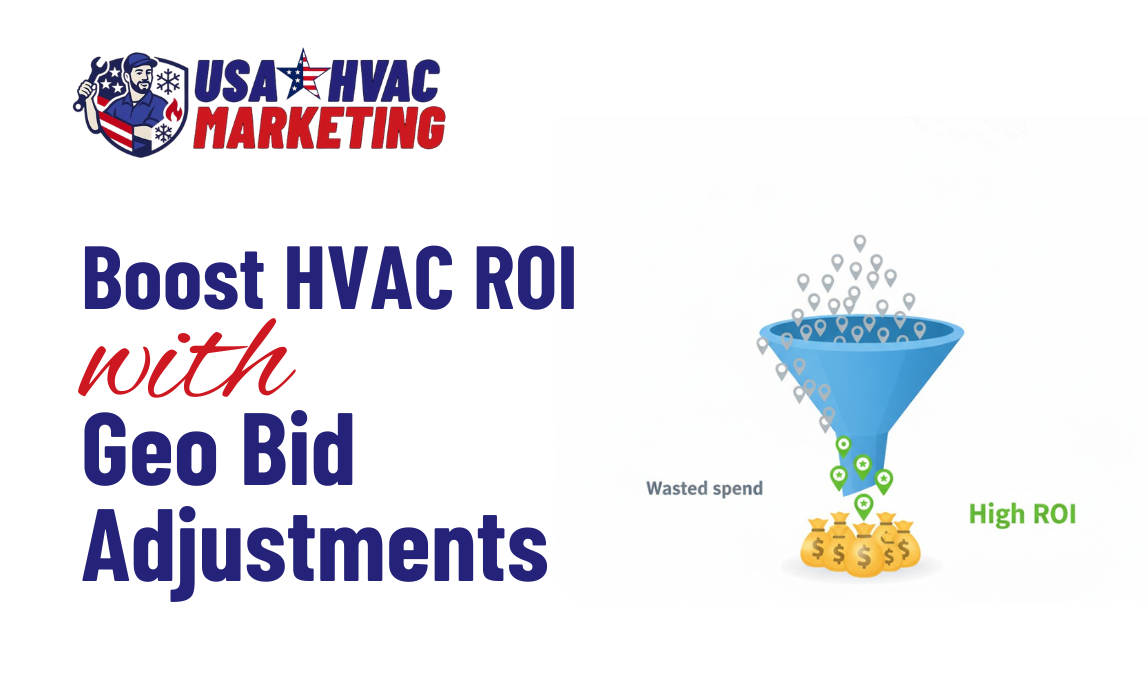
For an HVAC company that serves multiple locations, geographic bid adjustments are a fundamental tool for managing advertising spend effectively. Not all service areas are created equal; some zip codes will consistently generate higher-value jobs than others. Applying geographic bid adjustments in your pay-per-click (PPC) campaigns allows you to allocate more of your budget toward these profitable areas and reduce spending in less valuable ones. This strategy directly impacts your return on investment by focusing advertising dollars where they are most likely to convert into significant revenue, such as full system replacements or high-margin repairs.
This article explains how to use location-based bidding to improve your advertising results. Having managed numerous campaigns for multi-location HVAC businesses, USA HVAC Marketing has seen firsthand how a well-defined geographic strategy separates profitable campaigns from wasteful ones. The information here comes from practical application and analysis of what works in the HVAC market.
How Location-Based Bidding Works
Geographic bid adjustments are percentage-based increases or decreases you apply to your standard bids for specific locations. These locations can be as broad as a state or as granular as a zip code or radius around a point. The adjustment tells advertising platforms like Google Ads how much more or less you’re willing to pay for a click from a user in that particular area.
For example, if your standard maximum bid for the keyword “AC repair” is $50, a +20% bid adjustment for a high-value zip code means you’re willing to pay up to $60 for a click from a user in that area. Conversely, a -30% adjustment for a low-priority area means your maximum bid there would be just $35. According to Google, searches with local intent, such as “ac repair near me,” have grown significantly, making location targeting more important than ever.
Identifying Your Most Valuable Service Areas
The success of your geographic bidding strategy depends entirely on accurate data. You cannot guess which areas are best; you need to know. Use a combination of your internal business data and external market data to make informed decisions.
Analyze Your Own Job Data
Your most reliable source of information is your own customer history. Look at the last 12 to 24 months of job data and sort it by zip code. You should be looking for:
- Average Invoice Value: Which zip codes generate the highest-paying jobs?
- Job Type: Where are you getting more system replacements versus simple repairs?
- Profit Margin: Account for travel time and other costs. A high-invoice job far away might be less profitable than a medium-invoice job nearby.
- Lead-to-Booking Rate: Which areas produce leads that are more likely to turn into actual jobs?
Bonus Tip: Create a “value score” for each zip code by combining these factors. This gives you a clear, data-backed hierarchy of your service areas, making it simple to decide which locations deserve a higher bid.
Use External Demographic Data
Once you know where your best customers have come from, you can find other areas like them. Use demographic data to identify new promising territories. Key indicators for high-value HVAC customers often include:
- Homeownership Rate: Homeowners are your target audience, not renters.
- Median Household Income: Higher-income areas can more easily afford expensive repairs or replacements.
- Average Home Age: A study from the National Association of Home Builders found that the median age of owner-occupied homes is around 39 years. Older homes are far more likely to have aging HVAC systems.
The table below shows a simplified approach to setting bid adjustments based on location analysis.
| Location Profile | Dominant Housing Type | Average Home Age | Recommended Bid Adjustment | Rationale |
|---|---|---|---|---|
| Zone A (Urban Core) | Apartments, Condos | 10-20 Years | -25% | Lower ticket jobs (repairs), high renter population. |
| Zone B (Established Suburb) | Single-Family Homes | 30+ Years | +30% | Prime candidates for full system replacements. |
| Zone C (New Development) | New Single-Family Homes | 0-5 Years | -50% or Exclude | Systems are new and under warranty. |
| Zone D (Rural Outskirts) | Single-Family Homes | Varies | -15% | Higher operational costs due to drive time. |
Things to Consider Before Adjusting Bids
Making changes to your location bids isn’t something you should do without careful thought. Several factors can influence the right approach for your business.
Seasonality and Climate
HVAC demand is driven by the weather. In hot southern climates, you might bid more aggressively in all your service areas during the summer for AC repair calls. In northern states, the same logic applies to furnace repairs in the fall and winter. Be prepared to adjust your geographic strategy as the seasons change. For instance, a heatwave might make even a typically lower-value area temporarily profitable.
Competitor Saturation
Is a specific zip code dominated by a well-established competitor? If so, you might need to bid more aggressively to get visibility. Or, you might decide to apply a negative bid adjustment and focus your budget on areas with less competition where your dollar will go further. Use the auction insights report in Google Ads to see who you’re up against in different areas.
Budget Allocation and Drive Times
Always consider your operational capacity. It makes no sense to bid aggressively in an area that is a 90-minute drive for your technicians if it means you can’t properly service the profitable neighborhood right next to your office. Ensure your bid strategy aligns with your dispatching logic and technician availability.
Bonus Tip: Use tiered bidding based on distance from your office. For example, you can bid +15% for zip codes within a 10-mile radius, 0% for those 10-20 miles away, and -10% for anything further. This helps control fuel costs and improves response times.
Final Thoughts
A flat bidding strategy that treats all customers in all locations equally is an inefficient way to manage an advertising budget. By using geographic bid adjustments, multi-location HVAC companies can intelligently focus their resources on the neighborhoods and zip codes that actually drive profit. Start by analyzing your own job data, layer in market demographics, and continually refine your approach based on performance. This method ensures your marketing dollars are working as hard as your technicians.
Get a Professional Campaign Analysis
If you’re managing PPC campaigns across multiple service areas and aren’t using geographic bid adjustments, you are likely leaving money on the table. For a detailed analysis of your current advertising strategy, contact USA HVAC Marketing. Reach out via email at [email protected] or call (315) 907-5444 to see how a location-focused approach can work for you.
Frequently Questions About Geo-Bidding
How granular can my location targeting be?
You can target by country, state, city, county, and zip code. You can also use radius targeting, which allows you to target a specific distance (e.g., 20 miles) around your business address or any other point on the map. For most HVAC companies, zip code and radius targeting are the most effective.
Will negative bid adjustments stop my ads from showing completely?
A negative bid adjustment of -100% will effectively stop your ads from showing in that location. Any adjustment less than that (e.g., -90%) simply lowers your bid, making you less competitive in the ad auction but not removing you entirely.
What is a good starting bid adjustment?
If you have solid data indicating an area is high-value, starting with a +15% to +25% adjustment is a safe approach. For low-value areas, a starting adjustment of -20% to -40% is recommended.
Should I bid on competitor locations?
Targeting the area around a competitor’s physical office can be a smart tactic, but be prepared for higher costs. This is an advanced strategy that should only be used if you have a strong offer and a budget that can handle the increased competition.
Sources:
- About location bid adjustments — Google Ads Help: Google’s official guide explaining how location bid adjustments work, how to set them up, and when to use them to improve ad performance by region.
- Make Google Ads Bid Adjustments Like a Pro — KlientBoost: A detailed marketing guide showing how to optimize bids for different devices, times, and locations to maximize ad ROI for local and multi-location businesses.