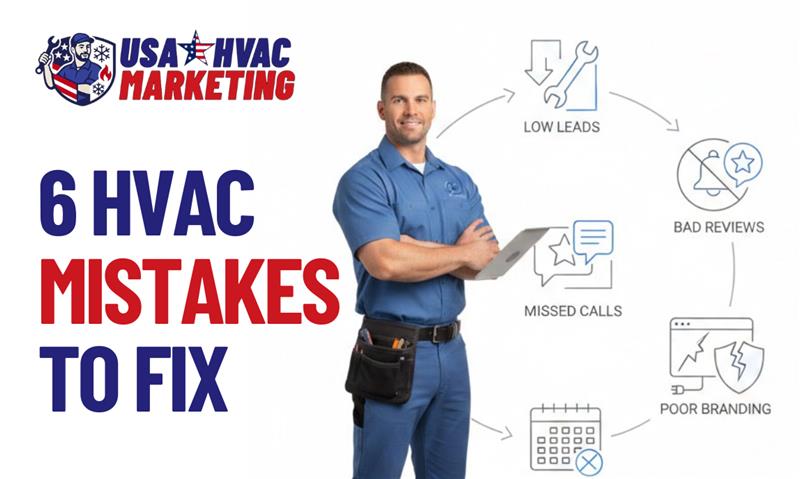
The most expensive errors HVAC businesses make involve neglecting speed-to-lead times, failing to optimize Google Business Profiles for local visibility, and ignoring critical retention and tracking strategies. These foundational gaps bleed revenue before a technician ever steps foot in a service van. Correcting these specific operational and digital flaws often yields a higher return on investment than increasing the advertising budget.
Successful HVAC marketing requires a tight integration between generating interest and operational execution. USA HVAC Marketing has analyzed data across the industry to identify where money leaks out of the funnel. This guide breaks down the specific areas where contractors lose leverage and explains how to plug those holes to protect profit margins.
Ignoring the “Speed to Lead” Rule
The single fastest way to lose revenue is a slow response time. When a homeowner’s AC breaks in July, they do not wait around. They call the next number on the list. Research indicates that waiting just five minutes to respond to a web lead drops the odds of contacting that lead by 10 times.
Many contractors treat web forms or emails as tasks to handle “when they get back to the office.” This delay allows competitors to swoop in. Implementing automated text message responses or using a dedicated call center service ensures immediate engagement.
Table: Impact of Response Time on Lead Qualification
| Response Time | Qualification Rate | Success Probability |
|---|---|---|
| < 5 Minutes | High | 80-90% |
| 10 Minutes | Moderate | 60-70% |
| 30 Minutes | Low | < 40% |
| > 1 Hour | Very Low | < 10% |
Data is extrapolated from industry response standards.
Bonus Tip: Set up an auto-responder for missed calls that sends a text message saying, “Sorry we missed you! How can we help with your heating or cooling needs?” This keeps the conversation alive.
Neglecting the Google Business Profile
Most homeowners find local services through Google Maps. An incomplete or unverified Google Business Profile renders a business invisible in the “Local Pack”—the top three map results shown above standard search links. Failing to post regular updates, ignoring questions, or leaving categories blank signals to Google that the business is inactive.
Google ranks local businesses based on relevance, distance, and prominence. While you cannot control distance, relevance and prominence are entirely within your control. According to Moz, Google Business Profile signals are the most significant driver of local pack visibility.
Seasonal Marketing Blindness
A common mistake involves turning marketing on and off like a light switch based on the weather. Many owners pause all advertising during shoulder seasons (spring and fall) to save money. This creates a “feast or famine” cycle.
Regional Guidance:
- Northeast/Midwest: Use the shoulder season (September/October) to push furnace tune-ups and heating maintenance agreements before the first freeze.
- South/Southwest: Use early spring (March/April) to market AC pre-season checks. The goal is to fill the board with maintenance calls that often turn into replacement opportunities before the rush hits.
Consistent marketing builds brand awareness so that when the temperature spikes, your company name is the first one customers recall.
Failing to Monetize the Existing Database
Chasing new customers costs significantly more than retaining existing ones. A massive revenue leak occurs when companies service a unit once and never contact that homeowner again. These customers already know and trust the technician.
Implementing an email or direct mail campaign to existing customers for seasonal check-ups usually yields a high conversion rate. Ignoring this asset forces the business to pay high customer acquisition costs for every single job.
Bonus Tip: Color-code your customer database by the age of their equipment. Send targeted offers for replacements specifically to customers with units older than 10 years.
Poor Review Management
Reputation drives revenue. A study by BrightLocal shows that 98% of people read online reviews for local businesses. Ignoring negative reviews or failing to ask happy customers for feedback creates a stagnant or declining rating.
A rating below 4.0 stars acts as a barrier to entry. Even if a potential customer sees an ad, they will likely check reviews before calling. If the competitors have 4.8 stars and you have 3.5, the ad spend is wasted. Actively requesting reviews after every successful service call builds a digital firewall against competitors.
Lack of ROI Tracking
Spending money on ads without tracking the results is financial negligence. Many contractors write checks for billboards, radio, or PPC without knowing which channel makes the phone ring. This results in “ghost spending,” where budget goes toward ineffective channels.
Using call tracking numbers and setting up proper conversion goals in Google Analytics provides clear data. If a specific campaign costs $1,000 but only brings in $500 in revenue, it must be cut immediately. Conversely, if a channel brings in $5,000 for every $1,000 spent, the budget should increase.
Internal Capacity Considerations
Before overhauling a marketing strategy, evaluate these internal factors to ensure the business can handle the potential growth.
- Technician Capacity: Do you have enough manpower to handle a 20% increase in call volume? Generating leads you cannot service damages your reputation.
- Dispatcher Training: Is the front office staff trained to convert calls into booked appointments? Marketing gets the phone to ring; dispatchers get the truck to the driveway.
- Cash Flow: Can the business sustain the upfront cost of a new campaign for 30 to 60 days before the revenue starts coming in?
Strategic Questions
Why are my leads not converting?
If the phone rings but the schedule remains empty, the issue lies with the CSR (Customer Service Representative) or the sales process, not the marketing. Listen to call recordings to identify training gaps.
Is SEO better than Pay-Per-Click?
They serve different purposes. PPC provides immediate leads but stops working when you stop paying. SEO builds long-term organic traffic but takes months to show results. A balanced strategy uses both.
Conclusion
Eliminating these six mistakes protects profit margins and stabilizes cash flow. Focusing on speed-to-lead, managing online reputation, and leveraging the existing customer base creates a sustainable growth model. HVAC owners should audit their current processes against these points to identify where immediate improvements will stop revenue leakage.
Need Help Fixing Your Marketing Strategy?
Stop guessing where your marketing budget is going. If you want to identify the leaks in your current strategy and start seeing real returns, contact the experts at USA HVAC Marketing. We specialize in helping contractors grow.
Email: [email protected]Frequently Asked Questions
What is the ideal marketing budget for an HVAC company?
Most residential contractors should allocate 5% to 10% of their gross revenue toward marketing. Companies in aggressive growth mode often spend up to 15% to capture market share.
How often should I post on social media?
Posting 2-3 times per week is sufficient. Focus on showcasing completed jobs, technician introductions, and community involvement rather than constantly pushing sales.
Do I really need a blog on my website?
Yes. Specific articles about local issues (like “Hard Water effects on humidifiers in [City Name]”) help search engines understand your service area and expertise, improving local rankings.
How do I handle a fake negative review?
Flag the review for removal if it violates platform policies. If it stays up, reply professionally, stating you have no record of the service and asking them to contact the office to resolve the issue. This shows other customers you are reasonable.
Sources:
- Moz – A comprehensive study on the factors that influence Google’s local search algorithm and map pack rankings.
- BrightLocal – Annual research regarding consumer behavior and the impact of online reviews on local business selection.