If you run an HVAC company, you already know the phones don’t ring by themselves. The market is crowded, the seasons are brutal, and the contractor down the street is spending money on ads you haven’t even heard of yet. This guide cuts through the noise and gives you a clear, practical roadmap for HVAC marketing that actually generates calls, booked jobs, and long-term revenue growth.
Whether you’re a one-truck operation trying to fill your schedule or a multi-tech company ready to dominate your metro area, this guide covers every channel, every budget level, and every strategy that’s working right now for HVAC contractors across the country.
What Is HVAC Marketing and Why Does It Matter for Contractors?
HVAC marketing is the process of promoting your heating, ventilation, and air conditioning services to homeowners and businesses in your service area so they call you when they need help. It includes everything from your Google Business Profile and your website to paid ads, social media, email campaigns, and the reviews customers leave about you online.
Here’s the hard truth: most HVAC calls go to whoever shows up first. When a homeowner’s AC dies on a 95-degree afternoon, they’re not scrolling through ten pages of Google results. They’re calling the first company they see, trust, and can reach. That’s what marketing does for you. It puts your name in front of the right person at exactly the right moment.
The HVAC industry in the United States is intensely local and intensely competitive. A report from IBISWorld shows there are over 100,000 HVAC contractors in the country, and most of them are fighting for the same zip codes you are. The contractors winning the most calls aren’t necessarily the best technicians, they’re the ones with the most visible, credible, and consistent marketing presence.
Without a deliberate marketing strategy, you’re relying entirely on word of mouth and repeat customers. Those are valuable, but they’re not predictable. A slow January or a mild summer can destroy your cash flow if you don’t have a steady pipeline of new leads coming in. Marketing solves that problem by creating demand on your schedule, not just when the weather cooperates.
How to Build a Local HVAC Marketing Strategy That Actually Works
Before you spend a dollar on ads or hire an HVAC marketing company, you need a strategy. Without one, you’re just guessing – and in this market, guessing is expensive.
A local HVAC marketing strategy starts with three questions: Who are your best customers? Where do they look for HVAC help? And how do you make sure they find you first?
Define your service area clearly Most HVAC contractors try to serve too large an area, which dilutes their marketing budget and makes it harder to dominate any single market. Pick your core zip codes – usually within a 20 to 30-mile radius of your shop – and focus your resources there before expanding.
Know your services and seasonality An AC installation in July and a furnace tune-up in November require completely different messaging. Your marketing calendar should map to your seasonal demand so you’re pushing the right services at the right time. Plan your campaigns at least 60 days in advance of peak seasons.
Build your marketing foundation first Before running a single ad, make sure your website is fast and mobile-friendly, your Google Business Profile is complete and optimized, and you have a system to collect and respond to customer reviews. These are the pillars that every other marketing channel depends on. Ads send people to your website. Reviews close the deal. If either is weak, you’re wasting money.
Set clear goals for each channel Not every marketing tactic has the same job. Some channels, like Google Search Ads, are designed to generate immediate calls. Others, like SEO and content marketing, build long-term visibility over months. Your strategy should include a mix of both so you have short-term leads coming in while you build long-term assets.
Track everything Use call tracking numbers for your ads so you know exactly which campaigns are driving calls. Set up Google Analytics on your website. Review your metrics monthly, cut what isn’t working, and double down on what is. The contractors who grow fastest aren’t the ones with the biggest budgets, they’re the ones who pay the closest attention to their data.
The Channels That Drive HVAC Leads
There isn’t a single marketing channel that guarantees success for HVAC contractors. What actually works in competitive local markets is a combination of different systems working together. Some channels bring immediate calls, while others build long-term visibility and brand authority. Understanding how each one contributes helps contractors avoid wasted spend and focus on what actually produces consistent inbound leads.
Google Search Ads: The Highest Intent Leads Money Can Buy
Google Search Ads appear when potential customers actively search for HVAC services like repairs or installations. These users already have intent, which is why this channel is often considered one of the fastest ways to generate calls.
Instead of paying for visibility, you only pay when someone clicks your ad. Costs vary depending on competition, location, and keyword demand, especially for emergency-related searches where urgency is high.
When properly structured with correct targeting, strong ad copy, and location filters, this channel can consistently generate leads at a predictable cost per acquisition. However, without proper setup, budgets can be wasted quickly, which is why many contractors rely on specialized management.
Local Services Ads (LSAs): The Fastest Way to Get Google Guaranteed
Local Services Ads are Google’s pay-per-lead product for service businesses, and they appear at the very top of search results – even above regular pay-per-click ads. The Google Guaranteed badge that appears next to your name tells customers that Google has verified your business, which dramatically increases click and call rates.
With LSAs, you pay per lead rather than per click. A cost analysis by WordStream suggests leads typically cost between $20 and $80 for HVAC services. You only pay for leads that come through the platform, and you can dispute leads that don’t qualify. This makes LSAs one of the most cost-effective lead generation tools available for HVAC contractors.
To qualify, you’ll need to complete Google’s verification process, which includes background checks, license verification, and insurance confirmation. This takes a few weeks but is worth doing as quickly as possible, since the Google Guaranteed badge significantly boosts consumer confidence.
SEO: The Slowest Start But the Best Long-Term ROI
Search engine optimization is the process of improving your website’s ranking in Google’s organic (non-paid) search results. When done well, SEO can put your HVAC company in front of thousands of local searchers every month without paying for every click.
The catch is time. Documentation from HubSpot indicates that HVAC SEO typically takes 6 to 12 months to produce significant results. You’re competing against established local businesses that have been building their online presence for years, and Google’s algorithm rewards consistency and authority over time. If you stop halfway through, you lose your progress.
But the long-term payoff is enormous. A contractor ranked in the top three organic results for “HVAC company [city name]” can receive dozens to hundreds of free calls per month. Unlike paid ads, that traffic doesn’t disappear the moment you stop spending. It’s an asset that keeps delivering as long as you maintain it.
Effective HVAC SEO includes local keyword optimization on your service pages, a well-optimized Google Business Profile with regular posts and photos, consistent citations across online directories, a fast and mobile-friendly website, and fresh content that answers the questions your customers are actually searching for. This pillar page you’re reading right now is an example of the kind of content that helps HVAC websites rank for high-value searches.
Local SEO: The Foundation of HVAC Lead Generation
Local SEO is what determines whether your HVAC business shows up in your city when someone searches for services like “AC repair near me” or “HVAC contractor in [city].”
Unlike general SEO, local SEO focuses specifically on map rankings and local intent searches. This includes your visibility in the Google Map Pack—the top 3 local listings that appear above organic results.
Key parts of strong HVAC local SEO include:
- Fully optimized Google Business Profile
- Consistent NAP (Name, Address, Phone) across directories
- Location-based service pages for each city you target
- High-quality local backlinks
- Regular reviews from real customers
- Geo-tagged photos and weekly Google posts
Local SEO is often what separates contractors who “exist online” from those who actually dominate their service area.
Website Optimization: Turning Traffic Into Actual Calls
No matter how much traffic your marketing generates, your website determines whether that traffic turns into real phone calls or lost opportunities.
Many HVAC contractors spend money on Google Ads, SEO, and social media but still struggle with lead volume because their website is slow, outdated, or confusing. If a homeowner lands on your site and cannot immediately see what you do, where you work, and how to contact you, they often leave and call the next company instead.
A high-converting HVAC website should include:
- Fast loading speed on mobile devices
- Clear click-to-call phone buttons
- Service pages for each HVAC service
- City pages for every target location
- Trust signals like reviews and certifications
- Simple contact forms above the fold
- Financing and emergency service messaging
Your website should not function like an online brochure. It should work like a 24/7 sales tool that helps convert visitors into booked service calls.
For many contractors, improving website conversion rates can generate more leads without increasing ad spend.
Social Media: Brand Awareness and Seasonal Pushes
Social media platforms like Facebook and Instagram don’t capture people actively searching for HVAC services the way Google does. Instead, they help you reach homeowners based on location, demographics, and interests through highly targeted ads.
Both platforms are part of the Meta ad system, which means you can run campaigns across Facebook and Instagram from the same dashboard. This makes them powerful for HVAC contractors who want to build brand awareness and promote seasonal offers.
Facebook is especially strong for:
- Local community targeting
- Lead generation ads (forms inside Facebook)
- Service promotions like tune-ups or maintenance plans
- Retargeting website visitors who didn’t convert
Instagram is more visual and works best for:
- Before-and-after HVAC installation photos
- Short reels showing work quality or job sites
- Branding and trust-building content
- Younger homeowner audiences and mobile users
Running HVAC social media ads typically costs between $500 and $3,000 per month depending on your service area and goals. The key is not just running ads but using strong visuals, clear offers, and sending traffic to dedicated landing pages instead of your homepage.
When used correctly, Facebook and Instagram don’t just generate leads, they build recognition so when homeowners are ready to buy, your company already feels familiar.
Email and SMS Marketing: The Cheapest Way to Win Back Old Customers
Your past customers are your most valuable marketing asset, and most HVAC contractors are not marketing to them consistently. If you’ve serviced a hundred homes in the past two years and you’re not sending those customers regular emails or text messages, you’re leaving significant revenue on the table.
Email and SMS marketing is inexpensive; most platforms cost between $30 and $150 per month depending on your list size. You can use these channels to send seasonal maintenance reminders, special offers for loyal customers, tips for keeping systems running efficiently, and referral requests. A single email campaign to past customers promoting a spring tune-up special can produce thousands of dollars in revenue for a minimal cost.
The key is to collect contact information at every service call and build your list consistently. Use your CRM or field service software to automate follow-up sequences so customers hear from you in the fall before the heating season and in the spring before cooling season, not just when they call with a breakdown.
Review Platforms and Directories: Free Visibility That Builds Instant Trust
Google, Yelp, Angi, HomeAdvisor, and the Better Business Bureau are platforms where homeowners research HVAC contractors before they make a call. A strong presence on these platforms is free visibility that builds trust before a customer ever reaches your website.
Your Google Business Profile is the most important of all. A complete profile with photos, regular posts, accurate hours, and a high review rating can outrank paid ads in local search results. Contractors with 100-plus reviews and a 4.8-star average consistently outperform competitors with fewer reviews, even when those competitors are spending more on ads.
Make asking for reviews a standard part of every service call. Train your technicians to ask happy customers to leave a review before they leave the job site. Use a simple text or email template that makes it easy for customers to click directly to your Google review page. Responding to every review (positive and negative) shows potential customers that you’re engaged and professional.
What to Look for in the Best HVAC Marketing Company
Hiring the right marketing partner can be the single best business decision you make. Hiring the wrong one can cost you tens of thousands of dollars and months of lost growth. Here’s what separates the best HVAC marketing companies from the pretenders.
Industry specialization matters A general digital marketing agency can help many types of businesses, but HVAC marketing has specific nuances: seasonal demand, emergency service keywords, local SEO competition, equipment-based targeting – that require specialized experience. Look for agencies that work primarily or exclusively with home service contractors and can show you real results from HVAC clients.
Transparent reporting is non-negotiable Any marketing company worth hiring will give you access to live dashboards, monthly performance reports, and clear metrics like cost per lead, call volume, and revenue attributed to their campaigns. If an agency is vague about performance data or makes you ask repeatedly for basic numbers, that’s a red flag.
Ask for references and case studies A legitimate HVAC marketing agency should be able to connect you with current or past clients who will speak honestly about their experience. Look for case studies that show specific results – calls generated, cost per lead, revenue growth – not just vague claims about improved visibility.
Look for a long-term partner, not a vendor The best agency relationships feel like having a dedicated marketing team without the overhead. Your agency should understand your business goals, know your service area, and proactively bring you new ideas. If your account manager changes every few months or you can never get someone on the phone, the relationship won’t deliver long-term value.
Be cautious of guarantees Any agency that guarantees you a number one ranking on Google or promises a specific number of leads before understanding your market is either uninformed or being dishonest. Good agencies set realistic expectations and explain what they can and cannot control.
Affordable HVAC Marketing: What Realistic Budgets Look Like
You don’t need to spend a fortune to get results from HVAC marketing, but you do need to spend enough to be competitive. Here’s how to think about the budget at each stage of your growth.
Entry Level If you’re just starting out or working with a tight budget, prioritize the channels with the highest immediate return: Google Business Profile optimization (free), getting to 25-plus Google reviews (free), and Local Services Ads with a budget of $500 to $800 per month. These three things alone can generate meaningful call volume in most markets without a big investment.
Long Term Once you’re generating consistent revenue and want to accelerate growth, add Google Search Ads to your mix. Start with a budget of $1,000 to $1,500 per month, monitor your cost per lead closely, and scale up as you identify which campaigns are performing.
Comparison Table
| Stage | Priority Channels | Estimated Monthly Budget |
|---|---|---|
| Just Starting Out | Google Business Profile (free) + LSAs | $500 – $800 |
| Ready to Grow | Add Google Search Ads | $1,000 – $1,500 |
| Scaling Up | Add SEO + Email Marketing | $2,000 – $4,000+ |
The key principle of affordable HVAC marketing is return on investment, not cost. A $2,000 per month marketing program that generates $15,000 in revenue is more “affordable” than a $500 per month program that generates $1,000. Focus on what it costs to acquire a job and what that job is worth, not on minimizing your marketing spend.
Trust Signals That Make Customers Call You
In the HVAC industry, trust is everything. Homeowners are letting a stranger into their house to work on equipment that controls their family’s comfort and safety. They want to know that the person they’re calling is licensed, reliable, professional, and honest. Your online reputation is how you communicate all of that before the phone even rings.
Google Reviews
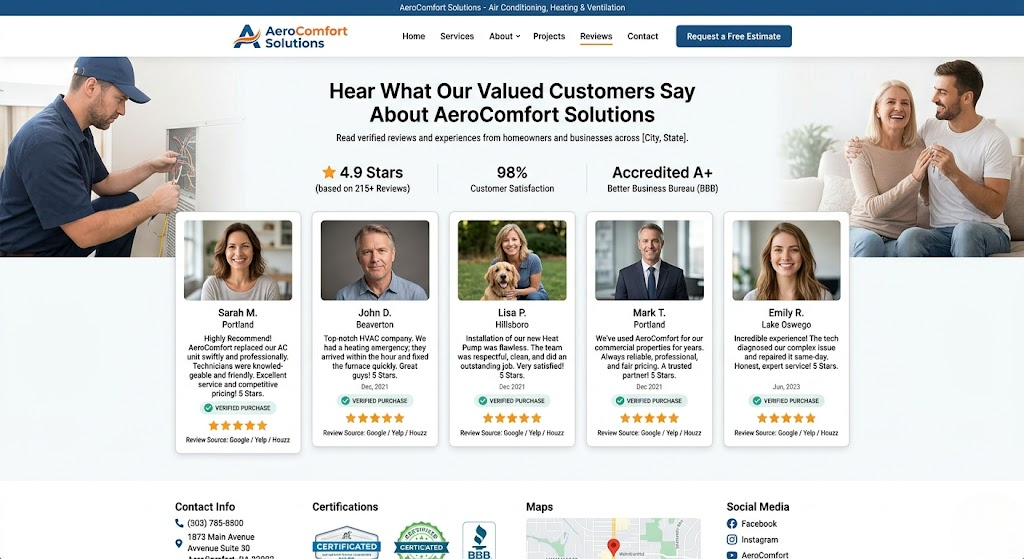
Google reviews are the most powerful trust signal in local HVAC marketing. Businesses with a large number of recent, positive reviews consistently win more calls than competitors with fewer or older reviews, even when those competitors have better websites or are spending more on ads. Data from a BrightLocal study highlights that most consumers read reviews before contacting a local service business, and star rating is often the deciding factor between two otherwise similar companies.
Building a strong review profile requires consistency. Don’t ask for reviews only when you remember to build it into your process at the end of every service call. A simple text message sent an hour after the technician leaves, with a direct link to your Google review page, is the highest-converting review request method most contractors use. Aim to collect at least four to six new reviews per month to stay ahead of the competition.
License Credentials
Beyond reviews, trust signals on your website matter enormously. Display your licenses and certifications prominently. Show photos of your actual team and trucks – not stock images. Feature a money-back guarantee or satisfaction guarantee if you offer one. Add trust badges from manufacturer certifications like Carrier, Lennox, or Trane. Include a clear statement of your service area so visitors immediately know you serve their neighborhood.
Online Presence
Social proof from third-party platforms like Angi, the BBB, and your local chamber of commerce adds credibility you can’t manufacture yourself. Make sure your profiles on these platforms are complete, accurate, and consistent with your website and Google listing.
Ready to Get More HVAC Leads? Here Is How to Start
You’ve read this entire guide, which means you’re serious about growing your HVAC business. Here’s a simple action plan to get started.
In the next seven days, audit your Google Business Profile. Make sure every field is complete, your photos are current, and your service area is accurate. Set up a simple review request system – even if it’s just a saved text message template – and start using it on every call.
In the next 30 days, evaluate your website. Is it fast? Is it mobile-friendly? Does it clearly communicate what you do, where you serve, and how to reach you? If not, fixing your website is the highest-priority marketing investment you can make.
Within 60 days, get your Local Services Ads account set up and verified. This is one of the fastest ways to start generating qualified calls, and the Google Guaranteed badge will immediately differentiate you from competitors who haven’t completed the process.
For ongoing growth, work with an experienced HVAC marketing agency that can manage your Google Ads, build your SEO presence over time, and help you make smarter decisions with your marketing budget. The right partner pays for itself many times over.
At USA HVAC Marketing, we work exclusively with HVAC contractors who are serious about growth. We understand the seasonality of your business, the competitiveness of local search, and what it actually takes to get your phone ringing consistently. Whether you need a full-service digital marketing strategy or just want help with a specific channel like Google Ads or SEO, we’re here to help.
Book a Free Strategy Call
Your competitors are already investing in marketing. Every week you wait is another week of missed calls and lost customers going to someone else.
Book a free strategy call with USA HVAC Marketing and find out exactly what it takes to dominate your local market and consistently get more HVAC leads.
Email us at [email protected].
FAQs
How much do HVAC contractors typically spend on marketing?
Most HVAC contractors spend between $1,000 and $3,000 per month on marketing, depending on their market size, competition, and growth goals. Many contractors start with a smaller budget, measure cost per lead carefully, and increase spending only after identifying which channels consistently produce profitable jobs.
How fast will I see results from HVAC marketing?
Google Ads and Local Services Ads can begin generating calls within the first week when campaigns are set up correctly. SEO usually takes 6 to 12 months to build momentum because rankings improve gradually over time. Most successful HVAC companies use both short-term and long-term strategies together.
Is social media worth it for HVAC companies?
Social media can support HVAC marketing, but it usually is not the strongest direct lead source. Platforms like Facebook and Instagram work better for seasonal promotions, brand awareness, and staying visible with past customers. They should support your marketing strategy, not replace search-based lead generation.
How many Google reviews do I need to compete?
Most HVAC contractors should aim for at least 50 Google reviews with a rating of 4.7 stars or higher. In more competitive markets, top-ranking companies often have more than 100 reviews. The most important factor is collecting new reviews consistently so your profile stays active and trustworthy.
Can I do HVAC marketing myself or do I need an agency?
Many contractors can manage the basics themselves, including Google Business Profile updates, review requests, and simple social media posting. However, channels like Google Ads and SEO require technical experience. In many cases, contractors spend more money fixing mistakes than they would have spent hiring an experienced HVAC marketing specialist from the start.
Sources
- IBISWorld: A market research firm providing comprehensive industry reports and statistics on the US HVAC contractor market.
- WordStream: A leading search marketing resource that analyzes cost-per-lead and performance metrics for Google Local Services Ads.
- HubSpot: A global CRM and marketing platform that provides detailed research on search engine optimization timelines and benchmarks.
- BrightLocal: A local SEO authority that publishes annual consumer research regarding the impact of online reviews on local businesses.