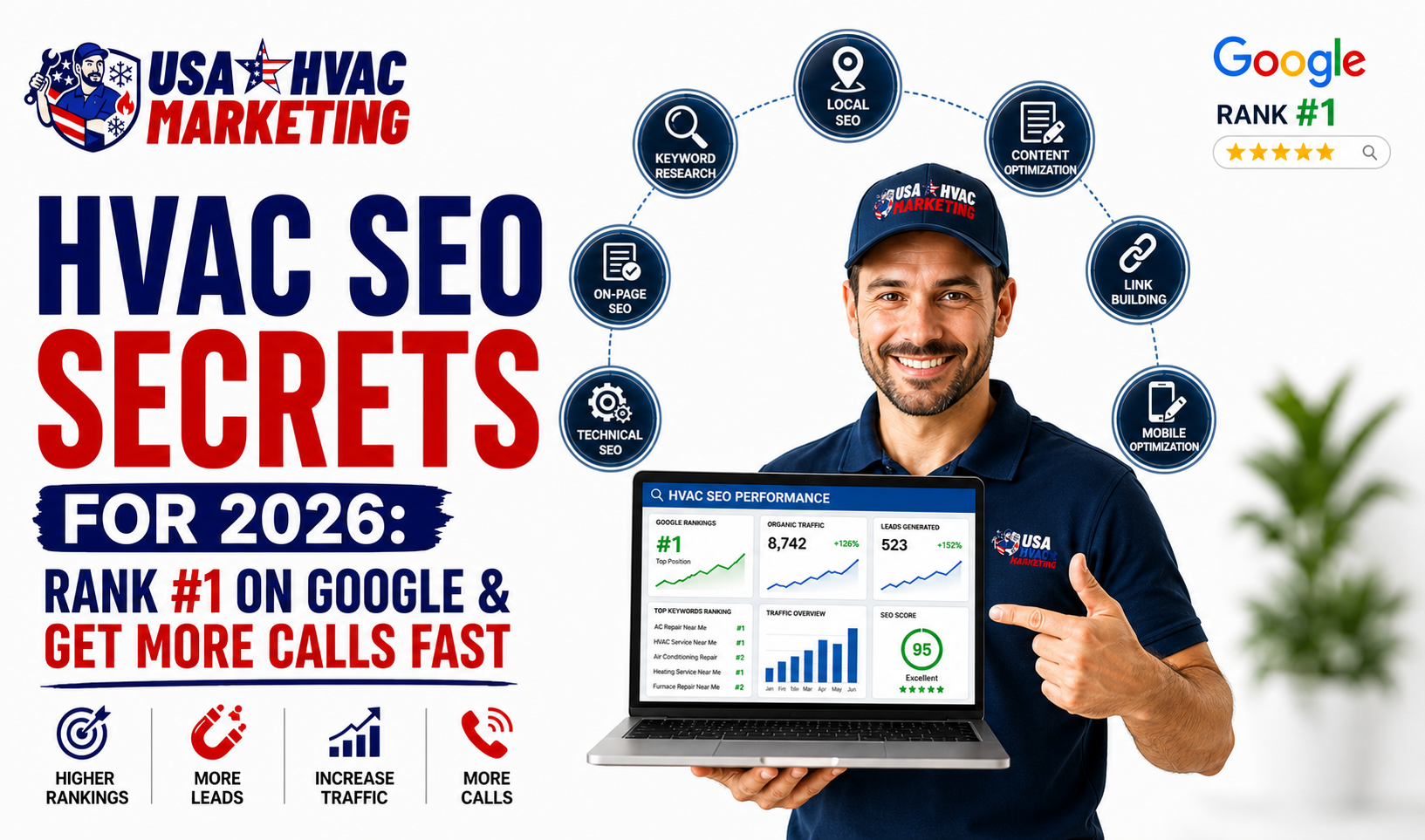
HVAC SEO is a long-term strategy that helps contractors rank higher on Google, get more local calls, and reduce dependency on paid ads. Below are the most common questions HVAC business owners ask when planning their SEO strategy.
Why HVAC SEO Matters for Contractors in 2026
The HVAC industry has never been more competitive online. Homeowners and facility managers no longer flip through phone books or rely on neighbor referrals as their first step. They go straight to Google. Searches like “AC repair near me,” “furnace installation [city],” and “emergency HVAC service” generate millions of queries every month across North America alone. If your business is not showing up in those results, your competitors are capturing every one of those leads.
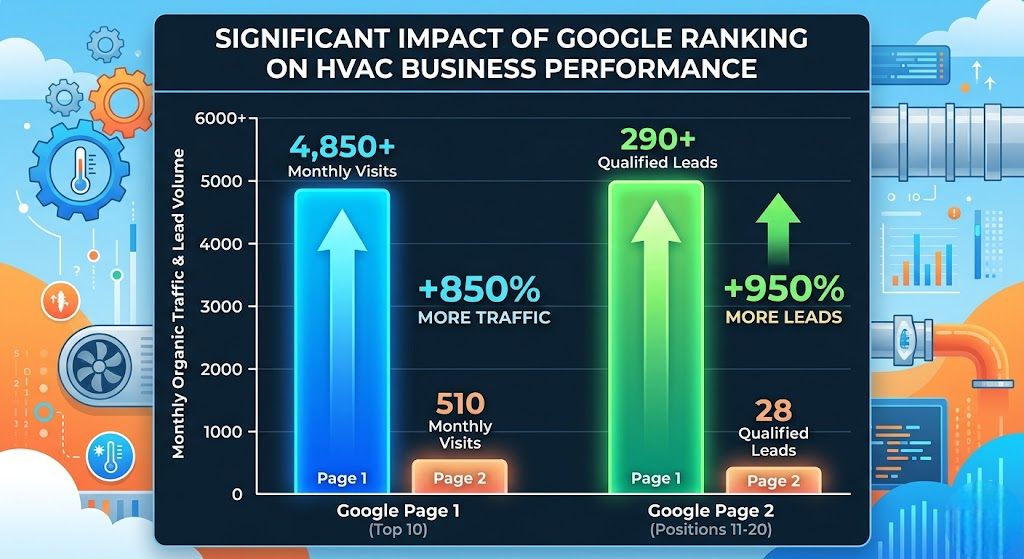
Consider the numbers. According to a study by BrightLocal, more than 90 percent of consumers begin their search for a local service provider online. HVAC companies that rank on the first page of Google consistently receive 10 to 20 times more website traffic than those on page two or beyond. With the average HVAC job worth anywhere from $300 for a tune-up to $12,000 or more for a full system replacement, even a handful of additional calls per month can translate into tens of thousands of dollars in additional annual revenue.
The demand for HVAC services is also growing. Climate change is extending extreme weather seasons, aging housing stock requires more frequent servicing, and commercial buildings face stricter indoor air quality standards. This sustained demand means the contractors who invest in SEO now will be positioned to capture a disproportionate share of the market for years to come. Meanwhile, contractors relying solely on word-of-mouth or paid ads are finding those channels increasingly expensive and unpredictable.
HVAC SEO is not a marketing expense. It is a long-term asset that compounds in value over time, delivering leads month after month without a recurring cost per click.
What Is HVAC SEO and How It Generates Consistent Leads
Search Engine Optimization (SEO) for HVAC companies is the process of improving your website and online presence so that Google ranks your business prominently when potential customers search for heating, cooling, ventilation, and air quality services in your area.
Insights from Search Engine Journal explain that SEO builds organic authority that continues to generate traffic over time, unlike paid advertising (PPC), where you pay for every click and your visibility disappears the moment you stop spending. A well-optimized HVAC website becomes a 24/7 lead generation machine, answering customer questions, showcasing your expertise, and driving calls and form submissions even while you sleep.
The HVAC SEO process works through several interconnected channels:
- Keyword Research: identifying the exact terms your customers search for
- On-Page Optimization: structuring your pages so Google clearly understands what you offer
- Technical SEO: ensuring your website loads fast, is mobile-friendly, and is easy for Google to crawl
- Local SEO: dominating Google Maps and local pack results for searches in your service area
- Content Marketing: publishing helpful articles and guides that attract visitors at every stage of the buying journey
- Link Building: earning mentions from authoritative local and industry websites to build your domain credibility
When these elements work together, your HVAC business shows up consistently for the searches that matter most, driving a steady stream of qualified, purchase-ready leads.
HVAC SEO Services Explained (What You Actually Get)
When you invest in professional HVAC SEO services, you are purchasing a comprehensive strategy, not just a few tweaks to your website. Understanding what these services entail helps you evaluate providers and set realistic expectations.
On-Page SEO
On-page SEO covers everything visible on your website that influences rankings. This includes optimizing your page titles, meta descriptions, heading structure, and body content to target the right keywords. For HVAC companies, this means creating dedicated service pages for AC installation, furnace repair, heat pump services, ductwork, and every other offering you provide. Each page should target a specific set of keywords and be written to satisfy both search engines and potential customers.
Technical SEO
Technical SEO addresses the behind-the-scenes factors that affect how well Google can find and understand your website. Site speed, mobile responsiveness, secure HTTPS connections, structured data (schema markup), XML sitemaps, and crawl error resolution all fall under this category. For HVAC websites, technical issues are a surprisingly common reason for poor rankings. A slow page or a broken mobile experience can erase the benefit of even excellent content.
Local SEO
Local SEO is perhaps the most critical component for HVAC contractors. This involves optimizing your Google Business Profile, building consistent citations across online directories, earning and responding to customer reviews, and creating geo-specific landing pages for every city or neighborhood you serve. Ranking in Google’s local map pack results dramatically increases visibility and drives direct calls from high-intent customers.
Content SEO
Content SEO involves publishing blog posts, guides, FAQs, and educational articles that attract visitors searching for HVAC-related information. Topics like “how often should I service my HVAC system,” “signs your AC needs replacement,” or “SEER rating explained” draw in homeowners who are actively researching. A consistent content strategy builds topical authority and signals to Google that your website is a comprehensive resource on all things HVAC.
How An HVAC SEO Company Helps You Rank Faster
Partnering with a dedicated HVAC SEO company accelerates results in ways that DIY efforts simply cannot match. The difference comes down to specialized knowledge, professional tooling, and dedicated bandwidth.
Strategy vs. DIY SEO
Most HVAC business owners who attempt SEO on their own face the same challenges: limited time, steep learning curves, and a rapidly changing algorithm landscape. What worked two years ago may actually hurt your rankings today. A professional HVAC SEO company brings a proven, up-to-date strategy tailored to the competitive dynamics of your local market. They know which keywords convert, which link-building tactics are safe, and how to structure your site for maximum crawl efficiency.
Tools They Use
Professional SEO agencies invest in enterprise-level tools, including Ahrefs, SEMrush, Moz, Screaming Frog, and Google Search Console, that provide data most businesses cannot cost-effectively access on their own. These tools reveal what keywords your competitors rank for, which pages on your site need improvement, how your backlink profile compares to top-ranking competitors, and where technical issues are costing you rankings.
Reporting and Accountability
Reputable HVAC SEO companies provide transparent monthly reports covering keyword ranking progress, organic traffic trends, lead volume, and return on investment. This data-driven approach ensures you always know what is working, what is being tested, and where your budget is going. It also creates accountability so your SEO partner is motivated to deliver measurable results.
An experienced HVAC SEO company typically achieves results 2 to 3 times faster than DIY approaches, thanks to proven processes and access to proprietary data.
Choosing the Best HVAC SEO Company for Your Business
Not all SEO agencies are created equal, and choosing the wrong partner can cost you time, money, and rankings. Here is what to look for when evaluating the best HVAC SEO company for your specific needs.
Industry Experience
The best HVAC SEO companies have a track record specifically in the trades. They understand the seasonal nature of HVAC demand, the geographic specificity of service areas, and the nuances of HVAC keyword intent. Ask any prospective partner how many HVAC clients they currently work with and for how long.
Case Studies and Proven Results
Request case studies from HVAC or home services clients. Look for documented evidence of ranking improvements, traffic growth, and most importantly, lead generation increases. Vanity metrics like “more impressions” matter far less than actual phone calls and form submissions from qualified leads.
Industry Focus and Specialization
Generalist marketing agencies may be capable, but niche SEO firms that specialize in HVAC and trades have a critical advantage. They have already solved the problems you are facing for other clients. They know your competitors, understand seasonal keyword trends, and have content templates proven to rank in your industry. USA HVAC Marketing is one such firm, built exclusively around helping HVAC contractors dominate their local markets through search.
ROI-Focused Approach
The best HVAC SEO company ties its strategy directly to your business goals. Revenue growth, cost per lead, and return on SEO investment should be the primary metrics, not just rankings for their own sake. Ask how they measure success and ensure their definition aligns with yours.
Local SEO for HVAC Contractors (Dominate Your City Rankings)
For most HVAC contractors, local SEO is the highest-leverage SEO activity available. Ranking in Google’s local map pack, the three business listings that appear above organic results for local searches, can double or triple your inbound call volume almost overnight.
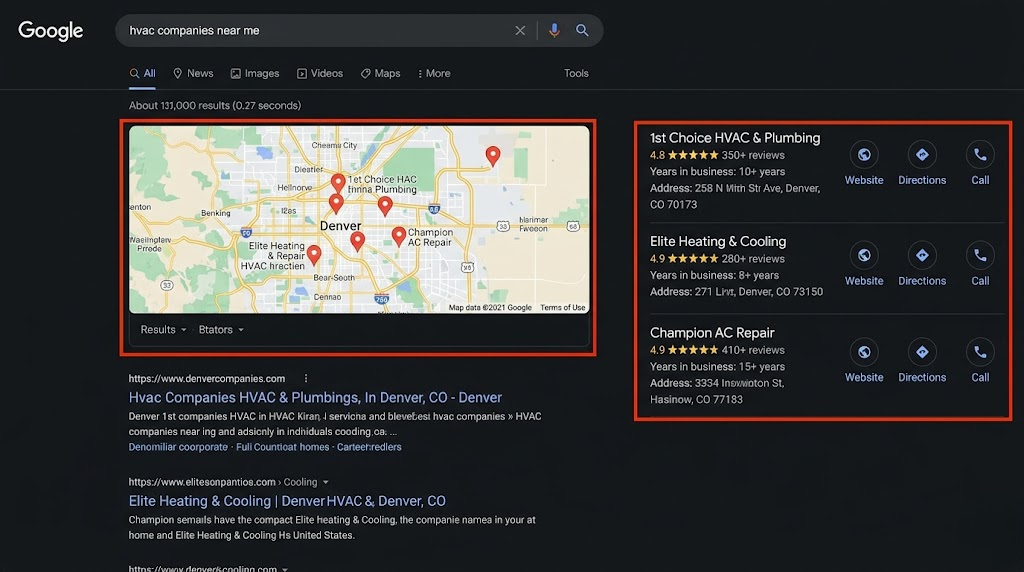
Google Business Profile Optimization
Your Google Business Profile (GBP) is the cornerstone of local SEO for HVAC contractors. Documentation from Google Business Profile Help emphasizes that you must ensure your profile is fully complete with an accurate business name, address, and phone number. Select all relevant service categories, upload high-quality photos of your team, trucks, and completed work, write a compelling business description with target keywords, and respond actively to questions and reviews.
Map Pack Ranking Factors
Google’s local algorithm weighs three primary factors: relevance (does your profile match what the searcher is looking for?), distance (how close are you to the searcher?), and prominence (how well-known and trusted is your business online?). Improving your GBP completeness, building local citations, and earning reviews all directly improve these signals.
Reviews and Reputation Management
Reviews are one of the most powerful local ranking signals. HVAC companies with 50 or more recent, positive reviews consistently outrank competitors with fewer reviews, even when other factors are comparable. Build a systematic process for requesting reviews from satisfied customers immediately after job completion. A simple text or email with a direct link to your GBP review page dramatically increases response rates.
Local Citations
Citations are mentions of your business name, address, and phone number (NAP) on external websites, including directories like Yelp, Angi, HomeAdvisor, and the BBB. Consistent, accurate NAP information across all citations builds trust with Google and strengthens your local authority. Audit your citations regularly to correct any discrepancies.
Geo-Specific Landing Pages
If you serve multiple cities or neighborhoods, create dedicated landing pages for each location. A page targeting “AC repair in [City Name]” with locally relevant content, testimonials from customers in that area, and area-specific calls to action signals to Google that you serve that geography, dramatically improving your chances of ranking for searches from that location.
HVAC Website SEO Optimization (Technical + On-Page Guide)
Your website is the foundation of your entire HVAC digital presence. Without proper HVAC website SEO optimization, even the best content and link-building efforts will underperform. Here is a comprehensive guide to the technical and on-page factors that matter most.
Site Speed
Documentation from Google Search Central confirms that Google has made page speed a confirmed ranking factor, and HVAC customers searching on mobile will abandon a slow-loading site within seconds. Target a Largest Contentful Paint (LCP) of under 2.5 seconds. Achieve this by compressing images using WebP format where possible, minimizing JavaScript, enabling browser caching, using a fast hosting provider, and implementing a Content Delivery Network (CDN). Test your speed monthly using Google PageSpeed Insights.
Mobile UX
More than 60 percent of HVAC searches happen on mobile devices, often from customers in urgent situations. Your website must be fully responsive with click-to-call buttons prominently displayed, easy navigation, readable text without zooming, and forms that work flawlessly on touchscreens. Google mobile-first indexing means your mobile experience is what Google actually evaluates when determining rankings.
Schema Markup
Schema markup is structured data code that helps Google understand the content of your pages. For HVAC websites, implementing LocalBusiness schema, Service schema, Review schema, and FAQ schema provides additional context to search engines and can earn rich snippets, which are enhanced search results with star ratings, prices, or FAQs displayed directly in Google, dramatically improving click-through rates.
Internal Linking
A strategic internal linking structure distributes link equity across your site and helps Google discover and understand all of your pages. Link from blog posts to relevant service pages, connect service pages to your contact page, and use descriptive anchor text such as “AC installation services in Phoenix” rather than “click here.” A well-structured internal linking architecture also improves user experience by guiding visitors to the information they need.
Service Page Structure
Each service page should follow a proven structure: keyword-rich H1 heading, introductory paragraph addressing the customer’s need, detailed description of the service, FAQ section addressing common questions, customer testimonials, and a prominent call to action. This structure satisfies both Google’s content quality requirements and the informational needs of a potential customer considering hiring you.
HVAC Lead Generation SEO (Turning Rankings Into Leads)
Ranking on page one is a milestone, but HVAC lead generation SEO is about what happens after someone clicks your link. Converting organic traffic into actual leads requires deliberate optimization beyond just getting to the top of Google.
Conversion Rate Optimization
Start by auditing your highest-traffic pages to identify where visitors are dropping off. Tools provided by Hotjar reveal exactly where users click, scroll, and exit. Use this data to make targeted improvements such as moving contact forms higher on the page, adding urgency messaging for emergency services, or simplifying navigation to reduce decision fatigue.
Landing Pages for Every Intent
Create dedicated landing pages for your highest-value service and location combinations. A page for “AC installation in [City]” targeting homeowners ready to buy should look and feel different from a page answering “how does central air conditioning work” that targets early-stage researchers. Matching the page content and design to the searcher’s intent at each stage of the buying journey is fundamental to HVAC lead generation SEO.
CTA Optimization
Your call to action is the hinge between traffic and leads. Test different CTA variations including “Get a Free Estimate,” “Schedule Your Service Today,” and “Call Now for Same-Day Service” to identify which language drives the highest response in your market. Make CTAs visually prominent, place them above the fold and after key sections of text, and ensure they are optimized for mobile tap targets.
Tracking and Attribution
You cannot improve what you do not measure. Set up Google Analytics 4 with goal tracking for form submissions, click-to-call events, and chat initiations. Connect Google Search Console to identify which queries are driving traffic and conversions. Combine this data with call tracking to build a complete picture of your SEO-driven lead flow and use it to make informed decisions about where to invest next.
Keyword Strategy for HVAC SEO (How Contractors Actually Rank)
A successful HVAC keyword strategy goes far beyond targeting generic terms like “HVAC company.” Contractors who rank and stay ranked build a comprehensive keyword architecture that captures demand at every stage of the customer journey.
Service Keywords
Service keywords are the foundation: AC repair, furnace installation, heat pump service, duct cleaning, air quality testing, and HVAC maintenance plans. Create a dedicated page for each service, optimized for its primary keyword and a cluster of related terms. Avoid the common mistake of trying to rank a single homepage for every service you offer.
City and Service Combos
Search terms like “AC repair Dallas,” “furnace installation Chicago,” and “HVAC company near me” combine high purchase intent with geographic specificity. They are the most valuable terms in HVAC SEO. Build geo pages for every city, suburb, and neighborhood in your service area and optimize each one for relevant local keyword combinations.
Long-Tail Keywords
Long-tail keywords are more specific, lower-volume phrases that often convert at higher rates than broad terms. Queries like “how much does it cost to replace an AC unit in [city],” “best HVAC brand for humid climates,” and “why is my furnace making a banging noise” come from customers who are deep in the research process and close to making a purchase decision. Blog posts and FAQ content targeting these terms build topical authority while capturing high-intent traffic.
Seasonal Keywords
Industry analysis from WordStream notes that HVAC demand is inherently seasonal. AC tune-up searches spike in spring, furnace repair searches surge in fall and early winter. Plan your content calendar to publish seasonal content 6 to 8 weeks before the relevant season begins, giving Google time to index and rank your pages before demand peaks. This seasonal keyword strategy is one of the most underutilized opportunities in HVAC SEO.
On-Page SEO Checklist for HVAC Websites
Use this checklist to audit and optimize every page on your HVAC website. Each element listed has a direct impact on how well Google understands and ranks your content.
| Page Element | Best Practice | Priority Level |
|---|---|---|
| Page Title | Primary keyword near start, under 60 characters, unique per page | Critical |
| Meta Description | 150 to 160 characters, includes keyword and a clear call to action | Critical |
| H1 Tag | One per page, contains primary keyword naturally | Critical |
| H2 / H3 Tags | Include related and semantic keywords, break content into scannable sections | High |
| Body Content | Minimum 500 words per service page, written for humans first | High |
| Image Alt Text | Descriptive and keyword-aware for every image on the page | Medium |
| Image File Names | Descriptive names (e.g., ac-repair-dallas.jpg) instead of IMG_1234.jpg | Medium |
| Internal Links | Link to relevant service and location pages using descriptive anchor text | High |
| Schema Markup | LocalBusiness, Service, FAQ, and Review schema where applicable | High |
| Page Speed | Largest Contentful Paint under 2.5 seconds, compress all images | Critical |
Technical SEO for HVAC Websites (Behind-the-Scenes Ranking Factors)
While on-page SEO is visible to users, technical SEO happens in the background. For many HVAC websites, it is where the most significant ranking improvements are hiding.
Crawlability and Indexing
Google must be able to find and index your pages before it can rank them. Submit an XML sitemap through Google Search Console, review your robots.txt file to ensure important pages are not blocked, and use the URL Inspection tool to confirm key pages are properly indexed. Orphan pages, meaning pages with no internal links pointing to them, are commonly missed by Google’s crawlers and should be integrated into your site architecture.
Core Web Vitals and Speed
Google’s Core Web Vitals, which include Largest Contentful Paint, Interaction to Next Paint, and Cumulative Layout Shift, are official ranking factors. HVAC websites typically struggle with LCP due to unoptimized hero images and CLS caused by ads or dynamically loaded elements. Address these through image optimization, lazy loading, and reserved space for dynamic content.
Schema Markup Implementation
Beyond LocalBusiness schema, implement Service schema for each service page including price ranges where appropriate, FAQPage schema for FAQ sections, Review schema to display aggregate ratings, and BreadcrumbList schema to improve navigation display in search results. Properly implemented schema can meaningfully increase click-through rates from the same ranking position.
Mobile-First Indexing
Since Google switched to mobile-first indexing, the mobile version of your site is what Google evaluates for rankings. Conduct regular mobile usability audits using Google Search Console’s Mobile Usability report and test your pages on multiple device sizes. Ensure that all content, images, and structured data present on your desktop site are also fully accessible on mobile.
Link Building Strategy for HVAC Contractors
Research from Backlinko confirms that backlinks, which are links from other websites to yours, remain one of Google’s most powerful ranking signals. For HVAC contractors, a targeted local link building strategy is far more effective than pursuing generic links.
Local Backlinks
Partner with complementary local businesses such as real estate agents, home builders, property managers, plumbers, and electricians for mutual referral links and co-marketing content. Sponsor local events, youth sports teams, or community organizations that list sponsors on their websites. These local backlinks signal geographic authority and strengthen your local rankings directly.
Directories and Citations
Ensure your HVAC business is listed in all major directories: Google Business Profile, Yelp, Angi, HomeAdvisor, Houzz, BBB, Thumbtack, and industry-specific directories like ACCA. Each citation is a link or at minimum a NAP mention that contributes to your local authority. Consistency of business information across all listings is essential.
Industry Links
Links from HVAC industry websites, such as manufacturer partner pages for Carrier, Lennox, and Trane, ACCA membership pages, and NATE certification directories, carry significant authority. Pursue these by maintaining your certifications and registering as an authorized dealer with the brands you carry. These links are highly relevant, meaning they pass maximum authority for HVAC-related searches.
Common HVAC SEO Mistakes That Kill Rankings
Awareness of common pitfalls can save you months of lost progress and wasted budget. Here are the most damaging HVAC SEO mistakes contractors make:
- Thin Content: Single-paragraph service pages with no depth signal low quality to Google and fail to answer the questions customers are actually asking. Every service page needs substantive, helpful content at a minimum of 500 words.
- No Local SEO: Neglecting your Google Business Profile, skipping citation building, and failing to create geo-specific pages leaves your local competitors to capture all the high-intent, purchase-ready traffic in your area.
- No Tracking: Running SEO without analytics, call tracking, or conversion tracking means you have no idea what is working. Without data, you cannot make informed optimization decisions or demonstrate ROI.
- Wrong Keywords: Targeting only broad, highly competitive terms like “HVAC company” while ignoring high-intent local and long-tail keywords means you compete against national brands with far more authority while missing easier wins.
- Duplicate Content: Using manufacturer-provided boilerplate descriptions or copying content between location pages confuses Google and can result in ranking penalties. All content must be unique and specifically written for its target page and audience.
- Ignoring Reviews: In local SEO, review volume and recency are critical ranking factors. HVAC companies that do not actively cultivate reviews are voluntarily ceding ground to competitors who do.
How Long HVAC SEO Takes to Show Results
One of the most common questions HVAC contractors have when starting SEO is how long it takes to see results. The table below provides a realistic timeline based on industry experience across hundreds of HVAC campaigns.
| Phase | What Happens | What to Expect | ROI Signal |
|---|---|---|---|
| Months 1 to 3 | Technical fixes, GBP setup, citations, initial content | Impressions up, early keyword movement | Building |
| Months 3 to 6 | Pages reach pages 2 to 3, local pack appears for easier terms | Modest organic traffic increase | Growing |
| Months 6 to 12 | Page-one rankings for service and location keywords | Steady call volume from organic | Strong |
| Year 2 onward | Authority compounds, ranking for competitive metro terms | 3 to 5x ROI vs. comparable PPC spend | Compounding |
The contractors who see the fastest results are those who start with a technically sound website, produce consistent content, and actively build their local reputation through reviews and citations. Google’s algorithm rewards commitment and quality over shortcuts.
HVAC SEO Pricing: What Contractors Should Expect
Understanding HVAC SEO pricing helps you evaluate agency proposals and budget appropriately for a genuine return on investment. The table below compares SEO to paid advertising so you can make a well-informed channel decision.
| Factor | HVAC SEO | Google PPC |
|---|---|---|
| Upfront Cost | Medium (retainer) | High (per-click charges immediately) |
| Time to Results | 3 to 6 months | Immediate |
| Lead Cost Over Time | Decreases as authority grows | Stays high or increases |
| Visibility Duration | Persists after work stops | Ends when budget runs out |
| Click Cost (HVAC) | No per-click cost | $15 to $60 per click in most markets |
| Long-Term ROI | 3 to 5x PPC by year 2 | Flat, no compounding effect |
Monthly Retainer Ranges
Professional HVAC SEO services are typically priced on a monthly retainer basis. Entry-level retainers for small, single-location contractors in less competitive markets begin around $1,000 to $1,500 per month. Mid-market campaigns targeting multiple service areas or competitive metros typically range from $2,000 to $4,000 per month. Enterprise-level campaigns for large multi-location HVAC companies may range from $5,000 to $10,000 or more per month. Retainers below $800 per month rarely deliver meaningful results due to insufficient bandwidth for content creation, link building, and ongoing optimization.
A single new HVAC system installation worth $8,000 to $12,000 can more than cover a month’s SEO retainer. When you factor in the lifetime value of a recurring maintenance customer, the ROI of HVAC SEO becomes even more compelling as your authority grows year over year.
Final Strategy: How to Dominate HVAC SEO in 2026
The HVAC contractors who will dominate search results in 2026 and beyond are those who treat SEO as a core business strategy, not an afterthought. The path to the top of Google is not a secret. It requires doing the fundamentals consistently and well.
Start with your technical foundation. Ensure your website is fast, mobile-optimized, and free of crawl errors. Build out a complete service page structure with dedicated, conversion-optimized pages for every service and location you cover. Optimize your Google Business Profile and pursue a consistent review acquisition strategy. Publish helpful content that answers the questions your customers are already asking. Build local authority through citations, local partnerships, and industry directories.
Then measure everything. Track rankings, traffic, call volume, and cost per lead. Use the data to double down on what is working and fix what is not. Partner with an HVAC SEO specialist who brings industry-specific expertise, proven processes, and transparent reporting.
The competition for HVAC leads online is intense, but it is also winnable. The majority of your local competitors are still relying on word-of-mouth, outdated websites, or expensive paid advertising. A sustained, intelligent SEO strategy gives you a durable competitive advantage that grows stronger every month.
Every month you delay is another month your competitors are building the rankings that should belong to your business. The best time to start is now.
Ready to grow your HVAC business through search? The team at USA HVAC Marketing is ready to build a custom SEO strategy around your service area, your goals, and your budget. Reach out today and start turning Google rankings into real revenue.
Frequently Asked Questions About HVAC SEO
How Long Does HVAC SEO Take to Generate Leads?
Most HVAC contractors begin seeing ranking improvements within 3 to 6 months, with consistent lead flow typically building between months 6 and 12. Competitive metro markets can take up to 18 months for top map pack positions.
What Is the Difference Between HVAC SEO and Google Ads?
Google Ads delivers immediate visibility but charges per click and stops the moment your budget runs out. HVAC SEO builds organic authority that persists and improves over time, making it significantly more cost-effective in the long run.
How Much Do HVAC SEO Services Cost Per Month?
Most HVAC SEO retainers range from $1,000 to $5,000 or more per month depending on market competition and scope. Retainers below $800 per month rarely include enough work to produce meaningful results.
What HVAC Keywords Should I Target to Get More Local Calls?
Focus on city and service combinations like “AC repair [your city]” and “furnace installation [your city]” for the highest purchase intent. Layer in long-tail and seasonal keywords to capture customers at every stage of the buying journey.
Do HVAC Companies Really Need Local SEO or Is a Website Enough?
A website alone is not enough. Local SEO controls your Google Business Profile map pack rankings, which appear above organic results and capture the largest share of urgent, ready-to-book searches in your area.
Sources
- BrightLocal: A primary resource for local SEO research and annual consumer surveys regarding search behavior and review trust.
- Search Engine Journal: An authoritative digital marketing publication providing deep dives into SEO strategy and industry trends.
- Google Business Profile Help: Official documentation from Google regarding the optimization and management of local business listings.
- Google Search Central: The official portal for Google’s search algorithms and technical documentation regarding ranking factors like site speed.
- Hotjar: A leading provider of behavior analytics software specializing in website heatmaps and conversion rate optimization data.
- WordStream: A digital advertising platform that provides data-driven marketing guides and seasonal keyword analysis for the home services industry.
- Backlinko: A highly-regarded SEO research site that publishes comprehensive studies on search engine ranking factors and backlink authority.