If your HVAC company is not showing up when local homeowners search for heating and cooling help, you are losing jobs to competitors every single day. Local SEO for HVAC contractors is no longer optional. It is the most direct path between your business and the customers who are actively looking for your services right now.
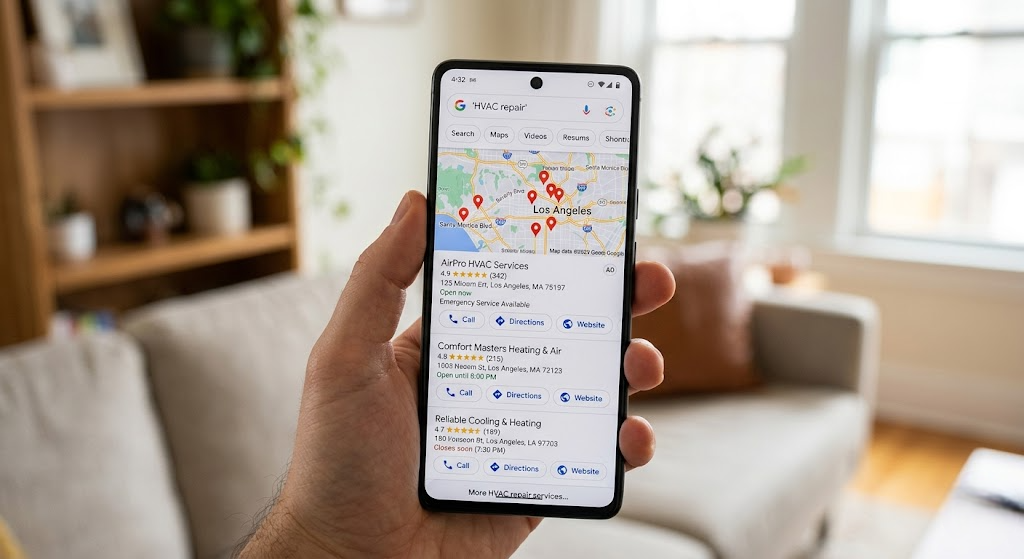
Google Maps rankings drive a disproportionate share of HVAC calls. When someone searches “AC repair near me” on their phone, the three businesses in the map pack capture the vast majority of clicks and calls before organic results even get a look. At the same time, AI-powered search tools like Google AI Overviews, ChatGPT, and Bing Copilot are reshaping how buyers find local service providers, adding a new layer to an already competitive landscape.
This guide walks you through every element of a high-performing local SEO strategy for HVAC companies in 2026: from Google Business Profile optimization and map pack rankings to on-page SEO, AI search readiness, link building, and how to choose the right HVAC local SEO services partner.
What Is HVAC Local SEO?
Search engine optimization (SEO) is the practice of making your online presence more visible in search engine results without paying for ads. Local SEO is a focused branch of SEO designed specifically for businesses that serve customers in a defined geographic area.
Traditional SEO aims to rank a website nationally or globally for broad topics. Local SEO for HVAC contractors is different. It targets the specific cities, neighborhoods, and zip codes where your technicians actually work. It connects your business to people searching for HVAC help in your service area, whether they are typing a query into Google, asking a voice assistant, or using an AI-powered search tool.
HVAC businesses depend on local visibility more than almost any other service category. A homeowner whose air conditioner breaks down in July is not browsing options in another state. They want the closest, most trusted company that can show up fast. If your business does not appear prominently in local search results and Google Maps, that call goes to someone else. That is precisely why HVAC local SEO services have become a cornerstone investment for contractors who want consistent, high-quality inbound leads.
Why HVAC Contractors Need Local SEO in 2026
The way people find local service businesses has shifted dramatically over the last few years, and the pace of that change is accelerating. Here is why local SEO is more critical than ever for HVAC companies.
Google Maps Dominance
The Google Map Pack, the cluster of three local business listings that appears above organic results for location-based searches, captures the highest click-through rates of any search result format. Studies consistently show that the top three map pack positions receive the overwhelming majority of local clicks. For HVAC companies, ranking in that pack is the single highest-leverage activity in your entire marketing strategy.
Near Me Searches
“Near me” searches for HVAC services have grown sharply year over year. Research published by Think with Google indicates that consumers are increasingly reliant on their mobile devices to find immediate, hyperlocal solutions. Queries like “HVAC repair near me,” “air conditioning company near me,” and “furnace tune-up near me” are extremely high-intent searches. Users typing these phrases have already decided they need help. They just need to find who to call.
Mobile Searches
More than 60 percent of local service searches happen on mobile devices. When a homeowner’s heat stops working on a cold night, they reach for their phone. Mobile searches trigger calls, and calls turn into booked jobs. A mobile-optimized presence, including Google Maps visibility and a fast-loading website, directly affects how many of those calls your company captures.
AI-Generated Search Results
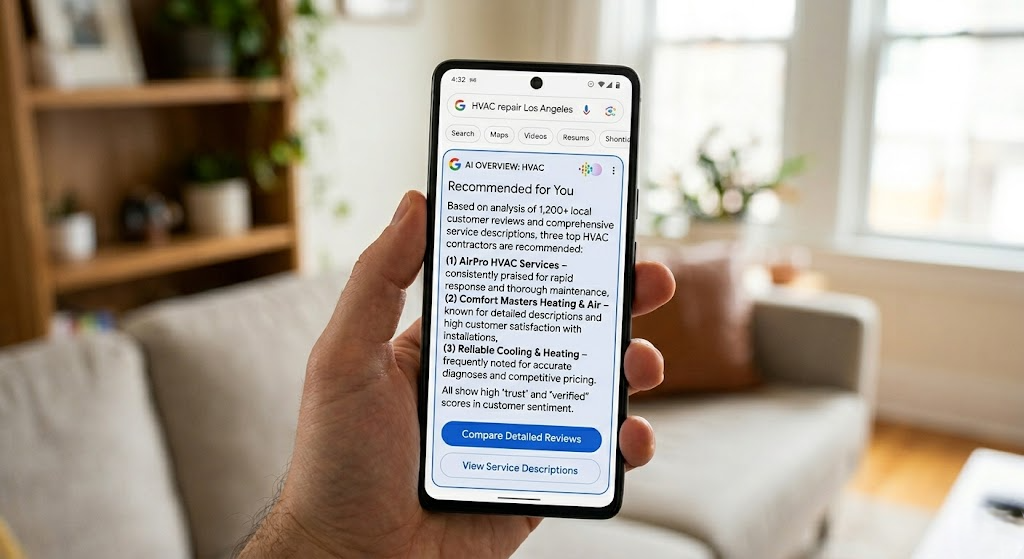
Google now places AI Overviews at the very top of many search results pages. These AI-generated summaries pull from trusted local sources to answer user questions. HVAC companies that are well-optimized for AI search, through structured data, authoritative content, and strong local signals, can appear as recommended businesses within these AI responses. This is a brand-new competitive advantage that most contractors have not yet seized.
Voice Search
Smart speakers and phone-based voice assistants handle a growing share of local service queries. Voice searches are conversational and question-based, such as “Who is the best HVAC company in Rochester?” or “Is there a 24-hour AC repair service near me?” Optimizing for these natural language queries through FAQ content and conversational page copy makes your business more likely to surface in voice results.
How Google Maps Rankings Work for HVAC Companies
Google uses three core factors to determine which businesses appear in the local map pack. According to a detailed analysis by Moz, understanding these specific signals is the foundation of any HVAC Google Maps SEO strategy.
Relevance
Relevance measures how closely your Google Business Profile and website match what the searcher is looking for. A profile that clearly describes your HVAC services, uses the right categories, and contains complete service information will be seen as more relevant for HVAC-related queries than a thin or vague profile.
Distance
Google estimates how far your business location is from the searcher or from the location mentioned in the query. For HVAC contractors who serve multiple cities, this makes service area configuration and geo-targeted landing pages extremely important for capturing searches across your full footprint.
Prominence
Prominence reflects how well-known and trusted your business is online. Factors that influence prominence include the number and quality of your Google reviews, the consistency of your business information across the web, the strength of links pointing to your website, and how much online content references your business. Established HVAC companies with strong reputations in the community naturally score higher on prominence.
Reviews
Reviews are a prominence signal, but they deserve special attention because they also directly influence user behavior. Data from the BrightLocal Local Consumer Review Survey shows that nearly all consumers look at local reviews before making a service decision. A business with 200 reviews and a 4.8-star rating will attract far more clicks and calls than a competitor with 15 reviews and a 3.9-star rating, even if both rank in the map pack. Actively generating and managing Google reviews is one of the highest-return activities in HVAC local SEO.
Behavioral Signals
Google pays attention to how users interact with your listing. Click-through rates, the number of calls placed directly from Google Maps, direction requests, and website visits all send signals about whether your listing is satisfying searchers. A listing that consistently earns engagement will outperform one that is technically complete but not compelling.
HVAC Google Business Profile Optimization Checklist
Your Google Business Profile (GBP) is the single most important piece of real estate in local HVAC marketing. An incomplete or poorly optimized profile leaves jobs on the table every day.
- Complete Every Business Detail: Fill in every available field in your Google Business Profile without exception. This includes your business name, address, phone number, website, business hours, holiday hours, and business description. Your description should naturally include your core services and service locations. Use all 750 characters available.
- Choose the Right HVAC Categories: Your primary category should be “HVAC Contractor.” Add all relevant secondary categories that match your services, such as Air Conditioning Contractor, Heating Contractor, Furnace Repair Service, and Refrigeration Contractor. Choosing precise categories tells Google exactly what kind of searches your profile should appear for.
- Add HVAC Service Areas: If you serve customers at their location rather than requiring them to visit your office, configure your service area in GBP. Add every city, town, and zip code where your team regularly works. This is how Google determines your eligibility to show up in searches across your full service footprint, not just in the immediate vicinity of your office address.
- Upload High-Quality Photos: Businesses with photos receive significantly more clicks and direction requests than those without. Upload photos of your team in branded uniforms, your service vehicles with company logos, completed HVAC installations, your office or dispatch facility, and before-and-after project shots. Update photos regularly since fresh visual content signals an active business.
- Post Weekly Updates: The Google Posts feature allows you to publish updates, offers, and news directly to your Business Profile. Posting weekly keeps your profile active and gives you an opportunity to highlight seasonal promotions, new services, and special offers. Active profiles are rewarded with better visibility.
- Optimize Services and Products: Use the Services section of your GBP to list every service you offer with descriptions that naturally incorporate relevant search terms. Include AC installation, AC repair, furnace installation, furnace repair, heat pump services, duct cleaning, indoor air quality, and any other service in your catalog. Detailed service listings directly improve relevance matching.
- Get More Google Reviews: Build a systematic process for requesting Google reviews from every satisfied customer. Send a follow-up text or email after each job with a direct link to your Google review page. Train your technicians to verbally request reviews at the close of every service visit. Respond to every review, both positive and negative, professionally and promptly.
- Answer Questions in GBP: The Questions and Answers section of your Google Business Profile is public and indexed by Google. Monitor this section regularly and answer questions thoroughly. You can also proactively post and answer common questions about your services, pricing, service areas, and availability. This content improves your profile’s relevance and can surface in AI-generated responses.
How to Rank in the Google Map Pack for HVAC Searches
Appearing in the Google Map Pack for competitive HVAC searches requires a coordinated strategy that reinforces your local authority across multiple signals.
- NAP Consistency: Your business Name, Address, and Phone number must appear identically across every online platform where your business is listed. Inconsistencies in how your NAP appears on directories, your website, social profiles, and your GBP confuse Google and dilute your local authority. Conduct a regular audit of your citations to catch and correct discrepancies.
- Local Citations: Local citations are mentions of your business name, address, and phone number on other websites. Key citation sources for HVAC companies include Yelp, Angi, HomeAdvisor, Thumbtack, BBB, Houzz, and local business directories. Building citations on authoritative, relevant platforms strengthens your local SEO footprint and supports HVAC map pack ranking efforts.
- Geo-Targeted Pages: Create dedicated landing pages for each city or service area you serve. A page optimized for “HVAC services in Syracuse, NY” with locally relevant content, a local phone number, and an embedded Google Map is far more likely to rank for searches in that city than a generic service page. These pages are foundational to ranking across a multi-city service territory.
- Reviews Strategy: Actively generate reviews, respond to all of them, and encourage detailed reviews that mention specific services and locations. A review that says “great furnace repair in Oswego” contains geographic and service signals that reinforce your relevance for that search.
- Local Backlinks: Links from other locally relevant websites, such as local news outlets, community organizations, and other local businesses, are a powerful signal of local authority. Every local backlink you earn tells Google that your business is embedded in and trusted by your community.
- Behavioral Engagement: Encourage customers to interact with your Google listing by calling from the Maps listing, clicking for directions, and visiting your website from your GBP. These behavioral signals validate that your listing is satisfying real users and are rewarded with improved rankings.
On-Page Local SEO for HVAC Websites
Your Google Business Profile is critical, but it works in partnership with your website. Strong on-page local SEO reinforces your GBP signals and builds the organic search presence that generates calls even beyond the map pack.
Optimize HVAC Service Pages
Each core service you offer—AC repair, furnace installation, heat pump service, duct cleaning, and so on—should have its own dedicated page. Each page should include a descriptive title tag and meta description that contain your service and primary city, a clear H1, detailed content that addresses what the service involves, why it matters, and what customers can expect, plus your local phone number and a clear call to action.
Create City-Specific Landing Pages
City landing pages are among the highest-value assets in local SEO for HVAC contractors. Build a unique page for every significant city or town in your service area. Each page should include locally specific content, not just swapped city names on a template. Reference local landmarks, common climate challenges, and community context where possible to create genuine local relevance.
Use Local Keywords Naturally
Integrate your target keywords, including service terms, city names, and neighborhood references, naturally throughout your page content, headings, image alt text, and metadata. Avoid forcing keywords where they do not read naturally. Modern search engines are sophisticated enough to recognize and penalize unnatural keyword use.
Add Internal Linking
Connect your service pages, city pages, and blog content through strategic internal links. Internal linking helps Google understand the structure and hierarchy of your site while distributing page authority across your content. It also helps visitors navigate to the information most relevant to their needs.
Improve Website Speed
Page speed is a confirmed Google ranking factor and a critical element of user experience. A slow HVAC website loses visitors before they even read your content. Compress images, use a content delivery network, enable browser caching, and minimize unnecessary code to keep your load times under three seconds on mobile.
Mobile Optimization
Given that the majority of local HVAC searches happen on mobile devices, your website must deliver an excellent mobile experience. This means responsive design, tappable phone numbers, click-to-call buttons, fast load times, and content that is easy to read on small screens. A frustrating mobile experience will cost you calls regardless of how well you rank.
Best Keywords for HVAC Local SEO
Targeting the right keywords ensures your content reaches the right people at the right stage of their decision-making process. Below are the core keyword categories organized by search intent.
| Commercial HVAC | Emergency HVAC | AC and Furnace Keywords | Near Me Keywords |
|---|---|---|---|
| HVAC services [city] | Emergency HVAC [city] | AC repair [city] | AC repair near me |
| Commercial AC installation | 24-hour HVAC service | Furnace repair [city] | Furnace repair near me |
| Commercial furnace repair | Emergency AC repair [city] | AC tune-up [city] | HVAC company near me |
| Commercial HVAC contractor | Same-day HVAC repair | Air conditioner replacement | Heating repair near me |
| Industrial HVAC services | Emergency heating repair | Furnace installation [city] | AC service near me |
In addition to these core keyword categories, incorporate semantic variations and related terms throughout your content: HVAC technician, heat pump repair, ductwork repair, HVAC maintenance, indoor air quality, energy-efficient HVAC, and seasonal HVAC tune-up. These related terms help search engines understand the full scope of your services and surface your content for a wider range of relevant queries.
HVAC AI Search Optimization Explained
Artificial intelligence is fundamentally changing how search engines retrieve and present information. As outlined in the Google Search Central guide to AI Overviews, search engines are now capable of synthesizing complex local data to provide direct answers. For HVAC companies, understanding and adapting to AI-powered search is becoming a meaningful competitive differentiator.
Google AI Overviews
Google’s AI Overviews appear at the top of search results for many informational and commercial queries. These summaries pull content from authoritative sources to directly answer user questions. HVAC companies that publish well-structured, accurate, and comprehensive content on topics like HVAC repair costs, system lifespan, efficiency ratings, and seasonal maintenance are more likely to have their content referenced in these AI summaries.
ChatGPT and AI Assistants
A growing number of consumers are using ChatGPT, Gemini, and other AI chat tools to research local service providers and get recommendations. These tools increasingly incorporate web browsing capabilities, which means businesses with strong online presence, quality reviews, and authoritative content are more likely to be recommended. Optimizing for AI search starts with the same fundamentals that drive strong local SEO.
Bing Copilot
Microsoft’s Bing Copilot integrates AI into search in a way that draws heavily on Bing’s local business index. Ensuring your business is listed and accurately represented in Bing Places is an important step for AI search visibility. Bing Copilot responds to conversational queries, so content that mirrors how customers ask questions verbally performs particularly well.
Conversational Search Queries
AI search tools are trained to handle natural language. Instead of optimizing only for short keyword phrases, structure your content to answer questions the way a real customer would ask them: “How much does it cost to replace a central air conditioner in [city]?” or “What should I do if my furnace stops working in the middle of winter?” This conversational approach aligns with how AI systems retrieve and present answers.
Structured Data and Schema Markup
Schema markup is code added to your website that helps search engines understand your content more precisely. For HVAC companies, relevant schema types include LocalBusiness, Service, FAQPage, and Review. Implementing schema markup increases the likelihood that your business information appears correctly in AI-generated responses, rich snippets, and voice search results.
Entity SEO
Entity SEO refers to building a clear, consistent identity for your business across the web so that search engines and AI tools recognize it as a distinct, trustworthy entity. This involves consistent NAP information, mentions of your business on authoritative sites, a well-maintained Google Knowledge Panel, and content that consistently references your brand, location, and areas of expertise.
FAQ Optimization for AI Search
Frequently asked questions sections on your website are particularly valuable for AI search. AI tools favor structured question-and-answer content because it closely mirrors how their users interact with them. Adding FAQ schema to your pages gives both Google AI Overviews and external AI tools a clear, citable answer format to draw from.
Local SEO Content Strategy for HVAC Companies
Content is the foundation of every effective local SEO program. Publishing the right content consistently builds your authority, attracts organic traffic, and supports your Google Maps presence.
- Blog Content: A regularly updated blog establishes your HVAC company as a knowledgeable, trustworthy resource. Target informational queries that your customers are already searching for: how to improve home air quality, when to replace an HVAC system, how to choose the right AC unit for your home, and what causes a furnace to short-cycle. Each blog post is a new opportunity to rank for a relevant query and drive traffic that converts to leads.
- Service Area Pages: Dedicated service area pages are essential for any HVAC company serving multiple cities. Each page should be genuinely unique, addressing the specific HVAC needs, climate conditions, and community context of that location. Generic templates with city names swapped in are easy for Google to identify and discount.
- FAQ Pages: Frequently asked questions pages address common customer questions in a structured format that search engines and AI tools both reward. Cover questions about your pricing, service process, warranties, equipment brands, service area, and emergency availability. FAQ content also directly supports voice search and AI search optimization.
- Seasonal Content: HVAC demand is heavily seasonal. Publishing content that anticipates seasonal needs—spring AC tune-up checklists, fall furnace inspection guides, and winter emergency heating preparedness—keeps your site relevant to what customers are actively searching for throughout the year. Seasonal content also gives you timely material for your Google Business Profile posts.
- Emergency Repair Content: Emergency HVAC calls are among the highest-value leads an HVAC company can receive. Dedicate specific pages to emergency AC repair, emergency furnace repair, and 24-hour HVAC service. These pages should emphasize your response time, availability, and service area, and should be structured to rank for high-urgency, high-intent searches.
HVAC Local SEO Link Building Strategies
Backlinks from authoritative external websites remain one of the most powerful ranking signals in both local and organic SEO. Building a strong local link profile takes time but delivers lasting competitive advantages.
Local Business Directories
Start with foundational directories that every local business should be listed on: Google Business Profile, Yelp, Angi, HomeAdvisor, Thumbtack, BBB, Houzz, and Facebook. These are not just citation sources. Many of them are high-authority domains, and links from them carry significant SEO value.
Chamber of Commerce
Joining your local chamber of commerce typically includes a listing on their website with a link back to yours. Chamber websites are trusted local authority domains, and a listing there reinforces your local relevance. Many chambers also feature member spotlights and community event coverage that create additional linking opportunities.
Supplier and Manufacturer Links
Equipment manufacturers and wholesale suppliers often maintain dealer or contractor locator pages on their websites. If you are an authorized dealer or preferred contractor for major HVAC brands, request inclusion on their dealer finder pages. These are high-authority links with direct relevance to your industry.
Sponsorships and Community Involvement
Sponsoring local sports teams, charity events, school fundraisers, or community organizations often results in a link back to your website from the organization’s site. These links are locally relevant, editorially placed, and build both your SEO authority and your community reputation simultaneously.
HVAC Trade Associations
Membership in national or regional HVAC associations such as ACCA, ASHRAE, or PHCC typically includes a business listing with a link. These are industry-relevant, high-authority links that strengthen your topical authority in HVAC-related searches.
Local PR and Media Coverage
Reach out to local news outlets, community blogs, and neighborhood publications with newsworthy stories about your business: community initiatives, significant service milestones, extreme weather response stories, or energy savings case studies. Earned media coverage delivers both brand visibility and powerful editorial backlinks.
Common HVAC Local SEO Mistakes to Avoid
Even well-intentioned SEO efforts can backfire if they rely on outdated tactics or overlook critical fundamentals. These are the most common mistakes that hold HVAC companies back in local search.
- Keyword Stuffing: Repeating your target keywords at an unnatural density was a black-hat tactic from years past. Modern Google algorithms identify and penalize it. Write naturally and let your expertise speak for itself.
- Duplicate City Pages: Creating dozens of city landing pages that are essentially identical except for the city name is a thin content practice that Google penalizes. Each city page must contain genuinely unique, useful content relevant to that location. Quality over quantity always wins in local SEO.
- Fake Reviews: Purchasing fake reviews or incentivizing customers to post reviews they did not earn violates Google’s policies and carries serious penalties, including GBP suspension. Build your review profile organically through excellent service and systematic follow-up requests.
- Inconsistent NAP: Inconsistencies in your business name, address, or phone number across the web undermine your local authority. Audit your citations at least quarterly and correct any discrepancies promptly.
- Ignoring Mobile UX: A website that is technically optimized but difficult to use on a mobile phone will lose leads at the moment of highest intent. Mobile UX is both a ranking factor and a conversion factor. Test your site on multiple mobile devices regularly.
- Thin Content: Short, vague service pages and city pages with no real information do not satisfy searcher intent and do not rank well. Invest in detailed, helpful content that genuinely answers the questions your potential customers are asking. Thin content is one of the most common and most damaging mistakes in HVAC website SEO.
How to Measure HVAC Local SEO Success
Effective local SEO is data-driven. Tracking the right metrics tells you what is working, what needs adjustment, and what return you are getting on your investment.
| Metric | What to Track and Why |
|---|---|
| Google Business Profile Insights | Track profile views, search queries, calls placed from GBP, direction requests, and photo views monthly. |
| Map Pack Rankings | Monitor where your business ranks in the local map pack for your most important target keywords across your service cities. |
| Organic Traffic | Track total organic traffic, city-level traffic, and which service pages are generating the most visits using Google Analytics or a similar tool. |
| Phone Calls | Use call tracking software to attribute inbound calls to specific SEO channels so you know exactly how many calls your local SEO is generating. |
| Form Submissions | Track contact form and quote request submissions by channel to measure local SEO lead volume separately from paid traffic. |
| Local Keyword Rankings | Use a rank tracking tool to monitor your position in organic search results for your target keywords across all service area cities. |
Set a monthly reporting cadence and review these metrics consistently. SEO is a long-term investment, and trends over three to six months are more meaningful than week-to-week fluctuations.
Should You Hire an HVAC SEO Company?
Many HVAC business owners start by attempting DIY SEO, quickly discover the complexity of the discipline, and eventually recognize the value of working with a specialized partner. Here is how to think through that decision.
What an HVAC SEO Company Should Offer
A legitimate HVAC SEO company should offer a comprehensive suite of services: Google Business Profile optimization, citation building and management, review generation strategy, city landing page creation, technical website SEO, content strategy and writing, link building, and AI search optimization. They should provide regular reporting with clear metrics and be able to explain their strategy in plain language.
Red Flags to Avoid
Be cautious of any agency that guarantees specific rankings on a specific timeline, since no one can guarantee Google rankings. Also avoid agencies that charge extremely low flat fees for “full-service” SEO, rely primarily on automated tools without human strategy, or are unwilling to explain their methods. Churn-and-burn SEO agencies can cause more harm than good.
Questions to Ask Before Hiring
Before signing with any HVAC SEO provider, ask: How many HVAC clients do you currently work with? Can you share case studies or references from HVAC companies? What does your reporting look like and how often do we meet? How do you handle algorithm updates? What happens to our content and citations if we stop working together?
DIY vs Professional SEO
DIY local SEO is possible for business owners who are willing to invest significant time learning and executing. You can claim and optimize your GBP, build citations, and publish basic content yourself. However, the competitive depth of HVAC local SEO in most markets, particularly for map pack rankings and AI search optimization, typically rewards businesses that work with specialists. The best HVAC local SEO company for your business is one that understands your market, speaks HVAC, and has a proven process for delivering measurable results.
Best HVAC Local SEO Services to Look For
When evaluating HVAC local SEO services, look for providers that offer the following capabilities as part of a cohesive, integrated strategy.
- Google Business Profile Optimization: Full GBP optimization including category selection, service area configuration, photo uploads, post management, Q&A monitoring, and ongoing profile maintenance should be a core service offering. This is the highest-impact starting point for any HVAC local SEO campaign.
- Citation Management: Building accurate, consistent business listings across all major directories and HVAC-specific platforms, and maintaining them over time as your business information changes, is a foundational local SEO activity that requires ongoing attention.
- Review Generation: A systematic, compliant review generation program that helps you consistently earn new Google reviews from satisfied customers, including response management, is essential for both rankings and conversion.
- Local Landing Pages: Professional creation of city-specific and service-specific landing pages that are genuinely useful, properly optimized, and designed to convert visitors into callers is a core component of any comprehensive HVAC local SEO services package.
- Content Writing: Regular publication of high-quality blog posts, FAQ content, and service area content by writers who understand the HVAC industry builds your site’s authority and topical relevance over time.
- Technical SEO: Site speed optimization, mobile performance, proper schema markup implementation, crawlability, and site architecture are technical foundations that support every other SEO activity. These should be audited and maintained on a regular basis.
- AI Search Optimization: Working with a partner who understands entity SEO, structured data, and conversational content strategy positions your company to capture leads from the next generation of search experiences, including Google AI Overviews, ChatGPT, and Bing Copilot.
USA HVAC Marketing delivers all of these services tailored specifically to the HVAC industry, with strategies built around the competitive dynamics of HVAC local search in your market.
Need Help Growing Your HVAC Company With Local SEO?
Ranking higher on Google Maps and capturing leads from AI-powered search requires a specialized strategy built around how HVAC customers actually search. At USA HVAC Marketing, we combine deep industry knowledge with proven local SEO methods to help contractors dominate their local markets.
We offer custom local SEO strategies built specifically for HVAC companies, with a focus on:
- Google Maps rankings that generate real calls
- AI search visibility across Google, ChatGPT, and Bing
- More inbound leads without increasing your ad spend
- Measurable growth tracked and reported every month
Ready to see what is possible for your business? Contact us today for a free Local SEO audit and a no-pressure conversation about your growth goals.
Frequently Asked Questions
How Long Does HVAC Local SEO Take to Show Results?
Most HVAC companies begin to see meaningful improvements in Google Maps visibility and organic traffic within three to six months of starting a properly executed local SEO campaign. Some results, such as improved GBP engagement and citation corrections, can show up within the first four to eight weeks. Competitive map pack rankings in larger markets typically take six to twelve months of consistent effort. SEO is a compound investment where results build on each other over time.
How Much Do HVAC Local SEO Services Cost?
HVAC local SEO services typically range from around $800 to $3,000 or more per month, depending on the scope of services, the size of your service area, the competitiveness of your market, and whether content creation is included. Basic citation building and GBP management packages sit at the lower end, while comprehensive programs that include content, link building, and AI search optimization are priced higher. The right investment level depends on your growth goals and the competitive landscape in your market.
Can HVAC Companies Rank Without Google Ads?
Absolutely. Google Maps and organic search rankings are entirely separate from paid advertising. Many HVAC companies generate the majority of their leads through local SEO alone, with no Google Ads spend. While paid ads can generate faster initial visibility, organic and map pack rankings built through local SEO deliver traffic and calls without an ongoing cost per click. Over time, strong local SEO typically produces a far better return on investment than paid search alone.
What Is the Google Map Pack?
The Google Map Pack, also called the local pack or three-pack, is the group of three local business listings that appears near the top of Google search results for location-based queries. It displays a map alongside three business listings showing each company’s name, rating, address, and phone number. The Map Pack captures the highest click-through rates of any search result format for local service queries, making it the most valuable piece of search real estate for HVAC companies.
Does AI Search Affect HVAC Companies’ Local SEO?
Yes, and the impact is growing. Google AI Overviews, ChatGPT with browsing, and Bing Copilot are all changing how consumers discover and evaluate local service providers. HVAC companies with well-structured websites, strong review profiles, authoritative content, and proper schema markup are better positioned to appear in AI-generated recommendations and summaries. Optimizing for AI search is increasingly part of a complete local SEO strategy, not an optional add-on.
Sources
- Think with Google: A research platform that provides insights into consumer behavior, specifically highlighting the growth of hyperlocal “near me” search queries.
- Moz: A leading authority in SEO that publishes annual reports on local search ranking factors, including relevance, distance, and prominence.
- BrightLocal: A specialized local marketing platform that conducts extensive research into consumer review habits and their impact on local business visibility.
- Google Search Central: The official developer documentation from Google regarding the implementation and appearance of AI Overviews in search results.