Every HVAC contractor knows that a full schedule means a healthy business. But in 2026, filling that schedule is harder than ever. Competition for local HVAC work has surged, digital advertising costs have climbed, and homeowners have more choices than they know what to do with. The difference between contractors who grow and those who stagnate often comes down to one thing: the quality of their leads.
Not all leads are created equal. A cheap lead from an aggregator shared with five other contractors is a very different asset than an exclusive inbound call from a homeowner who is ready to book. This guide breaks down everything HVAC contractors need to know about generating, buying, nurturing, and converting leads in today’s market so you can build a pipeline that actually grows your business.
What Are HVAC Leads?
An HVAC lead is any contact from a potential customer who has expressed interest in heating, ventilation, or air conditioning services. That interest can come through a phone call, a web form submission, a live chat message, or even a direct referral from a satisfied customer. The key is that the person has signaled a need, and your job is to convert that signal into a booked job.
| Lead Type | Who It Comes From | Speed to Close | Average Job Value |
|---|---|---|---|
| Residential | Homeowners | Fast | Lower |
| Commercial | Businesses, property managers | Slow (longer decision cycle) | Higher |
| Emergency | Any customer with a failed system | Very fast | Medium to high |
| Maintenance | Existing or new customers | Moderate | Lower, but recurring |
| Inbound | Customer initiates contact | Fast | Varies |
| Outbound | You initiate contact | Slower | Varies |
Residential vs. Commercial HVAC Leads
Residential leads typically come from homeowners dealing with a broken unit, a seasonal tune-up need, or a full system replacement. These jobs are usually faster to close but smaller in dollar value. Commercial HVAC leads involve businesses, property managers, and facilities teams. The decision cycle is longer, but the contract value and recurring revenue potential are significantly higher.
Emergency vs. Maintenance Leads
Emergency leads arrive when something has already failed. A homeowner whose AC stopped working on a 95-degree afternoon is not shopping around. They want help now, which makes these leads extremely high-intent and fast-to-close. Maintenance leads such as tune-ups, filter replacements, and seasonal checks require more nurturing but build long-term customer relationships and recurring revenue.
Inbound vs. Outbound Leads
Inbound leads come to you. The homeowner searched Google, found your website or listing, and reached out. Inbound leads tend to convert at higher rates because the prospect initiated contact. Outbound leads are generated when you reach out through paid ads, cold calls, or direct mail. They require more effort to convert but can be scaled predictably with the right budget and strategy. Understanding lead types is the foundation of any strategy because, as noted in a marketing breakdown by ServiceTitan, it determines which channels to prioritize and how to structure your follow-up process.
How HVAC Lead Generation Works
HVAC lead generation is the systematic process of attracting potential customers, capturing their contact information, and moving them toward a booked appointment. It is not a single tactic but a full-funnel system.
The Lead Capture Process
At the top of the funnel, a homeowner becomes aware of your company, usually through a Google search, a social ad, or a neighbor’s recommendation. They visit your website or landing page, where a clear call to action prompts them to call, submit a form, or book online. That action creates a lead record in your system.
High-converting HVAC websites must include:
- A clickable phone number visible at the very top of every page
- A short contact form with no more than three to four fields
- Live chat or a chatbot for after-hours inquiries
- Trust signals: reviews, licensing information, and years in business
- A mobile-first design that loads in under three seconds
Funnels, Calls, Forms, and Booking Requests
Effective HVAC lead funnels are short. Unlike e-commerce, where a customer might research for weeks, HVAC customers often decide within hours, especially for emergency calls. Your funnel should move from awareness to contact in as few steps as possible.
| Capture Method | Best For | Conversion Strength | Response Speed Needed |
|---|---|---|---|
| Phone call | Emergency and urgent needs | Highest | Immediate |
| Web form | Non-urgent quotes and estimates | Medium | Within 5 minutes |
| Online booking | Maintenance and scheduled services | High | Auto-confirmed |
Lead Nurturing
Not every lead books on the first contact. A basic nurturing sequence should include:
- An immediate auto-response confirming receipt of the inquiry
- A personal follow-up call within five minutes during business hours
- A follow-up text if the call goes unanswered
- A second call attempt within one to two hours
- An email with financing options or a seasonal promotion within 24 hours
- A final follow-up call or text within 48 to 72 hours
The contractors who invest in hvac lead generation services and hvac sales lead generation infrastructure consistently outperform those who rely on word of mouth alone because their pipeline never goes dry.
Best HVAC Lead Generation Strategies
No single channel dominates HVAC lead generation. The most successful contractors build a multi-channel approach that covers both short-term paid traffic and long-term organic growth.
| Strategy | Best For | Time to Results | Cost Level |
|---|---|---|---|
| SEO | Long-term organic lead flow | 6 to 12 months | Medium upfront, low ongoing |
| Google Ads | Immediate leads, emergency demand | Immediate | High ongoing |
| Local Services Ads | High-intent local leads | Immediate | Medium (pay per lead) |
| Google Business Profile | Map pack visibility, free calls | 1 to 3 months | Low |
| Facebook/Instagram Ads | Brand awareness, retargeting | Immediate | Medium |
| Email Marketing | Existing customer reactivation | Immediate | Very low |
| Referral Programs | High-trust, high-close leads | Ongoing | Very low |
SEO for HVAC Contractors
Search engine optimization puts your website in front of homeowners who are actively searching for HVAC services. Ranking on the first page of Google for terms like “AC repair [city]” or “furnace installation near me” delivers consistent, free traffic month after month. A comprehensive guide from Search Engine Journal explains that local SEO involves:
- Optimizing page titles, headers, and meta descriptions for local keywords
- Publishing service pages for every major service and city you cover
- Building authoritative backlinks from local and industry websites
- Improving site speed and mobile usability
- Earning and managing customer reviews across Google, Yelp, and other directories
A well-optimized HVAC website typically sees compounding results, with traffic and leads growing steadily over 6 to 12 months and continuing to build without ongoing ad spend.
Google Ads
Google Ads puts your business at the top of search results immediately. You pay only when someone clicks your ad, and you can target specific keywords, zip codes, and times of day. Google Ads works especially well for:
- Emergency repair keywords during peak season
- Replacement and installation queries from high-intent buyers
- New service areas where organic rankings have not yet developed
- Seasonal promotions tied to specific dates or weather events
The downside is cost. HVAC keywords are among the most competitive in local services, and clicks can run $15 to $50 or more depending on your market. Without proper campaign management, ad budgets can disappear without generating quality calls.
Facebook and Instagram Ads
Social media advertising is not the first place homeowners go when their AC breaks, but it is an excellent channel for:
- Building brand awareness in your local service area
- Promoting seasonal maintenance specials and financing offers
- Retargeting website visitors who did not convert
- Reaching homeowners by age, income level, and homeownership status
Local SEO and Google Business Profile
Your Google Business Profile is often the first thing a local homeowner sees when they search for HVAC help. A fully optimized profile should have:
- Accurate service categories and a complete business description
- Updated hours including holiday and emergency availability
- Photos of your team, trucks, and completed work
- A steady stream of recent five-star reviews with professional responses
- Regular posts about seasonal promotions and new services
Local Services Ads (LSAs)
Google’s Local Services Ads appear above even regular paid ads and carry a “Google Guaranteed” badge. As outlined by Google Support, you pay per lead rather than per click, and Google handles the verification process. For HVAC contractors in competitive markets, LSAs deliver high-intent leads at a predictable cost per acquisition.
Email Marketing
Your existing customer list is one of the most underutilized assets in HVAC. Effective HVAC email campaigns include:
- Spring AC tune-up reminders sent in March and April
- Fall heating checkup promotions sent in September and October
- Financing offer announcements tied to system replacement season
- Win-back emails for customers who have not booked in 12 or more months
- Post-service follow-ups requesting reviews and referrals
Referral Programs
A structured referral program turns satisfied customers into your best lead source. Marketing insights from Jobber suggest offering a meaningful reward such as a service discount, a gift card, or a donation to a local charity, and making it easy for customers to refer friends and family. Referral leads close at some of the highest rates because they arrive with built-in trust.
Local HVAC Leads vs. Shared Leads
What Are Local HVAC Leads?
Local HVAC leads are generated from homeowners in your specific service area. Rather than purchasing leads from a national aggregator serving contractors across the country, local leads are tied to geographic intent. The homeowner searched for HVAC help in your city, not somewhere 300 miles away.
Why Geo-Targeted Leads Convert Better
Geography matters in HVAC because your technicians can only travel so far. Geo-targeted leads convert better for several reasons:
- The homeowner is within your actual service radius
- Local leads reflect your market’s specific pricing expectations
- Seasonal demand patterns match your climate and service schedule
- Response times are faster when dispatch distances are shorter
- Local brand recognition means the homeowner may already know your name
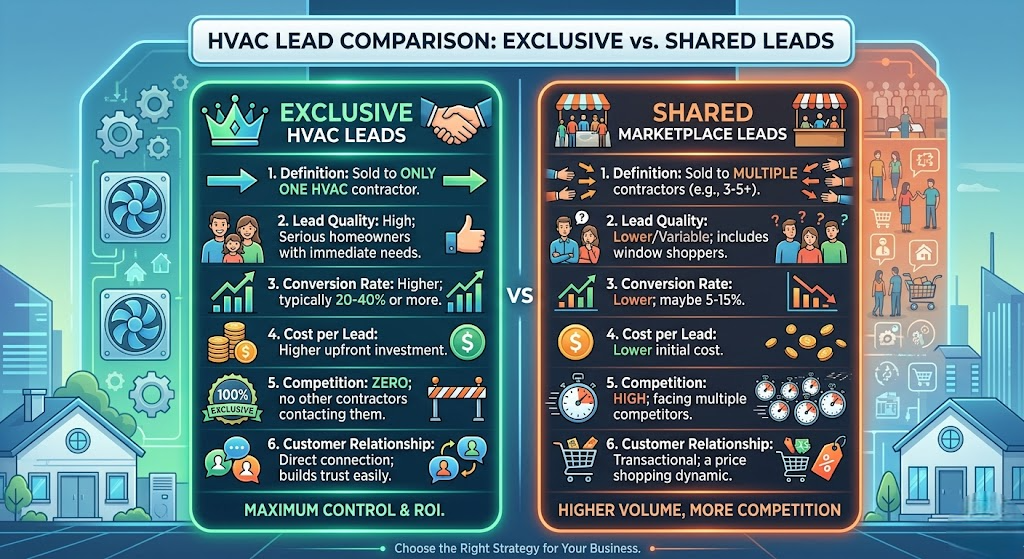
Shared vs. Exclusive Lead Systems
| Feature | Shared Leads | Exclusive Leads |
|---|---|---|
| Sent to how many contractors | 3 to 5 simultaneously | You only |
| Competition at first contact | High | None |
| Typical close rate | 10% to 20% | 30% to 50%+ |
| Cost per lead | Lower ($20 to $50) | Higher ($60 to $150) |
| Pricing pressure from homeowner | High (multiple quotes expected) | Low |
| Long-term ROI | Lower | Higher |
Most lead marketplaces sell shared leads, meaning the same homeowner’s contact information is sent to multiple contractors simultaneously. You are immediately in a race to be the first to call, and even if you win that race, the homeowner knows other contractors are calling them too, which drives down your pricing power. Exclusive local hvac leads go to only one contractor. The homeowner reached out through your own marketing channels, and you are the only business they contacted. Conversion rates are dramatically higher because there is no competition at the point of contact.
Are Exclusive HVAC Leads Worth It?
The short answer is yes, for most contractors who have the follow-up process to capitalize on them.
Pros of Exclusive HVAC Leads
- No race to the phone against competitors
- Homeowner has already engaged with your brand specifically
- Conversion rates of 30% to 50% or higher vs. 10% to 20% for shared leads
- You control the conversation and pricing from the very first call
- Higher average job value because the homeowner is not already price-shopping
Cons and Considerations
- Higher cost per lead upfront compared to shared packages
- Requires a fast, disciplined follow-up process to convert effectively
- Not all “exclusive” providers are actually exclusive; always verify in writing
- Volume may be lower than shared lead packages, especially in smaller markets
Conversion Rates and ROI
| Scenario | Shared Leads | Exclusive Leads |
|---|---|---|
| Cost per lead | $30 | $80 |
| Close rate | 15% | 40% |
| Leads needed per booked job | ~7 | ~2.5 |
| Lead cost per booked job | ~$210 | ~$200 |
| Competitor pressure | High | None |
| Pricing power on the call | Low | High |
At similar effective acquisition costs, exclusive hvac leads deliver more booked jobs, less price resistance, and a stronger long-term customer relationship. For contractors investing in growth, they are a competitive necessity in crowded markets.
Should You Buy HVAC Leads Online?
Buying HVAC leads online is a fast way to fill a slow pipeline, but it comes with trade-offs every contractor needs to understand before committing a budget.
The Case for Buying Leads
- Provides immediate lead volume while longer-term marketing matures
- Useful for testing new service areas before investing in local SEO
- Reputable providers handle targeting and some qualification work for you
- No long setup time compared to SEO or organic campaigns
Risks and Lead Quality Issues
- Leads may be weeks or months old by the time you receive them
- Wrong contact information is common with low-quality providers
- Prospects may have already booked with a competitor before you call
- Some leads are generated through deceptive forms promising “free estimates”
- Shared lead fatigue means homeowners stop answering calls from unfamiliar numbers
Red Flags to Avoid When You Buy HVAC Leads Online
- Provider cannot explain exactly how each lead was generated
- No refund policy for invalid, duplicate, or out-of-area leads
- Long-term contracts with no performance guarantees or exit clauses
- No cap on how many contractors receive the same lead simultaneously
- Unable to provide sample leads, verifiable references, or a trial period
- Pricing is hidden until after you speak with a salesperson
How to Choose the Best HVAC Lead Generation Company
The market for HVAC lead generation services is crowded with vendors making similar promises. Here is what separates legitimate partners from lead mills.
| Evaluation Criteria | What to Look For | Red Flag |
|---|---|---|
| Pricing transparency | Clear cost per lead, all fees listed upfront | “Call us for pricing” |
| Lead exclusivity | Guaranteed in writing, one contractor per lead | Vague or loose definitions of “exclusive” |
| Tracking and reporting | Call recordings, source attribution, conversion data | No reporting dashboard |
| Industry specialization | HVAC-specific experience and verifiable case studies | Serves every industry equally |
| Reviews and references | Verified contractor testimonials in similar markets | Generic or unverifiable reviews |
| Contract terms | Flexible, month-to-month options available | 12-month lock-ins with no exit clause |
Pricing Transparency
A trustworthy lead generation company shows you exactly what you are paying for. Cost per lead, cost per booked call, management fees, and any setup costs should be clearly disclosed before you sign anything. Vague pricing that requires a sales call to unlock is a warning sign.
Lead Exclusivity
Ask directly: are the leads you send me exclusive to my business? Get the answer in writing. Some providers define “exclusive” loosely, meaning they may not sell to a direct competitor but still share leads within a broader partner network.
Tracking and Reporting
Good reporting includes:
- Call recordings for every inbound lead
- Lead source attribution showing which channel generated each contact
- Conversion tracking from lead to booked job
- A live reporting dashboard you can check at any time
- Monthly performance reviews with actionable recommendations
Reviews and Industry Specialization
A company that serves every industry is rarely an expert in any. HVAC has unique seasonality, keyword patterns, and customer psychology that general marketing agencies often miss. Look for a partner who specifically works with HVAC contractors and can point to verified case studies and client reviews from contractors in comparable markets. The best hvac lead generation company for your business will have deep HVAC-specific experience, transparent reporting, and a proven track record of generating exclusive, high-intent leads in real local markets.
What Does an HVAC Contractor Leads Service Include?
A full-service hvac contractor leads service is more than a list of phone numbers. It is an end-to-end system for generating, capturing, tracking, and nurturing prospects through the booking process.
| Service Component | What It Does | Why It Matters |
|---|---|---|
| Call tracking | Assigns unique numbers per channel to attribute call sources | Know exactly which campaigns generate calls |
| CRM integration | Pushes leads automatically into your management system | No leads lost in email or voicemail |
| Appointment booking | Lets homeowners self-schedule on your calendar | Reduces friction, captures after-hours leads |
| PPC management | Manages bids, keywords, and ad copy for Google Ads | Maximizes leads per dollar of ad spend |
| SEO campaigns | Builds organic rankings through content and link building | Generates leads without ongoing ad cost |
| Reporting dashboard | Real-time visibility into leads, calls, and conversions | Enables data-driven budget decisions |
Call Tracking
Every inbound call should be tracked to its source. Call tracking software assigns unique phone numbers to different marketing channels so you know whether a caller found you through Google Ads, organic search, a Facebook ad, or your Google Business Profile. This data is essential for understanding what is working and where to invest more.
CRM Integration
Leads should flow automatically into your customer relationship management system so nothing falls through the cracks. CRM integration lets you track every prospect from first contact through estimate, follow-up, and booked job. Without this, leads get lost in email inboxes and missed calls.
Appointment Booking
Online booking tools reduce the friction between a curious homeowner and a confirmed appointment on your calendar. The best systems allow homeowners to see your available time slots and book directly without waiting for a callback. This matters especially after hours when many homeowners are searching for HVAC help.
PPC Management
Pay-per-click advertising requires ongoing optimization, bid management, negative keyword maintenance, and ad copy testing. A dedicated PPC manager keeps your Google Ads campaigns performing efficiently so your budget generates the maximum number of qualified calls.
SEO Campaigns
Long-term HVAC lead generation depends on organic search visibility. An ongoing SEO campaign includes:
- Technical website optimization for speed and mobile performance
- Local service pages targeting every major keyword and service area
- Google Business Profile management and optimization
- Link building from local and industry-relevant websites
- Monthly reporting on rankings, traffic, and lead volume
Cost of HVAC Leads in 2026
Understanding lead costs helps you set a realistic budget and evaluate the ROI of different channels.
| Lead Type | Average Cost Per Lead | Close Rate | Effective Cost Per Booked Job |
|---|---|---|---|
| Shared marketplace leads | $20 to $50 | 10% to 15% | $130 to $500 |
| Exclusive purchased leads | $60 to $150 | 30% to 50% | $120 to $500 |
| Google Ads (cost per call) | $40 to $120 | 25% to 35% | $115 to $480 |
| Local Services Ads | $30 to $80 | 30% to 40% | $75 to $265 |
| SEO (annualized per lead) | $10 to $40 | 35% to 50% | $20 to $115 |
| Referral leads | Near zero | 50% to 70% | Minimal |
Google Ads costs tend to be highest in large metro areas and during peak season (summer cooling, winter heating). SEO investment involves higher upfront costs but delivers a lower effective cost per lead over 12 to 24 months as rankings compound. A balanced strategy typically combines paid channels for immediate lead flow with SEO for long-term cost efficiency.
How to Convert More HVAC Leads Into Paying Customers
Generating leads is only half the equation. Contractors who master conversion turn the same lead volume into twice the booked jobs.
Faster Response Times
Speed is the single biggest conversion lever in HVAC. Research highlighted by the Harvard Business Review indicates that businesses that attempt to contact potential customers within an hour of receiving a query are nearly seven times as likely to have a meaningful conversation as those who wait even 60 minutes longer. Response time benchmarks every contractor should aim for:
- Within 1 minute: Highest possible conversion rate
- Within 5 minutes: Strong conversion, still competitive
- Within 30 minutes: Conversion drops significantly
- Over 1 hour: Most leads have already contacted a competitor
Invest in systems that alert you to new leads instantly and build a process for responding within minutes during business hours.
Better Follow-Up
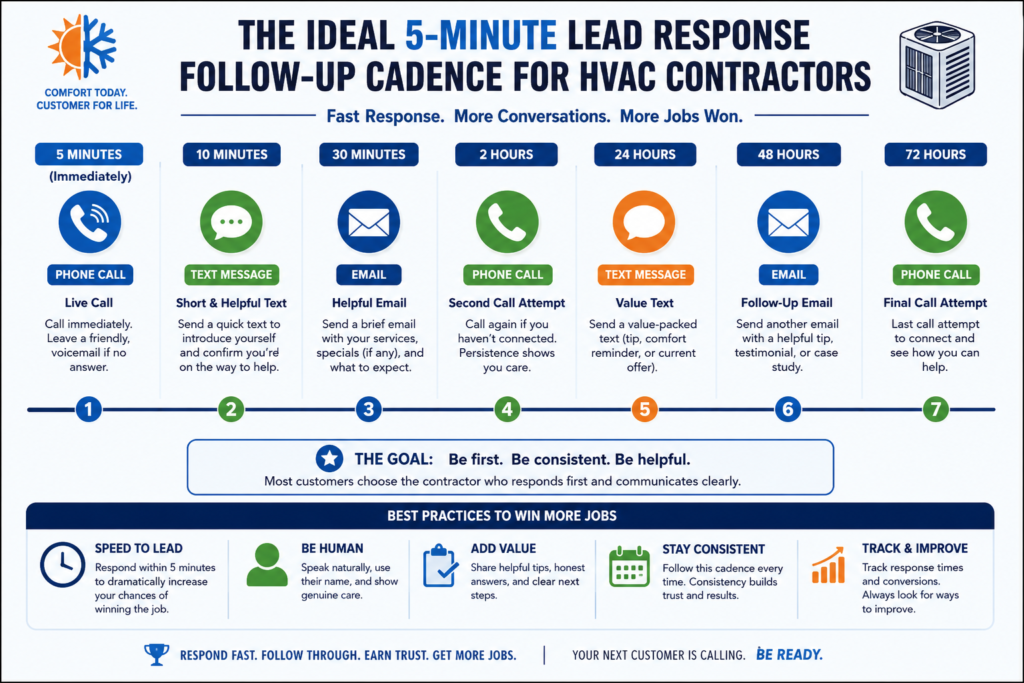
Most HVAC contractors give up after one or two attempts. A structured follow-up cadence to maximize conversion:
- Attempt 1: Call within 5 minutes of lead arrival
- Attempt 2: Text if the call goes unanswered, within 10 minutes
- Attempt 3: Second call within 1 to 2 hours
- Attempt 4: Email with quote or promotion within 24 hours
- Attempt 5: Final call or text within 48 to 72 hours
SMS Automation
Text messages are opened at far higher rates than emails and feel more personal than an automated voicemail. An SMS automation sequence can:
- Acknowledge a new lead immediately with a personal confirmation
- Remind a prospect of an upcoming estimate appointment
- Follow up after a quote with a time-sensitive financing offer
- Request a review after a completed job
Sales Scripts and Estimate Processes
A consistent, professional estimate process builds trust and reduces price shopping. Train your technicians and sales team to:
- Ask diagnostic questions before presenting any price
- Present two or three solution options at different price points
- Highlight warranties, financing, and the value of your guarantee
- Ask for the booking directly at the end of every estimate conversation
Online Reviews
Reviews are social proof that convert leads who are on the fence. Build a systematic review generation process:
- Send a review request text or email within one hour of job completion
- Use a direct link to your Google review page to reduce friction
- Respond publicly to every review, positive and negative
- Feature your review count prominently on your website and ads
Common HVAC Lead Generation Mistakes
Even well-run HVAC businesses make these mistakes. Avoiding them is often the fastest path to more booked jobs.
| Mistake | Why It Hurts | What to Do Instead |
|---|---|---|
| Buying low-quality leads | Wastes your team’s time on unqualified prospects | Vet providers and track close rate by source |
| Ignoring SEO | Leaves long-term, low-cost leads on the table | Invest in local SEO alongside paid ads |
| No call tracking | Cannot identify which campaigns actually work | Set up call tracking before running any ads |
| Weak website UX | Loses leads that paid ads worked hard to deliver | Audit mobile speed and phone number visibility |
| Slow callbacks | Competitors win the job before you call back | Build a 5-minute response process |
| No follow-up system | Leads that do not book on day one are abandoned | Implement a 5-touch follow-up sequence |
| Focusing only on volume | High lead count with low conversion burns budget | Prioritize lead quality and close rate |
Best HVAC Lead Sources for Contractors
Not all channels are equally effective for every contractor. Here is how the top lead sources compare in 2026:
| Lead Source | Lead Intent | Exclusivity | Cost Level | Best Use Case |
|---|---|---|---|---|
| Google Search (Organic) | Very high | Exclusive (you rank) | Low after SEO investment | Long-term foundation |
| Google Business Profile | Very high | Exclusive | Very low | Free local visibility |
| Google Local Services Ads | High | Near-exclusive | Medium | Fast, verified leads |
| Google Ads | High | Exclusive (your ad) | High | Immediate volume |
| Facebook/Instagram Ads | Medium | Exclusive | Medium | Awareness and retargeting |
| Yelp | Medium to high | Shared | Low to medium | Review-driven markets |
| HomeAdvisor/Angi | Medium | Shared | Medium | Gap-filling only |
| Referrals | Very high | Exclusive | Near zero | Highest close rate |
Build a Predictable HVAC Lead Generation System
Generating HVAC leads in 2026 is not about chasing the cheapest source or the highest volume. It is about building a system that consistently delivers high-intent, qualified prospects who are ready to book, and converting them faster and better than your competition.
The contractors who win are the ones who:
- Invest in their own marketing infrastructure through SEO and a strong Google presence
- Prioritize exclusive leads over shared ones to protect their close rates and pricing
- Treat lead follow-up as a professional discipline, not an afterthought
- Track every lead source with call tracking and attribution reporting
- Build a review and referral engine that generates high-trust leads at near-zero cost
Quality always beats quantity in HVAC. Ten exclusive, high-intent leads close more jobs and generate more revenue than 50 recycled names from an aggregator database. Focus on channels that deliver homeowners who are ready to buy, invest in the follow-up process to convert them, and track every lead source so you know exactly where your revenue is coming from.
If you are ready to build a lead generation system that grows your HVAC business on a sustainable, long-term basis, USA HVAC Marketing is ready to help. Contact our team at [email protected] to discuss a custom strategy for your market.
FAQs: HVAC Leads for Contractors
Q1: How do HVAC contractors get leads?
HVAC contractors generate leads through a combination of SEO, Google Ads, Local Services Ads, Google Business Profile optimization, social media marketing, referrals, and email campaigns. The most successful contractors rely on multiple lead sources instead of depending on one channel alone.
Q2: Are exclusive HVAC leads better than shared leads?
Yes, exclusive HVAC leads usually convert better because the homeowner contacts only your business instead of multiple contractors at the same time. While exclusive leads cost more upfront, they often deliver higher close rates and better ROI.
Q3: How much do HVAC leads cost?
HVAC leads can range from $20 to $150+ depending on the source, market competition, and exclusivity. Shared leads are cheaper but convert at lower rates, while exclusive leads cost more but usually generate more booked jobs.
Q4: What is the best HVAC lead generation company?
The best HVAC lead generation company is one that specializes in HVAC marketing, provides transparent reporting, offers exclusive leads, and has proven results in local markets. Look for providers with HVAC-specific experience, SEO expertise, and strong client case studies.
Q5: Is buying HVAC leads worth it?
Buying HVAC leads can help generate quick opportunities, especially for newer contractors or slow seasons. However, long-term growth usually comes from building your own lead sources through SEO, Google Business Profile optimization, referrals, and paid advertising campaigns.
Sources
- Google Support: Official documentation explaining the “Google Guaranteed” badge and how Local Services Ads function on a pay-per-lead basis.
- Harvard Business Review: A classic study on the impact of lead response times, detailing how quickly conversion potential drops after the first hour.
- ServiceTitan: An industry-leading resource for HVAC business management, providing benchmarks for lead types and marketing ROI.
- Search Engine Journal: A specialized SEO publication offering tactical advice on ranking in local search results and managing online reputation.
- Jobber: A home service business academy providing field-tested marketing ideas and referral program strategies for contractors.