Running a successful HVAC business in 2026 means competing harder than ever for every service call, installation appointment, and maintenance contract. Homeowners and property managers are not flipping through phone directories or waiting for a neighbor’s word-of-mouth referral. They are typing urgent searches into Google the moment their AC stops cooling or their furnace goes silent. If your company is not visible at that exact moment, you are handing revenue directly to a competitor. This playbook covers every dimension of Google Ads for HVAC companies, from strategy and keywords to budgets, landing pages, and tracking, so you can build a lead generation machine that runs profitably year after year.
Why Google Ads Matter for HVAC Companies in 2026
The HVAC industry has become one of the most competitive local service verticals in digital advertising. Homeowners searching for emergency AC repair or furnace replacement need a solution fast, and Google Ads puts your business at the top of those high-intent searches within hours of launching a campaign. Organic SEO is valuable but slow. Social media builds brand awareness but rarely drives emergency calls. Google Ads delivers demand-capture advertising that meets customers precisely when they have their credit cards ready.
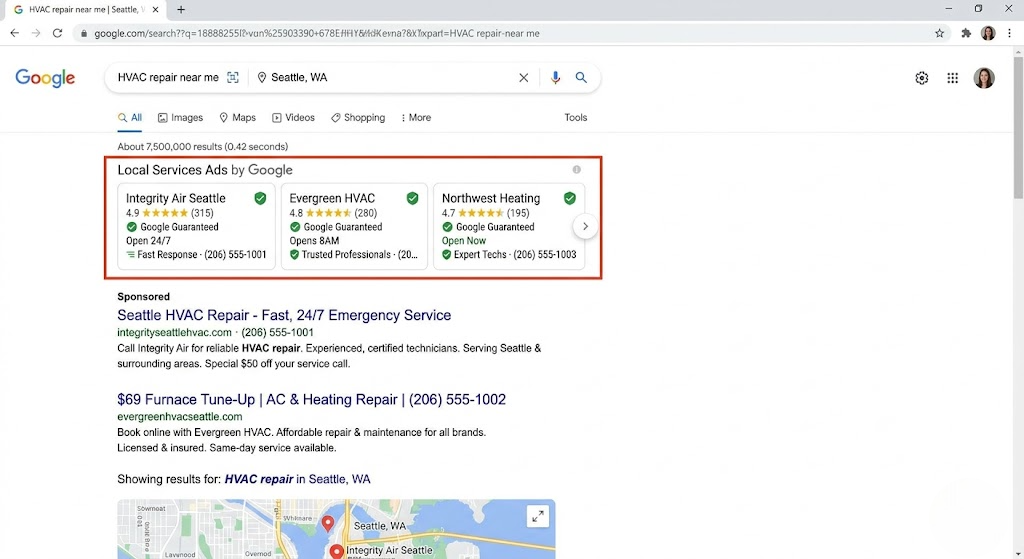
Several trends make 2026 the most important year yet to invest in HVAC paid search. Voice search and mobile queries have reshaped how people find contractors. Phrases like “AC repair near me open now” and “emergency HVAC service” are exploding in volume. As reported by WordStream, the home services sector remains one of the most effective categories for search advertising due to this high-intent behavior. Google’s AI-powered Smart Bidding has matured, enabling smaller HVAC businesses to compete effectively against national chains if campaigns are structured correctly. Local Services Ads have also layered into the Google ecosystem, and understanding how to stack LSAs alongside traditional search ads gives savvy contractors a dominant presence across the entire results page.
Beyond visibility, Google Ads creates a reliable, scalable revenue channel. Unlike referrals that arrive unpredictably or seasonal door-hangers that generate thin response rates, a well-managed PPC campaign can be turned up during peak season and dialed back in slower months. It generates measurable data on every click, call, and conversion, allowing you to optimize continuously and squeeze more leads from every dollar spent.
How HVAC Google Ads Generate Leads
Google Ads for HVAC contractors works by placing your business in front of homeowners and property managers at the exact moment they are searching for services you offer. Unlike display advertising or social campaigns that interrupt people mid-scroll, search ads appear in response to a specific query, which means the person clicking your ad already has a defined problem and is actively looking for someone to solve it.
The lead quality from Google Ads tends to be significantly higher than leads purchased from aggregator platforms. When someone calls you directly from a Google Ad, they have chosen your business based on your ad copy, your Google rating, and your landing page. They are not a recycled lead sold to four other contractors simultaneously. That exclusivity drives higher close rates and better customer lifetime value.
For HVAC contractors specifically, Google Ads delivers leads in three primary categories:
- Emergency and repair calls: Searches like “AC not working” or “furnace repair same day” indicate immediate need and carry the highest urgency and conversion intent.
- Replacement and installation inquiries: Searches around new system installation represent larger ticket jobs that can anchor an entire month’s revenue.
- Maintenance and tune-up appointments: Ongoing service agreement customers generate recurring revenue and reduce seasonal volatility.
The platform also allows HVAC contractors to control exactly when their ads appear. You can set ads to run only during business hours, exclude geographic areas outside your service radius, and allocate more budget on days when search volume historically spikes, such as the first hot weekend of summer or during a cold snap in January.
HVAC PPC Management Services vs DIY Campaigns: What’s Better?
One of the most common questions HVAC business owners face is whether to manage Google Ads themselves or hire a professional. The honest answer depends on the size of your budget, the time you can realistically invest, and your tolerance for losing money during a learning curve.
DIY Google Ads campaigns are possible, and Google has invested heavily in making the interface accessible. However, the platform’s defaults are designed to maximize Google’s revenue, not your return on investment. Auto-applying recommendations, broad match keywords, and Smart campaigns without proper negative keyword lists routinely drain HVAC advertising budgets with little to show for it.
Professional HVAC PPC management services bring several advantages that are difficult to replicate without years of platform experience:
- Faster optimization cycles: Experienced managers spot underperforming ad groups, keyword match type issues, and conversion tracking errors in days rather than months.
- Industry benchmark data: Knowing that a competitive cost-per-click for “AC repair” in a large metro is $18 to $35 helps set realistic budget expectations and spot bidding anomalies early.
- Conversion rate expertise: Getting someone to click an ad is only half the battle. Experienced HVAC PPC managers understand how to build landing pages and call flows that convert clicks into bookings.
- Time savings: Managing a PPC campaign properly requires daily attention to bids, search term reports, and quality scores. For most HVAC operators, that time is better spent running their business.
A useful way to think about the decision: if your monthly ad spend is below $1,500, DIY may be acceptable while you learn. Above that threshold, the cost of wasted spend and missed optimization opportunities almost always exceeds the cost of professional management fees.
HVAC PPC Agency: How to Choose the Right Partner
Selecting the right HVAC PPC agency is one of the most consequential decisions you will make for your digital marketing. A skilled agency accelerates growth. A poor one burns through your budget and leaves you skeptical of paid advertising altogether. Here is what to evaluate before signing any contract.
Industry Specialization
General digital marketing agencies often struggle with HVAC PPC because they lack knowledge of seasonal demand patterns, emergency service dynamics, and HVAC-specific keyword intent. Ask any prospective agency how many active HVAC clients they manage and request case study data showing lead volume and cost-per-lead performance.
Transparency in Reporting
You should always have direct access to your own Google Ads account. If an agency wants to own the account and restrict your access, that is a major red flag. Your campaign data, your audience lists, and your conversion history belong to your business, not the agency.
Clear Pricing Structure
Most reputable HVAC PPC agencies charge either a flat monthly management fee or a percentage of ad spend, typically between 10% and 20%. Be cautious of agencies that bundle ad spend into their invoice without a clear breakdown, as this obscures whether your money is going toward media or overhead.
Communication Cadence
A good agency provides monthly performance reports, is reachable when campaign issues arise, and proactively communicates changes before they are implemented. Ask how they handle budget conversations, what happens if your cost-per-lead rises unexpectedly, and who your dedicated point of contact will be.
Proof of Results
Request references from other HVAC clients. Ask specifically about lead volume, average cost per lead, and how long it took to see meaningful results after campaign launch. Any agency reluctant to provide this information should be disqualified.
When to Hire an HVAC PPC Agency for Better ROI
Knowing when to bring in a professional HVAC PPC agency is as important as knowing how to choose one. Many contractors attempt to manage their own campaigns and hire an agency only after they have burned through thousands of dollars with little return. Catching the right moment earlier saves money and accelerates growth.
You should seriously consider hiring an HVAC PPC agency when:
- Your monthly ad spend exceeds $2,000 and your cost per lead is trending higher than expected for your market.
- You are spending more than two hours per week inside Google Ads and still feel uncertain about what is working.
- Your conversion tracking is not set up properly, meaning you are flying blind on which campaigns generate actual calls and bookings.
- You are entering a new geographic market or launching a new service line and need fast, structured campaign buildout.
- Your competitors are consistently appearing above you in search results despite similar or higher bids.
- Seasonal demand spikes like summer AC season or winter heating emergencies are not being captured efficiently.
The ROI case for hiring an agency is typically straightforward. If an agency fee is $1,500 per month and proper campaign management reduces your cost per lead from $90 to $55 while increasing lead volume by 30%, the math almost always favors professional management within the first two months.
HVAC Paid Advertising Services That Drive Calls and Bookings
HVAC paid advertising encompasses a broader ecosystem than Google search ads alone. A comprehensive paid advertising strategy layers multiple channels and ad formats to capture demand at different stages and maximize your share of local search visibility.
Google Search Ads
The backbone of any HVAC paid strategy. Text-based ads appear at the top of search results for high-intent queries and drive direct phone calls and form submissions.
Google Local Services Ads
LSAs appear above traditional search ads and display your Google Guarantee badge, business rating, and phone number. According to official documentation from Google Ads Help, these ads operate on a pay-per-lead model and are particularly powerful for emergency service searches. Stacking LSAs alongside search ads gives your business maximum page coverage.
Google Display Ads (Retargeting)
Display retargeting shows visual ads to people who have previously visited your website but did not call or book. In HVAC, where homeowners often visit two or three contractor sites before deciding, retargeting keeps your brand top of mind and recaptures undecided prospects at a fraction of the cost of new acquisition.
YouTube Pre-Roll Ads
Video ads on YouTube build brand recognition in your local market. A 15-second ad showing your technicians, equipment, and service guarantee runs before videos watched by homeowners in your target area and reinforces awareness that supports search ad performance.
Seasonal Promotions
Paid advertising services for HVAC should also include structured seasonal campaigns around tune-up specials, new system financing offers, and emergency service guarantees. These campaigns layer promotional intent on top of search intent and improve conversion rates during peak booking windows.
HVAC Google Ads Keyword Strategy: High-Intent Keywords That Convert
Keyword strategy is the foundation of every profitable HVAC Google Ads campaign. Choosing the wrong keywords means paying for clicks from people who will never hire you. Choosing the right ones means every dollar drives a potential customer.
HVAC keywords generally fall into three intent categories:
| Keyword Intent | Example Keywords | Conversion Potential |
| Emergency / Immediate | AC repair near me, furnace not working, emergency HVAC service | Very High |
| Purchase / Installation | New AC unit installation, HVAC system replacement cost, best HVAC company near me | High |
| Maintenance / Seasonal | AC tune-up special, furnace maintenance service, HVAC seasonal checkup | Medium |
| Informational | How much does AC repair cost, HVAC system lifespan, what is a heat pump | Low |
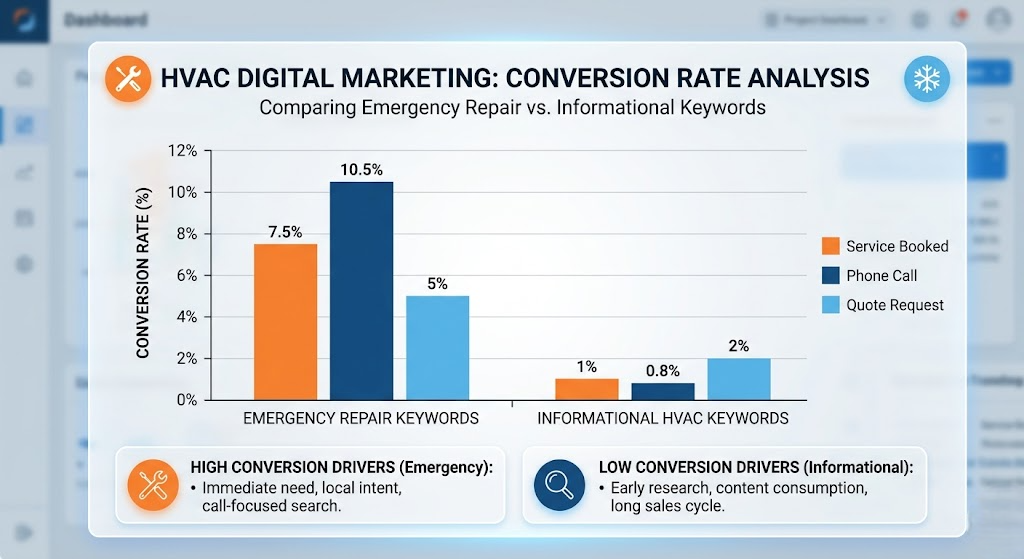
Best practices for HVAC keyword strategy include using exact match and phrase match keywords to control traffic quality, building tightly themed ad groups where each group contains closely related keywords that share a single dedicated landing page, and maintaining an aggressive negative keyword list that excludes terms like “DIY,” “how to,” “jobs,” “salary,” and equipment brand names when you do not service or sell that brand.
Long-tail keywords also deserve attention. While “AC repair” is competitive and expensive, “same-day AC repair in [city name]” or “24-hour air conditioning service [neighborhood]” often carries lower competition, lower cost-per-click, and higher conversion rates because the searcher has communicated both urgency and location specificity.
Writing High-Converting HVAC Google Ads: Ad Copy That Gets Clicks
Ad copy is where your Google Ads either earn their keep or waste your budget. The same keyword can generate wildly different results depending on the quality of the ad a searcher sees. HVAC ad copy needs to accomplish three things in the space of a few headlines and two description lines: capture attention, establish trust, and drive action.
The strongest HVAC ad copy follows these principles:
- Lead with urgency or benefit: Headlines like “Same-Day AC Repair” or “24/7 Emergency HVAC Service” immediately signal relevance to someone with an urgent problem.
- Include your location: Google personalizes ads, but including your city or service area in headlines reinforces local relevance and builds confidence that you actually serve their neighborhood.
- Display social proof: Using ad copy like “500+ 5-Star Reviews” or “Family-Owned Since 1998” establishes credibility before a prospect has even visited your website.
- State your offer clearly: Whether it is a free diagnostic, a tune-up special, or a financing promotion, clear offers outperform vague claims every time.
- Use a direct CTA: “Call Now for a Free Estimate” or “Book Online in 60 Seconds” gives the searcher a clear next step.
Ad extensions are equally important and often underutilized. Call extensions display your phone number directly in the ad. Sitelink extensions highlight specific service pages. Callout extensions add short benefit statements like “Licensed and Insured” or “Same-Day Service Available.” Structured snippet extensions can list the specific systems and brands you service. Using all available extensions increases ad real estate and improves click-through rates significantly.
Landing Pages for HVAC Google Ads: Convert More Traffic into Leads
Sending paid traffic to a poorly designed landing page is like hiring a great salesperson and then locking them in a room without a phone. Your landing page is where conversions happen or do not happen, and it deserves as much attention as your keyword strategy and ad copy.
An effective HVAC landing page includes:
- A clear, benefit-driven headline that matches the ad the visitor clicked. Message match is critical. If your ad said “Same-Day Furnace Repair,” your landing page headline should reinforce that promise immediately.
- A prominent phone number above the fold, ideally click-to-call formatted for mobile visitors, who represent the majority of HVAC emergency searchers.
- A short booking form requesting only the most essential information: name, phone number, service type, and preferred appointment time. Long forms kill conversion rates.
- Trust signals including Google rating, number of reviews, years in business, licensing information, and any manufacturer certifications or industry associations.
- A photo or short video of your team, trucks, or job site that humanizes your business and differentiates you from faceless competitors.
- A clear service area statement so visitors immediately confirm you work in their location.
Mobile optimization is non-negotiable. More than 70% of HVAC emergency searches happen on smartphones. Pages that load slowly, require pinch-to-zoom, or bury the phone number below multiple scrolls lose leads at an unacceptable rate. Test your landing pages on multiple devices before launching any campaign.
Budgeting and Bidding Strategy for HVAC PPC Campaigns
One of the most common sources of frustration for HVAC contractors new to Google Ads is setting budgets without context. Spending too little in a competitive market produces no meaningful data and no leads. Spending without a bidding strategy produces data but often at an unprofitable cost per lead.
A realistic starting budget for HVAC Google Ads in a mid-size metro area ranges from $2,000 to $5,000 per month. Industry analysis from LocaliQ indicates that average cost-per-click for home services can vary significantly based on local competition. In larger, more competitive markets like Phoenix, Houston, or Atlanta, competitive campaigns often require $6,000 to $15,000 per month to achieve meaningful lead volume. These are not arbitrary numbers; they reflect the cost-per-click reality of HVAC keywords, which typically range from $8 to $45 depending on the service type, geography, and competition level.
Bidding strategies should evolve with campaign maturity:
- New campaigns (first 30 to 60 days): Use Manual CPC or Maximize Clicks to gather data. Smart Bidding algorithms need conversion history to optimize properly, and forcing them too early produces unpredictable results.
- Established campaigns with 30 or more monthly conversions: Transition to Target CPA bidding, setting a target that is realistic based on your actual cost-per-lead data.
- Mature, high-volume campaigns: Consider Target ROAS bidding if you have connected revenue data, allowing the algorithm to optimize toward your most profitable service types.
Budget allocation should also reflect seasonality. In most HVAC markets, air conditioning demand peaks between May and August while heating demand peaks between November and February. Allocating 60% to 70% of your annual budget to these peak windows and reducing spend during shoulder months maximizes the return on your total annual investment.
Common HVAC Google Ads Mistakes That Waste Budget
Even well-intentioned HVAC Google Ads campaigns can hemorrhage budget through predictable and avoidable mistakes. Understanding these pitfalls is as valuable as knowing what to do right.
- Running broad match keywords without negatives: Broad match tells Google to show your ad for any loosely related query. Without negative keywords, HVAC contractors routinely pay for searches like “HVAC technician jobs near me” or “how to fix AC yourself.” These clicks never become customers.
- Sending all traffic to the homepage: Your homepage serves multiple audiences and contains competing calls to action. PPC traffic needs dedicated landing pages tailored to the specific service and ad that drove the visit.
- Ignoring search term reports: Google Ads shows you the exact queries that triggered your ads. Reviewing this report weekly reveals irrelevant searches burning budget and uncovers new high-performing keywords you may have missed.
- Setting and forgetting campaigns: Google routinely suggests campaign changes, budget increases, and new keywords that serve its interests more than yours. Campaigns without active management drift toward inefficiency within weeks.
- Skipping call tracking: If you cannot tie inbound calls to specific campaigns, keywords, and ads, you cannot optimize toward what is actually working. Call tracking is foundational, not optional.
- Bidding on competitor brand names without a clear strategy: While competitor keyword bidding can work, it is expensive and often attracts low-intent clicks from people who are specifically loyal to that competitor.
- Neglecting ad schedule optimization: Running ads at 2:00 AM when your office is closed and you cannot answer calls wastes budget. Adjusting bid modifiers by time of day and day of week aligns your spending with your actual business hours and peak response capability.
Tracking ROI from HVAC PPC Campaigns: Metrics That Matter
You cannot manage what you cannot measure. Tracking ROI from HVAC PPC campaigns requires setting up proper conversion tracking before you spend your first dollar and then monitoring a focused set of metrics that connect advertising activity to business outcomes.
| Metric | Why It Matters | Target Benchmark |
| Cost Per Lead (CPL) | Core efficiency metric showing what you pay for each inbound lead. | $50 to $150 depending on market and service type |
| Lead-to-Appointment Rate | Measures how well your team converts inbound leads to booked jobs. | 50% or higher for emergency calls |
| Click-Through Rate (CTR) | Indicates how compelling your ads are relative to the competition. | 5% to 12% for HVAC search ads |
| Conversion Rate | Percentage of clicks that become leads. Reflects landing page quality. | 8% to 20% for well-optimized pages |
| Quality Score | Google’s rating of ad relevance. Higher scores lower your cost-per-click. | 7 or above on core keywords |
| Revenue Per Lead | Links PPC investment to actual job revenue for true ROI calculation. | Varies by service; track by campaign |
Connecting Google Ads to a CRM or dispatch system unlocks the next level of optimization. When you can see not just which keywords generated leads but which ones generated completed jobs and at what revenue value, you can allocate budget with far greater precision. An AC installation keyword that generates fewer leads at a higher cost per click may deliver far better ROI than a repair keyword with cheaper traffic if the installation jobs average $8,000 versus $250 for a repair service call.
HVAC Google Ads Cost: How Much Should You Spend?
Understanding HVAC Google Ads cost requires looking at both the platform cost and the management cost as separate but related investments. Combining them thoughtfully is what produces sustainable, profitable campaigns.
On the ad spend side, the primary cost driver is cost-per-click. HVAC keywords are among the more expensive in local services advertising because the jobs are high-value and competition is intense.
| Service Type | Average CPC Range | Typical Monthly Budget Range |
| Emergency AC Repair | $20 to $45 | $2,500 to $8,000 |
| Furnace Repair | $15 to $35 | $2,000 to $6,000 |
| New HVAC Installation | $18 to $40 | $3,000 to $10,000 |
| AC Tune-Up / Maintenance | $8 to $18 | $1,000 to $3,000 |
| Heat Pump Installation | $20 to $42 | $2,500 to $8,000 |
Management fees add to the total investment but should be evaluated against the value they generate. A well-managed campaign that costs $1,200 per month in management fees but reduces cost per lead by $40 while adding 20 leads per month delivers a clear net positive. Calculate management cost as a percentage of the total return, not just a line item against ad spend.
How Long Does It Take for HVAC Google Ads to Work?
This is one of the most frequently asked questions from HVAC contractors evaluating paid search, and the honest answer is that it depends on your market, budget, campaign structure, and what “working” means to you. Here is a realistic timeline:
- Week 1 to 2: Account setup, campaign launch, and initial data collection. You will likely see some early clicks and possibly a few leads, but this phase is primarily about building the foundation.
- Days 14 to 30: Initial optimization begins. Your manager reviews search terms, adjusts bids, refines ad copy based on early CTR data, and tightens keyword match types. Lead volume typically increases and cost per lead begins to stabilize.
- Month 2: Quality Score improvements compound. Better scores lower CPCs. Campaigns generate enough conversion data to inform smarter bidding decisions. Most HVAC contractors see meaningful, consistent lead flow by the end of month two.
- Month 3 and beyond: Campaigns mature. Seasonal adjustments are applied. Retargeting lists populate and begin recapturing lost prospects. Cost per lead continues to improve as negative keyword lists grow and landing pages are refined based on conversion data.
It is important to set realistic expectations with any agency or internal team managing your campaigns. Promising 50 leads in the first week is a red flag. A well-managed HVAC Google Ads campaign builds momentum over two to three months and then delivers compounding results as optimization layers accumulate.
Final Thoughts: Building a Profitable HVAC Google Ads System
A profitable HVAC Google Ads system is not a single campaign or a one-time setup. It is an interconnected system of keyword strategy, compelling ad creative, high-converting landing pages, disciplined budget management, accurate tracking, and continuous optimization. Every component depends on the others, and weakness in any single area limits the performance of the whole.
The HVAC contractors who win at Google Ads treat it as an investment, not an expense. They measure performance rigorously, optimize relentlessly, and build on what the data reveals. At USA HVAC Marketing, we work exclusively with HVAC businesses across the country to build and manage Google Ads campaigns that generate consistent, high-quality leads without wasted spend. Our team understands the seasonal dynamics, competitive pressures, and service economics that make HVAC paid search fundamentally different from every other industry.
Whether you are launching your first campaign or rebuilding a struggling account, the principles in this playbook give you a clear foundation. Start with the right keywords, build dedicated landing pages for each service, set your budget to match your market’s competitiveness, and track every lead back to its source. Then optimize, test, and refine until every dollar is working as hard as you are.
The homeowner whose furnace just failed tonight is searching Google right now. The question is whether they find you or your competitor. Build the system that makes that decision easy. If you are ready to stop guessing and start growing, USA HVAC Marketing is ready to help. Reach out today at [email protected].
Frequently Asked Questions About HVAC Google Ads
1. How much should an HVAC company spend on Google Ads?
HVAC Google Ads costs vary based on your location, competition, and the services you promote. Most HVAC companies invest between $2,000 and $10,000 per month in ad spend, while highly competitive markets may require even larger budgets for consistent lead flow. Cost-per-click for HVAC keywords typically ranges from $8 to $45 depending on the search intent and service type. If you hire an HVAC PPC agency, management fees usually range from $800 to $2,500 monthly in addition to ad spend.
2. What are the best HVAC Google Ads keywords for generating leads?
The best HVAC Google Ads keywords are high-intent searches that indicate someone is ready to call or book a service. Examples include:
- AC repair near me
- Emergency HVAC service
- Furnace repair same day
- HVAC installation cost
- Air conditioner replacement
- 24-hour heating repair
Long-tail keywords with local modifiers often convert even better because they show urgency and location intent. Informational searches like “how HVAC systems work” usually generate low-quality traffic and should be excluded or limited with negative keywords.
3. How can HVAC companies track leads and ROI from Google Ads?
To accurately track HVAC PPC performance, you need proper conversion tracking in place. This typically includes:
- Call tracking software for phone calls
- Google Ads conversion tracking for forms and calls
- CRM integration to track booked jobs and revenue
These systems help identify which keywords, ads, and campaigns generate real customers instead of just clicks. Without proper tracking, it becomes difficult to optimize campaigns or calculate your true return on investment.
4. Should HVAC contractors use Google Local Services Ads or Search Ads?
Most HVAC companies see the best results by combining Google Local Services Ads (LSAs) with traditional Google Search Ads. LSAs appear at the very top of search results and include the Google Guarantee badge, helping build trust and increase call volume for emergency HVAC services. Traditional Search Ads provide greater control over keywords, ad copy, landing pages, and bidding strategies. Using both together maximizes visibility and captures more high-intent leads.
5. How long does it take for HVAC Google Ads to start working?
Most HVAC Google Ads campaigns begin generating clicks and leads within the first few days after launch. However, consistent and optimized performance usually takes two to three months. The first month focuses on collecting data and identifying winning keywords. By the second month, campaigns are optimized for better conversion rates and lower costs. By month three, Smart Bidding and conversion data typically produce more stable lead flow and stronger ROI.
Sources
- WordStream: A leading provider of digital marketing data and benchmarks for small business advertising.
- Google Ads Help: Official documentation from Google regarding the setup and function of Local Services Ads.
- LocaliQ: A marketing platform providing industry-specific research on search engine marketing costs and performance.