If you are an HVAC contractor struggling to fill your schedule, keep trucks busy during slow seasons, or compete with the big companies dominating Google search results, this guide is for you. Digital marketing has completely transformed how homeowners and businesses find HVAC companies. The days of referrals and Yellow Pages ads are fading fast. In 2026, your online presence is your most powerful sales tool.
This comprehensive guide walks you through every pillar of HVAC digital marketing, from SEO and Google Ads to local listings, lead generation, and choosing the right agency. Whether you are just getting started or looking to scale, you will leave with a clear roadmap to more calls, more booked jobs, and better ROI.
Why Digital Marketing Matters for HVAC Contractors in 2026
Changing Customer Behavior
Today’s homeowners do not flip through directories or ask neighbors first. They pull out their phones. A report from BrightLocal highlights that over 80% of consumers research local services online before making a purchase decision. For HVAC companies, this means your potential customer has already formed an opinion about you before they ever pick up the phone.
The customer journey has shifted from passive to active. Homeowners compare reviews, check websites, read before-and-after stories, and evaluate trust signals, all within minutes. If your HVAC business does not appear prominently in that research phase, you simply will not get the call.
Mobile Searches Are Dominating
More than 60% of all local service searches now happen on mobile devices, according to data provided by Statista. Searches like “AC repair near me” or “HVAC emergency service” spike in real time when a system breaks down. Studies analyzed by Think with Google consistently show that the majority of location-based searches result in an offline purchase, often within 24 hours.
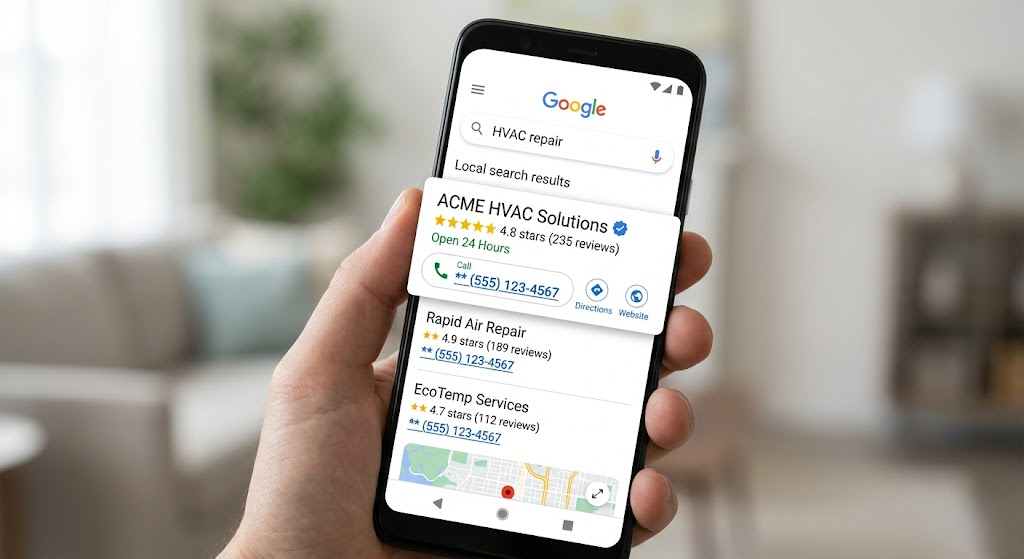
For HVAC contractors, this creates an enormous opportunity, but only if your website loads fast on mobile, your Google Business Profile is fully optimized, and you appear in the local map pack for the right keywords.
Local Competition Is Heating Up
Private equity-backed HVAC companies and regional chains are aggressively investing in digital marketing. Independent contractors who rely solely on word-of-mouth are losing market share year over year. The difference between a booked-out HVAC company and one that is struggling is often a well-executed digital strategy, not the quality of their work.
Seasonal Demand Requires Year-Round Marketing
HVAC demand spikes in summer and winter, creating feast-or-famine cycles for many contractors. Smart digital marketing helps you level out that curve by capturing air conditioning leads in spring before competitors, locking in maintenance contracts in fall, and using the off-season to build brand awareness and SEO authority.
Pro Insight: HVAC companies that run year-round digital campaigns generate 30 to 40% more annual revenue than those who only advertise during peak seasons.
Here is how smart HVAC contractors align their digital marketing with seasonal demand:
| Season | Primary Focus | Key Channels |
|---|---|---|
| Spring (Mar-May) | AC tune-ups, cooling system installs | Google Ads, SEO, Email |
| Summer (Jun-Aug) | Emergency AC repair, fast-response ads | Google LSA, PPC, GBP |
| Fall (Sep-Nov) | Furnace checks, maintenance agreements | SEO content, Social, Email |
| Winter (Dec-Feb) | Emergency heat repair, off-season brand building | PPC, Retargeting, GBP |
What HVAC Digital Marketing Includes
HVAC digital marketing is not a single tactic. It is an integrated system of multiple channels working together to generate awareness, build trust, and convert visitors into paying customers. Here is what a complete strategy looks like:
Search Engine Optimization (SEO)
SEO is the process of optimizing your website and online presence so that Google ranks you higher in organic search results. For HVAC contractors, this means appearing when someone searches for furnace repair or AC installation in your city without paying for every click. SEO takes time to build but delivers long-term, compounding returns.
Pay-Per-Click Advertising (PPC)
Google Ads and Microsoft Ads allow you to appear at the very top of search results instantly. You pay only when someone clicks. For HVAC companies, PPC is especially powerful for emergency services and seasonal campaigns where immediate visibility matters more than long-term authority.
Google Business Profile Optimization
Your Google Business Profile is what appears in the local map pack, the three business listings that show up with a map on Google search results. Properly optimized profiles with photos, reviews, and updated service information dramatically increase calls from nearby customers.
Online Reviews and Reputation Management
Reviews are the digital equivalent of word-of-mouth referrals. A study conducted by BrightLocal shows that 87% of consumers read online reviews for local businesses, and 79% trust online reviews as much as personal recommendations. Actively managing your reputation across Google, Yelp, and Facebook is non-negotiable in 2026.
Website Optimization
Your website is your 24/7 salesperson. It needs to load fast, work perfectly on mobile, clearly explain your services, display trust signals, and make it simple for visitors to call or book an appointment. A slow, outdated website loses you leads every single day.
Social Proof and Content Marketing
Before-and-after photos, customer testimonials, educational blog posts, and FAQ content all build trust and improve your SEO simultaneously. Social proof is often the deciding factor for homeowners comparing two HVAC companies.
Here is a quick overview of how each digital marketing channel works for HVAC contractors:
| Channel | Best For | Time to Results |
|---|---|---|
| SEO | Long-term organic lead generation | 3 to 6 months |
| Google Ads (PPC) | Immediate leads, emergency calls | 24 to 48 hours |
| Google Local Services Ads | Verified leads with Google Guarantee badge | 1 to 2 weeks |
| Google Business Profile | Local map pack visibility and reviews | Ongoing |
| Website Optimization | Improving conversion rate of all traffic | Immediate after launch |
| Reputation Management | Building trust and influencing purchase decisions | Ongoing |
How HVAC SEO Services Help Contractors Rank Locally
HVAC SEO services are specialized search engine optimization strategies tailored specifically to heating, cooling, and ventilation companies. Unlike generic SEO, these services focus on hyper-local ranking factors, service-area targeting, and the specific keywords HVAC customers use when they need help.
Targeting the Right Local Keywords
Effective HVAC SEO starts with keyword research built around how your actual customers search. High-value local keywords include terms like AC repair in your city, emergency furnace service in your zip code, HVAC installation near me, and heat pump replacement in your neighborhood. These long-tail, intent-driven keywords convert at significantly higher rates than broad terms.
Nearly half of all Google searches have local intent, meaning an enormous share of searches are looking for something nearby. Capturing even a fraction of that local search traffic in your service area can transform your lead volume.
Building Dedicated Service Pages
One of the most impactful HVAC SEO tactics is creating individual landing pages for each service you offer in each city you serve. Rather than one generic Services page, you build targeted pages like Air Conditioning Repair in Austin TX or Furnace Installation in Plano TX. Each page is optimized with local keywords, service descriptions, reviews, and a clear call to action.
Technical SEO for HVAC Websites
Technical SEO ensures Google can crawl, index, and understand your website properly. Guidelines from Google Search Central emphasize that factors like site speed and mobile responsiveness are now critical ranking signals. This includes implementing schema markup, setting up proper internal linking, and resolving duplicate content issues.
Ranking in the Google Map Pack
The map pack is the three local business listings that appear with a map at the top of local search results. Appearing there puts your phone number and reviews front and center before a potential customer even scrolls to organic results.
Key Stat: Research from Backlinko shows that the top three positions in Google’s local map pack capture over 75% of all local search clicks.
The table below breaks down the key factors that influence your HVAC map pack and organic rankings:
| Ranking Factor | Why It Matters for HVAC |
|---|---|
| Google Business Profile completeness | Incomplete profiles rank lower and earn fewer calls |
| Review quantity and recency | More recent reviews signal an active, trustworthy business |
| NAP consistency across directories | Inconsistent info confuses Google and reduces authority |
| Service-specific landing pages | Helps Google match your pages to the right local searches |
| Page speed and mobile performance | Core Web Vitals are confirmed Google ranking signals |
| Local backlinks and citations | Links from local businesses and directories build authority |
HVAC Google Ads Management for Fast Leads
While SEO builds long-term authority, HVAC Google Ads management delivers fast results. When a homeowner’s air conditioner breaks down in July, they are not waiting to find you organically. They are clicking the first result they see. That first result is usually a paid ad, and the companies running those ads are capturing the most urgent, highest-converting leads available.
Emergency Service Ads That Convert
HVAC emergency calls are the highest-value leads you can generate. Google Ads allows you to target keywords like emergency AC repair tonight, 24-hour HVAC service, and same-day furnace repair with pinpoint precision. These campaigns can go live within 24 to 48 hours and start generating calls almost immediately, something SEO simply cannot match for speed.
Call-Only Campaigns for Maximum Conversions
For HVAC companies, getting the phone to ring is often the primary goal. Google’s Call-Only campaigns show ads that, when clicked on mobile, immediately dial your business with no website visit required. This eliminates friction in the conversion process and is ideal for urgent service calls where every minute counts.
Smart Budget Management
One of the biggest mistakes HVAC contractors make with Google Ads is setting and forgetting their campaigns. Without active management, budgets get wasted on irrelevant searches, poorly converting keywords, and off-hours impressions. Professional HVAC Google Ads management includes negative keyword maintenance, bid adjustments by time of day and geography, ad copy testing, and regular performance reviews.
Measuring ROI on HVAC Paid Ads
Every dollar you spend on Google Ads should be tracked. This means using call tracking numbers, setting up Google Ads conversion tracking, connecting your ads to Google Analytics, and monitoring cost per lead, lead-to-appointment rate, and revenue generated per campaign.
Here is a breakdown of the main Google Ads campaign types and how HVAC contractors use them:
| Campaign Type | Best Use Case | Typical Cost Per Lead |
|---|---|---|
| Search Ads | Broad service and installation keywords | $40 to $90 |
| Call-Only Ads | Emergency repair, mobile users | $30 to $75 |
| Local Services Ads (LSA) | High-intent leads with Google Guarantee | $20 to $80 |
| Remarketing Ads | Re-engaging website visitors who did not call | $10 to $35 |
| Display Ads | Brand awareness in your service area | Lower intent, brand focused |
Local HVAC Marketing Services That Generate Nearby Customers
Local HVAC marketing services are strategies specifically designed to attract customers within your service area, including your city, surrounding suburbs, and target zip codes. These services focus on proximity-based search intent and are the backbone of sustainable lead generation for most HVAC contractors.
Optimizing Your Google Business Profile
Your Google Business Profile is the single most important free marketing asset available to HVAC contractors. A guide from Google Business Profile explains that businesses with complete profiles are 70% more likely to attract location visits and 50% more likely to lead to a purchase compared to incomplete profiles.
Building and Managing Online Reviews
Reviews are local SEO fuel. More reviews, especially recent ones, signal to Google that your business is active and trusted. A systematic review generation strategy, such as sending post-service follow-up texts or emails with a direct link to your Google review page, can rapidly build your review count. Aim for a minimum of 50 Google reviews before considering your profile competitive in most markets.
Local Citations and Directory Listings
Local citations are mentions of your business name, address, and phone number across the web on sites like Yelp, Angie’s List, HomeAdvisor, the Better Business Bureau, and industry-specific directories. Consistent, accurate citations across 50 or more directories strengthen your local SEO authority and improve your map pack rankings.
Geo-Targeted Landing Pages
Geo-targeted landing pages are city- or neighborhood-specific pages on your website designed to rank for local searches in areas beyond your primary location. If you serve 10 cities, you should have 10 location-specific pages, each with unique content, local references, and a clear call to action.
Use this checklist to assess the strength of your local HVAC marketing presence:
- Google Business Profile: 100% complete with photos, services, and hours
- Google review count: 50 or more with consistent 4.5+ star average
- Review response rate: 100% of reviews responded to within 48 hours
- NAP consistency: Identical across all 50+ directory listings
- Geo-targeted landing pages: One page per city or major suburb served
- Local citations: Listed on 50 or more relevant directories
- GBP posts: At least 2 posts per month with seasonal promotions
HVAC Lead Generation Services That Actually Work
HVAC lead generation services are strategies and tools specifically designed to attract, capture, and convert prospective customers. Not all leads are equal. The best lead generation systems filter for high-intent prospects who are ready to book, not just browse.
Paid Advertising for Immediate Leads
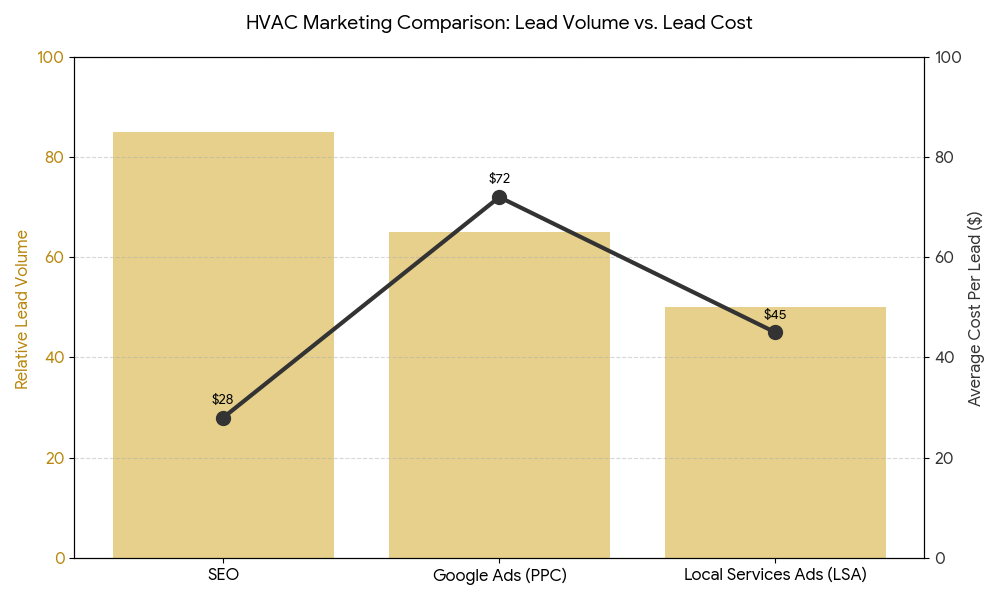
Google Ads, Google Local Services Ads, and Meta ads are the fastest ways to generate HVAC leads. A case study from WordStream notes that HVAC lead costs through LSAs typically range from $20 to $80 per verified lead, making them highly efficient. HomeAdvisor and Angi can also supplement your lead volume, though lead quality and exclusivity vary.
High-Converting Contact Forms and Booking Tools
Your website’s contact and booking forms are often the difference between a lead and a lost opportunity. Best practices include keeping forms short with fields for name, phone, service needed, and zip code; offering online scheduling integration; and following up with automated text and email sequences.
Call Tracking for Lead Attribution
Call tracking technology assigns unique phone numbers to each of your marketing channels so you know exactly which source generated each call. This data is critical for making smart budget decisions and proving ROI.
Here is how the most common HVAC lead generation sources compare:
| Lead Source | Average Cost Per Lead | Lead Exclusivity |
|---|---|---|
| Google Local Services Ads | $20 to $80 | Exclusive to your business |
| Google Search Ads | $40 to $90 | Exclusive to your business |
| HomeAdvisor / Angi | $15 to $100+ | Shared with up to 4 competitors |
| Organic SEO | $5 to $20 (blended) | Exclusive, earned over time |
| Facebook / Instagram Ads | $25 to $70 | Exclusive to your business |
| Referral / Word of Mouth | Near zero cost | Exclusive |
Choosing the Right HVAC Digital Marketing Agency
Choosing an HVAC digital marketing agency is one of the most important business decisions you will make. The right partner will grow your revenue systematically. The wrong one will drain your budget with little to show for it.
What to Look For in an HVAC Marketing Agency
- Proven experience working specifically with HVAC or home services contractors
- Transparent, itemized reporting showing leads generated and cost per lead
- You retain ownership of your website, ad accounts, and all data
- Dedicated account manager and a defined reporting cadence
Red Flags to Watch For
- Guarantees of a number one Google ranking
- Locked-in contracts with no performance benchmarks
- The agency owns your Google Ads account instead of you
Use this scorecard when comparing HVAC digital marketing agencies:
| Evaluation Criteria | What to Look For |
|---|---|
| HVAC-specific experience | 5 or more active HVAC clients with verifiable results |
| Reporting transparency | Monthly reports with CPL, traffic, and ranking data |
| Account ownership | You own your website, domain, and ad accounts |
| Contract terms | Month-to-month or fair exit clause after ramp period |
| Communication | Dedicated account manager with 24-hour response time |
| Strategy clarity | Written 90-day plan with measurable milestones |
Website Features Every HVAC Contractor Needs
Your website is the hub of all your digital marketing efforts. Every ad you run eventually leads back to your website. If your site underperforms, your entire marketing system leaks leads.
Mobile Optimization and Page Speed
Over 65% of HVAC service searches happen on mobile. Your website must be fully responsive and load quickly. Technical resources from Google Search Central indicate that slow load times can actively damage your ranking and user conversion rates.
Trust Signals and Financing
Trust signals tell a first-time visitor that you are a legitimate, professional company. These include star rating badges, BBB accreditation logos, and NATE certification badges. Additionally, displaying financing options prominently on your website reduces purchase anxiety for expensive system replacements.
Here is a quick-reference website audit checklist for HVAC contractors:
- Mobile responsiveness: Fully responsive on all screen sizes
- Page load speed: Under 3 seconds on mobile (PageSpeed score 80+)
- Click-to-call phone number: Visible in header on every page
- Contact / booking form: Short form with name, phone, service, and zip
- Online scheduling: Integration with ServiceTitan, Housecall Pro, or similar
- Trust badges: Google stars, BBB, manufacturer certifications visible
- Financing information: Prominently displayed on installation pages
- Service area pages: Individual page per city or suburb served
- SSL certificate: HTTPS enabled across all pages
- Google Analytics 4: Fully configured with conversion tracking active
How Much HVAC Digital Marketing Costs in 2026
One of the first questions HVAC contractors ask is what digital marketing is going to cost. It depends on your market size, goals, and the channels you prioritize.
| Service | Typical Monthly Cost | Notes |
|---|---|---|
| HVAC SEO | $1,000 to $3,500/mo | Excludes ad spend |
| Google Ads Management | $500 to $1,500/mo | Plus ad spend of $1,500 to $8,000 |
| Local Services Ads (LSA) | $20 to $80 per lead | Pay-per-verified-lead model |
| Full-Service Agency | $2,500 to $7,500/mo | Excludes ad spend |
| Website Build or Redesign | $2,500 to $8,000 one-time | Ongoing updates billed separately |
| Reputation Management | $300 to $800/mo | Review generation and monitoring |
Common HVAC Marketing Mistakes to Avoid
Even well-intentioned HVAC marketing efforts often fail because of avoidable mistakes.
Mistake 4: No Follow-Up System
Most HVAC leads do not convert on the first contact. An analysis by Invesp shows that 80% of sales require five or more follow-up touchpoints, yet most contractors give up after one or two attempts. Implement automated follow-up sequences via text and email for every lead that does not immediately book.
| Common Mistake | How to Fix It |
|---|---|
| Outdated or slow website | Redesign with mobile-first, fast-loading theme |
| No conversion tracking | Set up Google Analytics 4 and call tracking |
| Broad, non-local keywords | Use geo-modified, intent-specific keyword targeting |
| No follow-up system | Automate text and email follow-up within 5 minutes |
| Ignoring reviews | Set up automated review request sequences after jobs |
| No seasonal strategy | Plan campaigns 6 to 8 weeks ahead of seasonal spikes |
How to Measure HVAC Marketing ROI
You cannot manage what you do not measure. Tracking the right metrics transforms your marketing from a cost center into a predictable revenue engine.
| KPI | How to Calculate | Healthy Benchmark |
|---|---|---|
| Cost Per Lead (CPL) | Total spend / total leads | Under $75 for service, $150 for install |
| Lead-to-Appointment Rate | Booked jobs / total leads | 50% or higher |
| Lead-to-Close Rate | Completed jobs / appointments | 70% or higher |
| Customer Acquisition Cost | Total spend / new customers | Under one-third of customer lifetime value |
| Return on Ad Spend (ROAS) | Revenue from ads / ad spend | 5 to 1 or higher for HVAC |
Final Thoughts on HVAC Digital Marketing in 2026
The HVAC industry is more competitive than ever, but the opportunity for contractors who invest in digital marketing has never been greater. Homeowners need your services year-round. They are searching for you on Google every single day. The question is simply whether they find you or your competitor.
Ready to Grow Your HVAC Business?
Partner with USA HVAC Marketing We specialize exclusively in digital marketing for HVAC contractors across the United States. From local SEO and Google Ads to lead generation and reputation management, we build systems that fill your schedule year-round.
Email: [email protected]
Phone: (315) 907-5444
Frequently Asked Questions About HVAC Digital Marketing
How Long Does It Take for HVAC SEO to Show Results?
Most HVAC contractors begin seeing meaningful ranking improvements within 3 to 6 months of starting a professional SEO campaign. Competitive markets may take 6 to 12 months for significant results. Google Ads can generate leads within 24 to 48 hours of launching a campaign, making it the better short-term choice while SEO authority builds.
How Much Should an HVAC Company Spend on Digital Marketing?
A common recommendation is to allocate 5 to 10% of your target gross revenue to marketing. For a contractor targeting $1 million in annual revenue, that is $50,000 to $100,000 per year across all channels. Newer businesses trying to grow market share may need to invest at the higher end of this range initially.
Are Google Local Services Ads Worth It for HVAC Contractors?
Yes. Google Local Services Ads are widely considered one of the highest-ROI advertising options for HVAC companies. You only pay per verified lead, your Google Guarantee badge builds instant trust, and your listing appears above regular Google Ads in search results. Most HVAC contractors should prioritize LSAs alongside traditional Google Search Ads.
What Is the Difference Between SEO and PPC for HVAC Marketing?
SEO builds organic search rankings over time. It is slower to generate results but delivers long-term, compounding returns without paying per click. PPC such as Google Ads delivers immediate visibility at the top of search results but stops generating leads the moment you stop paying. The most effective HVAC marketing strategies use both simultaneously.
Do HVAC Companies Need Social Media Marketing?
Social media is a supporting channel rather than a primary lead source for most HVAC contractors. Facebook and Instagram can be effective for brand awareness, retargeting website visitors, promoting seasonal specials, and showcasing before-and-after work. However, the majority of your leads will come from Google, both organic and paid, and your local listings rather than social media.
Sources
- BrightLocal: A specialized local marketing research firm that publishes annual surveys on consumer review habits and local search behavior.
- Statista: A leading provider of market and consumer data, offering global statistics on digital device usage and search engine trends.
- Think with Google: Google’s marketing research division that provides data-driven insights on consumer intent and local search-to-purchase cycles.
- Backlinko: An SEO data analysis hub that provides detailed studies on Google click-through rates and search engine results page (SERP) behavior.
- Google Search Central: The official documentation portal for Google’s search team, detailing technical ranking factors like Core Web Vitals and mobile performance.
- Google Business Profile: The official resource for Google’s local business management tools, containing data on consumer engagement with local listings.
- WordStream: A search engine marketing resource that publishes industry benchmarks for lead costs across Google Ads and Local Services Ads.
- Invesp: A conversion optimization firm that aggregates data on sales processes, lead nurturing, and customer acquisition statistics.