A well-designed HVAC website is not just a digital brochure. It is your most powerful sales tool, working around the clock to bring in service calls, appointment requests, and emergency leads. Whether you run a one-truck operation or manage a team of technicians across multiple cities, the design and structure of your website directly determines how many potential customers pick up the phone or fill out a form. This pillar page covers everything HVAC contractors need to know about building a website that actually converts.
Why HVAC Website Design Matters for Contractors in 2026
First Impressions Impact HVAC Lead Generation
Visitors form an opinion about your website in less than a second. According to research published by Taylor & Francis Online, it takes users only 50 milliseconds to form an opinion about a website’s visual appeal. If your site looks outdated, loads slowly, or lacks clear contact information, most people will leave immediately and call your competitor instead. In the HVAC industry, where trust and speed are everything, your website must communicate professionalism and availability the moment someone lands on it.
Why Most HVAC Websites Fail to Convert
The majority of HVAC websites fail because they were built to look good rather than to generate leads. Common problems include unclear calls to action, no visible phone number above the fold, weak service descriptions, and a design that does not work well on smartphones. A pretty website that does not convert is a wasted investment.
The Role of Website Design in Local HVAC Marketing
Your website sits at the center of all your local marketing efforts. Whether you are running Google Ads, relying on organic search, or getting referrals, every channel eventually leads back to your site. If that landing experience is weak, your entire marketing funnel suffers. A strategically designed website ties together your SEO, PPC, and reputation management into one lead-generating system.
Mobile Users and Emergency HVAC Searches
More than 70 percent of HVAC searches happen on mobile devices, and a large portion of those are emergency situations. Data from Think with Google confirms that 76% of people who search on their smartphones for something nearby visit a business within a day. Someone whose air conditioner stopped working at 9 PM on a summer night is searching fast and expects to find a phone number immediately. Your website must be built with that scenario in mind, with tap-to-call buttons, fast load times, and a simple layout that gets them to contact you in seconds.
HVAC Website Design Services for Contractors (What’s Included)
Custom Website Design for HVAC Businesses
Custom design means your website is built specifically for your brand, your service area, and your target customer. It is not a drag-and-drop template with your logo swapped in. A custom HVAC website includes tailored layouts for each service, strategic placement of conversion elements, and visuals that reflect the professionalism of your business.
Mobile-Responsive HVAC Website Development
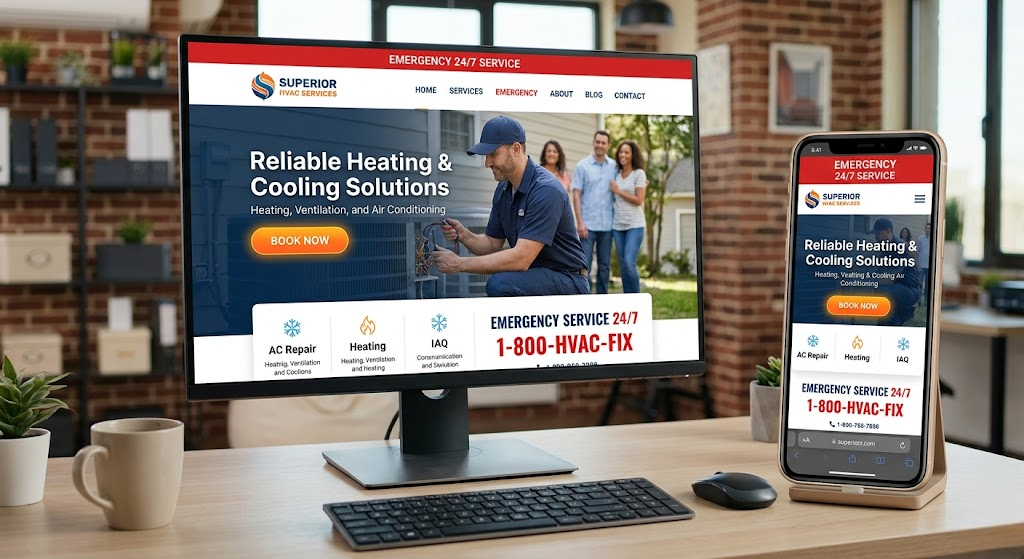
Every page of your site must function flawlessly on any screen size. Mobile-responsive development means the layout, images, forms, and buttons all adapt automatically to phones, tablets, and desktops. This is not optional. Google ranks mobile-friendly websites higher, and your customers expect a smooth experience regardless of the device they use.
Service Page Design and Optimization
Each core service you offer, whether that is AC installation, furnace repair, heat pump replacement, or duct cleaning, deserves its own dedicated page. These pages should include a clear headline, description of the service, benefits, trust signals, and a strong call to action. Well-designed service pages are both SEO assets and conversion tools.
Lead Capture Forms and Click-to-Call Features
Your website needs multiple ways for visitors to reach you. This includes a prominently placed phone number, a simple contact form, an estimate request form, and ideally an online booking option. Click-to-call functionality is critical for mobile users. The fewer steps required to contact you, the higher your conversion rate will be.
SEO-Friendly HVAC Website Structure
The architecture of your website affects how search engines crawl and rank your pages. As outlined in a guide by Search Engine Journal, a logical site structure is vital for helping search engines understand your location and services. An SEO-friendly structure includes logical URL formatting, proper header hierarchy, fast loading pages, schema markup for local businesses, and internal linking between related service pages and location pages.
Hire an HVAC Web Design Agency That Understands Lead Generation
Why HVAC Industry Experience Matters
Hiring a generic web designer is risky for HVAC businesses. Someone who builds restaurant websites or e-commerce stores does not understand the urgency of HVAC calls, the importance of local service areas, or the buyer psychology of homeowners facing equipment failure. An agency with HVAC-specific experience already knows what works and what does not.
What to Look for in an HVAC Web Design Agency
Look for an agency that can show you real HVAC websites they have built, demonstrate knowledge of local SEO for service businesses, and speak clearly about conversion rate optimization. They should also understand call tracking, Google Business Profile integration, and how to build landing pages for paid advertising campaigns.
Questions to Ask Before Hiring a Web Design Partner
Before signing any contract, ask the following questions. Who owns the website after it is built? How long will the project take? What does the ongoing maintenance include? How will the site be optimized for local search? What happens if you want to make changes? Clear answers to these questions protect your investment.
Red Flags to Avoid When Choosing an Agency
Avoid agencies that offer extremely low prices with no clear process, use locked platforms that prevent you from owning your site, or promise first-page rankings immediately after launch. Also be cautious of agencies that cannot show you examples of HVAC clients or do not ask questions about your business goals.
Custom HVAC Website Design Company vs Generic Web Designers
The Benefits of Industry-Specific Website Design
A custom HVAC website design company brings pre-built knowledge of what converts in the trades industry. They understand seasonal demand patterns, the importance of financing pages, how to structure emergency service CTAs, and what trust signals matter most to homeowners. This specialized knowledge leads to faster results and fewer revisions.
Why Generic Templates Often Fail HVAC Companies
Template-based websites create multiple problems for HVAC contractors. They look similar to hundreds of other businesses, they are rarely built with local SEO in mind, and they often lack the specific features HVAC companies need, such as service area maps, equipment brand pages, and seasonal promotion banners. Templates save money upfront but cost far more in missed leads.
Creating a Website That Matches Your HVAC Brand
Your website should reflect how you want customers to perceive your business. If you focus on premium service and same-day availability, every element of your site from the color scheme to the photography to the copy should reinforce that message. Brand consistency across your website, Google profile, and advertising builds the recognition that drives referrals.
Building Trust Through Professional Design
Homeowners are inviting your technicians into their homes. Before they do that, they need to trust your company. Professional design signals reliability. This means high-quality photos, a clean layout, visible licensing and insurance information, real reviews from local customers, and a team page that puts faces to your brand.
HVAC Contractor Website Design Experts (What Makes a Site Convert)
High-Converting Homepage Layouts
Your homepage should lead with your strongest value proposition, your service area, and a direct path to contact you. The most effective HVAC homepages include a bold headline with a local keyword, a phone number in the top right corner, a short form above the fold, and trust indicators such as years in business, number of reviews, and key certifications.
Service Pages That Generate More Calls
Each service page should answer the specific questions a customer has when they are about to call. What does the service include? How much does it cost? How fast can someone come out? What brands do you work with? Pages that answer these questions clearly, while incorporating local keywords and a clear CTA, consistently generate more phone calls than vague pages with only a few sentences.
Trust Signals That Increase Conversion Rates
A consumer survey from BrightLocal highlights that 87% of consumers used Google to evaluate local businesses in the past year. The most effective trust signals for HVAC websites include Google review counts and ratings, NATE certification badges, manufacturer partner logos, BBB accreditation, before and after photos of real jobs, and written testimonials from customers in your service area. Place these throughout your site, not just on a testimonials page.
User Experience Best Practices for HVAC Websites
Every design decision should reduce friction for the visitor. Use simple navigation with no more than six main menu items. Keep forms short, asking only for name, phone number, and service needed. Use white space to make content easy to scan. Avoid pop-ups that block content on mobile. The goal is to make it as easy as possible to become a lead.
Professional HVAC Website Development Services Explained
Front-End vs Back-End HVAC Website Development
Front-end development controls everything a visitor sees and interacts with, including layout, buttons, colors, and forms. Back-end development handles the systems running behind the scenes, such as form submission routing, database connections, and CRM integrations. Both layers need to be built correctly for your site to perform reliably.
Website Speed Optimization for HVAC Contractors
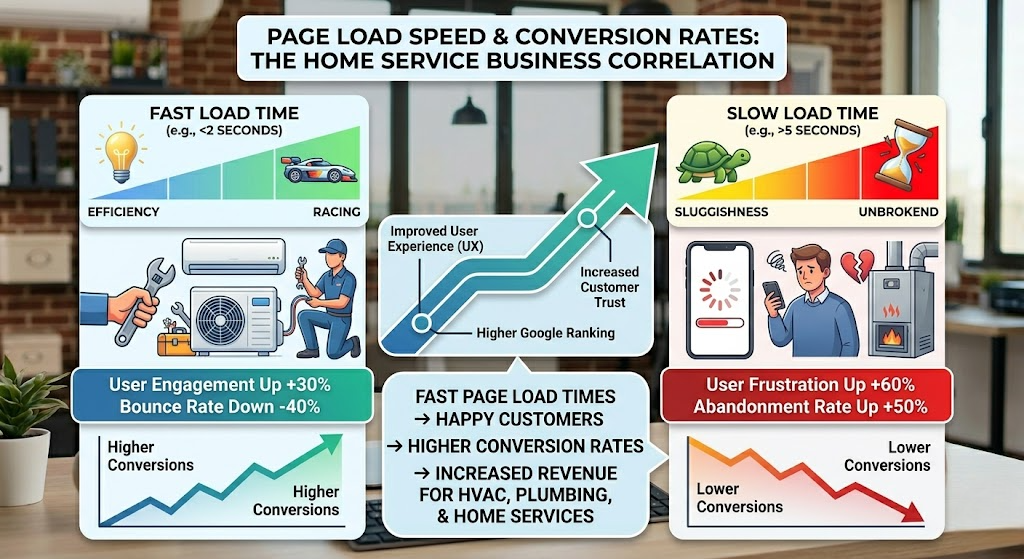
Page speed directly affects both your search rankings and your conversion rate. A study by Cloudflare explains that even a small decrease in page load speed can significantly lower conversion rates and negatively impact user experience. Best practices include compressing all images, using a content delivery network, enabling browser caching, minimizing unnecessary code, and choosing fast hosting. A site that loads in under two seconds gives you a significant advantage over competitors with slow websites.
Secure Hosting and Website Maintenance
Your website needs reliable hosting with strong uptime guarantees and SSL encryption. Beyond launch, ongoing maintenance includes software updates, security monitoring, backup management, and performance checks. Neglecting maintenance leads to downtime, security vulnerabilities, and declining search rankings.
CRM, Booking, and Call Tracking Integrations
The best HVAC websites connect directly to the tools you use to run your business. This can include CRM platforms like ServiceTitan or Jobber, online scheduling tools, and call tracking software that tells you exactly which marketing channels are driving phone calls. These integrations turn your website into the hub of your entire operation.
HVAC Website Redesign Service for More Leads
Signs Your HVAC Website Needs a Redesign
If your website is more than three years old, loads slowly on mobile, does not rank for local search terms, or consistently produces a high bounce rate and few form submissions, it is time for a redesign. A website that is not generating leads is a liability, not an asset.
Improving Conversion Rates With Better UX
Redesigns focused on conversion improvement often produce dramatic results. Moving the phone number to a more visible location, adding a sticky call button on mobile, shortening the contact form, or improving the headline on a service page can each meaningfully increase the number of people who take action.
Modernizing Outdated HVAC Websites
Outdated websites hurt your brand perception. Visitors associate a modern, fast, clean website with a professional, reliable company. If your site looks like it was built ten years ago, homeowners may question whether your business practices are equally outdated. A redesign positions your company as the current, capable choice.
Redesign Strategies That Increase Calls and Form Submissions
The most effective redesign strategies focus first on the homepage and top service pages, since those receive the most traffic. Improvements include stronger headlines, faster load times, better mobile layouts, clearer CTAs, and the addition of trust signals. A phased approach allows you to measure improvements and apply what works across the entire site.
Affordable HVAC Website Design Packages (What Contractors Should Expect)
What’s Included in HVAC Website Packages
| Package Tier | Typical Inclusions |
|---|---|
| Starter | 5 to 8 pages, basic SEO setup, mobile responsive, contact form |
| Growth | 10 to 15 pages, full service pages, local SEO, call tracking, blog setup |
| Premium | 20 plus pages, custom design, CRM integration, ongoing optimization, PPC landing pages |
Budget vs Premium HVAC Website Solutions
A budget website gets you online. A premium website generates consistent leads. The difference lies in custom design, content quality, technical optimization, and ongoing improvements. Most established HVAC contractors find that investing in a higher-tier website pays for itself within the first few months through increased call volume.
Understanding Website Design Pricing
HVAC website design typically ranges from a few thousand dollars for a basic site to fifteen thousand or more for a fully custom, conversion-optimized build with integrations. Ongoing monthly fees for hosting, maintenance, and SEO add to the total investment but are essential for keeping the site performing over time.
Choosing the Right Package for Your Business Goals
If you are just starting out, a clean, professional starter site will help you establish credibility. If you are a growing company looking to increase lead volume, a growth or premium package with full SEO integration will deliver better returns. Align your website investment with your revenue goals and growth timeline.
Essential Features Every HVAC Website Needs
A high-performing HVAC website must include click-to-call buttons visible on every page, a sticky header with your phone number, online estimate request forms, financing and promotional banners for seasonal offers, service area pages targeting your key cities and counties, and live chat or AI chat to capture visitors who prefer not to call. Each of these features addresses a specific barrier that prevents visitors from converting.
HVAC Website SEO Optimization for Better Rankings
On-page SEO for each service page should include your primary keyword in the title tag, H1, first paragraph, and at least one subheading. Meta descriptions should be written to encourage clicks, not just keyword placement. Internal linking connects your service pages to location pages and blog content, distributing authority throughout the site. Technical SEO ensures your site passes Core Web Vitals assessments, which Google Search Central uses as a direct ranking signal for search results. Local SEO integration includes embedding your Google Business Profile, adding location-specific schema markup, and creating individual pages for each city you serve.
Mobile-Friendly HVAC Website Design Best Practices
Mobile optimization is not simply making your desktop site smaller. It means designing specifically for how someone on a phone navigates, reads, and takes action. Buttons must be large enough to tap easily. Text must be readable without zooming. Images must load quickly on mobile data connections. The phone number should be accessible from every screen with a single tap. Mobile UX mistakes such as tiny text, overlapping elements, and slow-loading hero images directly reduce your lead volume.
Common HVAC Website Design Mistakes That Cost You Leads
Slow website speed is the most damaging mistake, as even a one-second delay in load time reduces conversions significantly. Weak or missing calls to action leave visitors unsure of what to do next. Poor mobile experience frustrates the majority of your visitors. Generic stock images and vague branding fail to differentiate your company from competitors. Complicated navigation and long forms create unnecessary friction that causes people to abandon your site before making contact.
Measuring HVAC Website Performance and Conversion Rates
Tracking calls and form submissions through tools like Google Analytics and call tracking software gives you real data on what your website is producing. Bounce rate and session duration reveal whether visitors are engaging with your content or leaving immediately. Heatmap tools show you exactly where users click, scroll, and drop off, giving you a clear roadmap for improvement. Regular conversion rate optimization means your website improves continuously rather than being built once and forgotten.
How Long Does It Take for an HVAC Website to Generate Leads?
A newly launched website with paid traffic can start generating leads immediately. Organic SEO typically takes three to six months to produce consistent results, depending on your market competition and the quality of your on-page optimization. Factors that affect results include the age of your domain, the number of competing businesses in your area, the quality of your content, and the consistency of your link-building efforts. Scaling performance over time requires ongoing content creation, SEO maintenance, and regular conversion testing.
Final Thoughts: Building an HVAC Website That Consistently Generates Calls
An HVAC website that generates consistent leads is built around the user experience, not the contractor’s preferences. Speed, clarity, trust, and a direct path to contact are the foundations of a high-converting site. USA HVAC Marketing works exclusively with HVAC contractors to design, build, and optimize websites that produce real business results. Combining strong SEO with conversion-focused design and paid traffic strategies creates a sustainable lead generation system that grows with your business. If your current website is not performing,
USA HVAC Marketing is ready to help you build one that does. Reach out today at [email protected] to discuss your HVAC website project.
Frequently Asked Questions
How much does HVAC website design cost for contractors?
HVAC website design typically costs between two thousand and fifteen thousand dollars depending on the size of the site, the level of customization, and the features included. Basic sites with a few pages and standard functionality fall at the lower end, while fully custom builds with CRM integrations, local SEO setup, and conversion optimization cost more. Ongoing maintenance and SEO are additional monthly investments that directly affect long-term lead generation performance.
How long does it take to build an HVAC website?
A professionally built HVAC website typically takes four to eight weeks from kickoff to launch. The timeline depends on how quickly content and photos are provided, the number of pages being built, and whether custom integrations are needed. Simpler sites can launch faster, while larger projects with multiple service areas and advanced features take longer to complete properly.
What makes a good HVAC website design for generating leads?
A good HVAC website for lead generation includes a visible phone number on every page, clear service descriptions with local keywords, mobile-responsive design that loads quickly, trust signals such as reviews and certifications, and multiple easy ways for visitors to contact you. The design should guide visitors toward taking action rather than simply presenting information about your company.
Should HVAC contractors use a template or custom website design?
Custom website design consistently outperforms template-based solutions for HVAC contractors who want to generate leads from organic search and paid advertising. Templates often lack the specific features, SEO structure, and brand differentiation that a custom site provides. For contractors serious about growing through their website, custom design is a better long-term investment even though the upfront cost is higher.
How do I know if my HVAC website needs a redesign?
Your HVAC website likely needs a redesign if it loads slowly on mobile devices, does not appear in local search results for your main services, produces very few form submissions or calls despite receiving traffic, has an outdated design that does not reflect your current brand, or lacks key features like click-to-call buttons, service area pages, and online booking. A professional website audit can identify exactly which areas are costing you leads.
Sources
- https://www.tandfonline.com/doi/abs/10.1080/01449290500330448 – A psychological study published in “Behaviour & Information Technology” explaining the 50-millisecond window for website first impressions.
- https://www.thinkwithgoogle.com/consumer-insights/consumer-trends/local-search-consumer-behavior-study/ – Google’s research on consumer behavior regarding local searches and mobile intent.
- https://www.searchenginejournal.com/local-seo/ – An authoritative guide from Search Engine Journal about optimizing site architecture for local visibility.
- https://www.brightlocal.com/research/local-consumer-review-survey/ – Annual survey data from BrightLocal detailing how online reviews impact local business trust.
- https://www.cloudflare.com/learning/performance/why-site-speed-matters/ – A technical explanation from Cloudflare regarding the impact of page load speed on user conversion.
- https://developers.google.com/search/docs/appearance/core-web-vitals – Official Google documentation regarding Core Web Vitals and their role as a ranking factor.